Book Review: Missouri and the Secession Crisis: A Documentary History

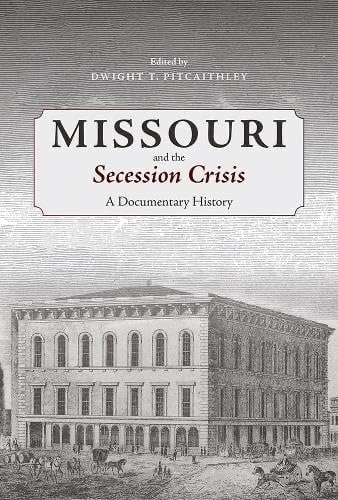
Missouri and the Secession Crisis: A Documentary History. Ed. Dwight T. Pitcaithley. Knoxville: The University of Tennessee Press, 2025. Hardcover, 392 pp. $46.08.
Reviewed by Tonya Graham McQuade
Historians have long debated the justifications for the South’s secession in 1860-61. However, as historian Dwight T. Pitcaithley argues in Missouri and the Secession Crisis: A Documentary History, “the puzzle of disunion is best addressed by examining the speeches and documents produced by the nation’s elected officials over Secession Winter.” (xv)
Pitcaithley should know. He has produced similar documentary secession histories about Tennessee, Kentucky, and Virginia. In each, Pitcaithley relies on the official published records, journals, addresses, and papers of important gatherings to explore the reasons behind each state’s eventual decisions and actions.
Missouri’s secession story shows just how politically divided the state was – it was officially recognized as part of both the Union and the Confederacy. Using the speeches and proposals of elected officials, Pitcaithley lays out the arguments both sides presented as they debated which path the state should take. Many of those arguments centered around two questions: “to what extent was the election of Abraham Lincoln a threat to the institution of slavery; and to what extent was the institution of slavery protected in the United States Constitution.” (xv)
Pitcaithley’s Timeline and Introduction provide an overview of Missouri’s secession crisis, and Appendices list State Convention Delegates and provide Questions for Discussion. His opening chapter presents several addresses made to the Missouri General Assembly in January 1861, including one by newly elected Missouri Governor Claiborne Fox Jackson, who was already revealing his secessionist leanings. While Jackson did not at this point call for secession, he called for “a Convention of the slaveholding states … [where they] could agree on such amendments to the Constitution as would secure to them their just rights.” (18)
In chapters 2 and 3, Pitcaithley moves on to debates going on in the U.S. Senate and House of Representatives, including proposals by Missouri Senator Trusten Polk and Missouri Representative John William Noell for Constitutional amendments they believed would help resolve the sectional crisis. Many in Missouri had favored the Crittenden Compromise proposed by Kentucky Senator John J. Crittenden in December 1860, which sought to appease the South and prevent further secession by permanently enshrining slavery in the Constitution.
The book’s largest section is devoted to the speeches and debates at the Missouri State Convention of March 1861. There, in Jefferson City, 104 elected delegates, primarily Unionists, gathered “to adopt such measures for vindicating the sovereignty of the State and the protection of its institutions, as shall appear to them to be demanded.” (94) While they never actually voted on secession, they ultimately adopted a resolution declaring there was “no adequate cause to impel Missouri to dissolve her connection with the Federal Union.” (204) Only one delegate cast a dissenting vote.
That agreement did not last long. Pitcaithley effectively summarizes key events that led to Missouri soon having two governments, beginning with Jackson’s refusal to supply the troops requested by Lincoln to suppress the insurrection. He then moves on to Jackson’s requests for military support from the Confederacy as early as April 1861; the Union’s capture of Fort Jackson in May; and the First Battle of Boonville in June, when Union forces under Brig. Gen. Nathaniel Lyon routed Jackson’s pro-Confederate Missouri State Guard troops under Gen. John S. Marmaduke, securing control of the Missouri River and the state capital.
Two documents in the “Afterward” are particularly interesting. One is Jackson’s pronouncement “To the People of Missouri” on June 12, 1861, in which he lays out his complaints against the federal government, brands it as the aggressor and himself as the defender of the rights of Missouri’s citizens, and calls upon Missourians to drive out “the invaders who have dared to desecrate the soil which your labors have made fruitful, and which is consecrated by your homes.” (226) The second is the Missouri State Convention’s response on July 31, where they describe the treasonous acts Jackson and others have committed and explain that “any remedy for our present evils … must be one which shall vacate the offices held by the officers who have thus bought our troubles upon us.” (237) The Convention appointed Hamilton R. Gamble to serve as governor until a new election could take place.
The book’s final document is the Ordinance of Secession passed by Jackson’s Rebel Legislature on October 28. One month later, the Confederate Congress admitted Missouri as a “full and equal member.” (247) Missouri’s “secession crisis” truly led to it being a state divided – and Pitcaithley does a superb job of piecing together the arguments and actions that led it to that outcome.


Always refreshing to see an explanation of antebellum – thru – Civil War Missouri politics, and this book review by Tonya McQuade provides many useful insights. In process of reviewing information regarding Missouri Democrat politician Claiborne Fox Jackson, mentioned above, I stumbled upon the Government of Missouri website Missouri Office of Administration and their Hall of Governors listing. The record for Governor C. F. Jackson is well worth a read as it details Jackson’s leadership of the Missouri Democrat Party, Anti-Benton Faction [which supported the continuation of slavery.] The Benton Faction of Missouri’s Democrat Party did NOT support the expansion of slavery [long-serving Missouri Senator Thomas Hart Benton was viewed as a supporter of the Wilmot Proviso.] The third leg of Missouri politics was the WHIG Party… which was in process of dying during the 1850s …its role eventually assumed by the Republican Party. Missouri Office of Administration, Hall of Governors may be found at https://oa.mo.gov/hall_of_governors/index
The ‘Virginia Secedes’ book looks very interesting, especially for the area I’m researching. A lot of these primary sources are harder to find than you’d expect.