Book Review: Take Freedom: Recovering the Fugitive History of the Denmark Vesey Affair

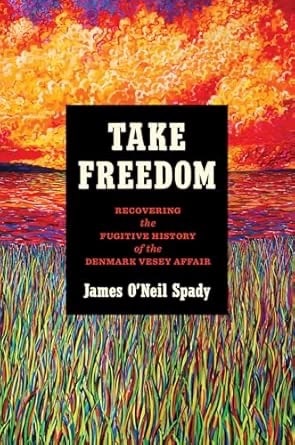
Take Freedom: Recovering the Fugitive History of the Denmark Vesey Affair. By James O’Neil Spady. Chapel Hill: University of North Carolina Press, 2026. Paperback, 226 pp. $29.95.
Reviewed by Dr. James J. Broomall
The name Denmark Vesey rings across history. In 1822, traditional narratives hold, he organized a slave insurrection in Charleston, South Carolina. Whites discovered the plot, convicted Vesey, and executed him. This telling, shaped by tribunal records, purposefully isolated one leading figure to elide discussions of Black freedom, obscure the extent of participation, and confirm racial hierarchies.
Yet, as historian James O’Neil Spady argues in Take Freedom, Vesey was part of a movement. In a deeply researched and thoughtful study, Spady recounts how a cosmopolitan and linguistically diverse group planned a rising, as they deemed it, against slavery. Once the plot was discovered, leading figures including Gullah Jack, Monday Gell, Peter Poyas, and Denmark Vesey used “strategies of silence, deception, and tactically incomplete truth-telling” to control, as much as possible, the fate of the movement and its adherents. (158)
Four chapters comprise this well argued, tidy volume. Spady is in conversation with studies about Black history and slave revolts; furthermore, he skillfully entwines accounts by other freedom figures, such as Frederick Douglass and Harriet Jacobs, with the experiences of Black Charlestonians. After a brief Prologue, Spady begins by reconstructing the world of Charleston’s free and enslaved Black population in the first quarter of the 19th century. As Chapter 1 explains, the city “was a peculiar amalgam of genteel exhibition and theater of power.” (25) South Carolina had a Black majority that whites tried to control through surveillance, fear, and violence. Free and enslaved populations nonetheless built and maintained fugitive communities and culture. In the years immediately before the rising, Black Charlestonians engaged in a mass church movement and, to a much lesser extent, an effort to emigrate to Sierra Leone and West Africa. Their social networks became a means for survival.
Spady uses language deliberately, carefully relying on the historical record to reconstruct the movement. Rather than mere semantics, members used the term rising to assert an “all-encompassing vision.” (46) They wanted freedom for as much of their community as possible. And they understood the costs. Chapter 2 broadly considers several factors that influenced timing. Throughout the 1810s and 1820s, slavers became more aggressive. They tightened manumission laws. And they hired out large numbers of slaves, thereby fragmenting families, because of the financial panic of 1819-20. They also violently persecuted the religious movement that had resulted in a Black-led African Church. Free and enslaved Blacks organized to forcefully take freedom from a population that denied them the right.
Chapter 3 methodically reconstructs the plot. Although it is hard to determine, it is likely hundreds of Blacks supported the movement and intended to act. The rebels planned a night crossing of the Ashley River and used the phases of the moon to determine optimal dates: June 16 and July 14 (both Sundays and both with similar moon phases).
They planned to proceed to Charleston’s Main Guardhouse and seize its arsenal. In Spady’s estimation, “The rebels’ smart strategic thinking about the geography and the powder magazine is impressive evidence of the plausibility of their plan.” (79) The organizers planned multidirectional assaults and had discussed strategy, tactics, and potential outcomes.
The complicated plot soon unraveled, though, because of an unwise conversation between two enslaved men, William Paul and Peter Prioleau. Peter, an unfamiliar figure and not previously associated with the movement, talked to authorities. William was arrested. A 1740 law permitted whites to form a tribunal for the regulation of free and enslaved Blacks. The body detained and interrogated large numbers of free and enslaved Blacks. The movement members’ unity soon fragmented.
In July 1822, as Chapter 4 explains, whites executed the convicted Blacks. The bodies were buried in a potter’s field, beginning a deliberate process of historical forgetting. “Grave dirt consumes bodies,” but “acid-free ink and paper” lasted. (p.129) The tribunal’s Official Report became history and concluded that the freeman Vesey planned the insurrection. Moreover, it maintained that the “African Church was the seedbed, and that the cause was the inherent barbarity of Black people.” (124) Black Charlestonians remembered things differently and commemorated the movement for decades. Spady references the Black intellectual W. E. B. Du Bois to shed light on the rebels’ otherwise lost ideologies noting how the movement was about Black freedom and liberation. The Vesey Affair echoed across time despite whites’ attempts to forget it.
Take Freedom is a compelling account of a liberation movement that foregrounds Black voices and places the events in Charleston in the context of a hemispheric struggle over freedom. Readers will see Spady’s passion for the subject written across the pages and confront a world of chaos and agony but also love and unity.
James J. Broomall holds the William Binford Vest Chair in the Department of History at the University of Richmond. He is a cultural historian and has published works in Commonplace, Ohio Valley History, Gettysburg Magazine, Civil War History, Civil War Monitor, and Civil War Times. He co-edited with William A. Link Rethinking American Emancipation: Legacies of Slavery and the Quest for Black Freedom (Cambridge University Press, 2016), and the University of North Carolina Press published his book, Private Confederacies: The Emotional Worlds of Southern Men as Citizens and Soldiers, in 2019.


“Tactically incomplete truth telling”…..Rather laborious when you require a deconstructed decoder ring to translate for the author…
Thanks for the excellent review, Jim. I added this one to my library shortly after you shared about it during our hike.