Book Review: The 14th New York State Militia in the Civil War, Volume 1: Baptized by Fire—from Bull Run to Bull Run, April 1861-April 1862

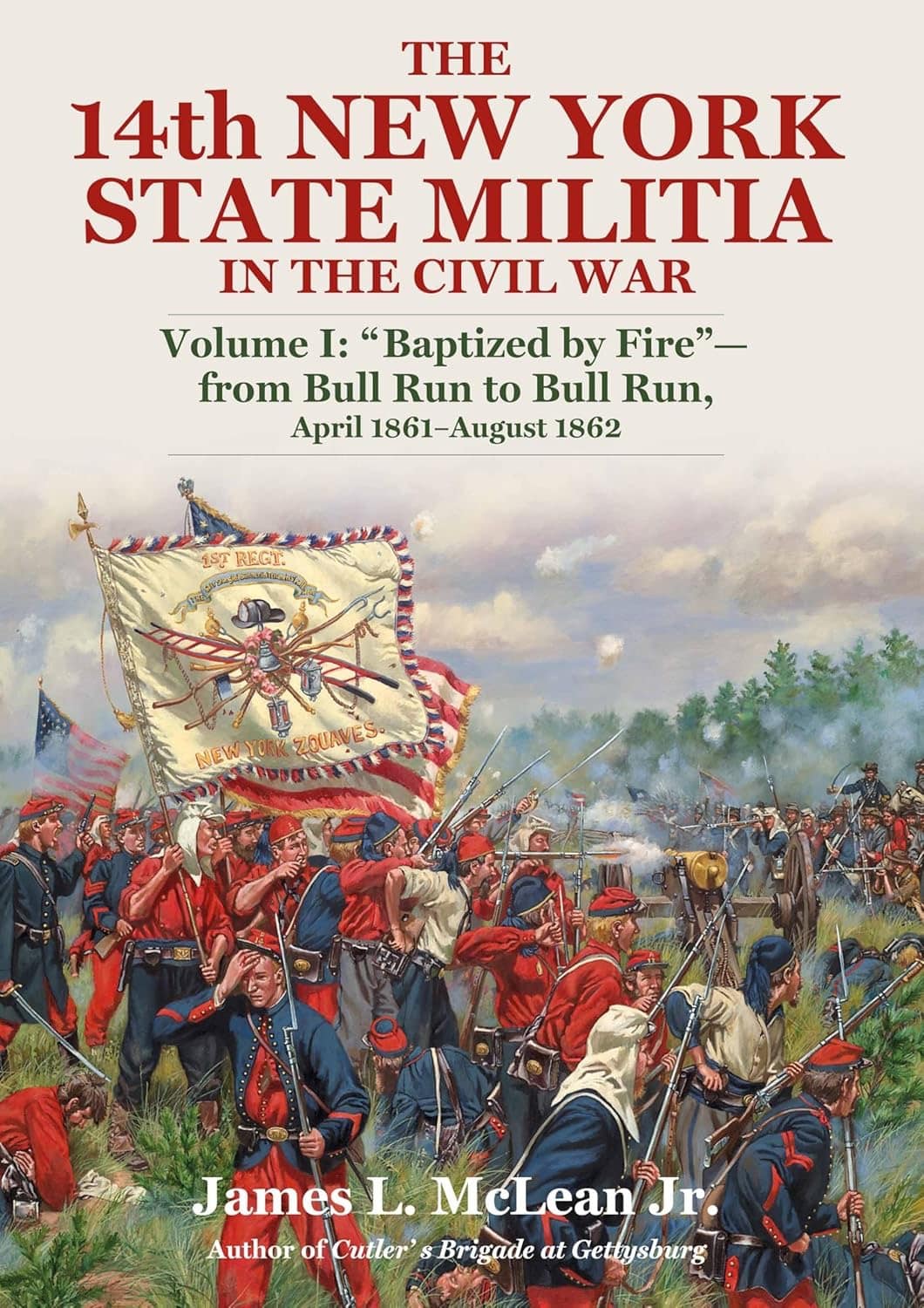
The 14th New York State Militia in the Civil War, Volume 1: Baptized by Fire—from Bull Run to Bull Run, April 1861-April 1862. By James L. McLean, Jr. El Dorado Hills, CA: Savas Beatie, 2025. Hardcover, 511 pp. $45.00.
Reviewed by J. Gregory Acken
In the Acknowledgments section of the first of a planned three-volume regimental history of the 14th New York State Militia, author James L. McLean, Jr. notes that his research for the project spanned five decades—a fact which seems almost unimaginable until the reader is presented with the scope and detail of the work, buttressed by an impressive array of primary sources, to tell the story of this somewhat forgotten regiment.
Recruited in Brooklyn, New York, the 14th New York (also known as the 84th New York Volunteer Infantry—and by some of their opponents as “Red-legged devils,” due to their distinctive uniforms) took the field in May 1861. The unit distinguished itself in many battles, notably at First and Second Bull Run, Antietam and Gettysburg. From Antietam onward, it belonged to the storied I Corps of the Army of the Potomac until the spring of 1864, when that corps was disbanded. Then, as part of the V Corps the regiment would go on to fight at the Wilderness and Spotsylvania before being mustered out of service in May 1864. Even though the Fourteenth lost over 700 men during the conflict, it received scant attention in official records of the war. Moreover, a regimental history published in 1884 is light on personal details. Jim McLean has remedied that.
Volume I covers the activities of the regiment from its recruitment and formation in the early weeks of the war through Second Bull Run in late August 1862. McLean chronicles the efforts to raise the regiment and the initial uncertainty that surrounded its term of service. Eventually the 14th moved to Washington and took part in the First Battle of Bull Run. There it gained fame during the fighting on Dogan’s Ridge and Henry Hill, losing more men than only a handful of other Federal regiments. After a winter in Washington characterized by discontent and desertions, the regiment moved to occupy Fredericksburg as part of Irvin McDowell’s command during the spring and early summer of 1862. McDowell’s troops became a part of John Pope’s Army of Virginia, and with them the 14th fought at the Second Battle of Bull Run in late August 1862.
This is not history from a 10,000-foot view. McLean writes well, and what helps distinguish this work is the level of detail he provides, as befits the extensive period of time the author devoted to his work. McLean derives valuable insights from hundreds of soldier letters, archival material, manuscripts, diaries and newspaper articles. His accounts of the battles and skirmishes the 14th took place in are excellent, providing rich descriptions on the regiment’s role as seen through the eyes of its soldiers without losing sight of the progression of the fighting. But it is not just the fighting that receives attention. McLean documents the “downtime” between the battles, and the struggles with homesickness and illness that all regiments experienced. Given all the material that the author gathered, one might be tempted, as some authors have done, to simply regurgitate it, but this is not the case. McLean’s analysis and interpretation of the experiences of the members of the regiment is stellar.
In addition to the admirable scholarship that characterizes it, the book is beautifully produced (though the smallish font is a bit of an eye test) with glossy pages, 36 color maps by the prolific Hal Jespersen, and hundreds of period and modern photographs, illustrations and reproductions of original documents placed succinctly within the text. Footnotes (not endnotes) are plentiful and informative. Ten appendices, including one which lists every battle and non-battle casualty suffered by the regiment in the sixteen months covered by the book, add additional value.
If the next two volumes in his trilogy on the 14th are as thorough and insightful as the first (and there is no reason to expect they will not be), McLean will have set a standard against which subsequent modern regimental histories will be judged.
Gregory Acken is the editor of four volumes of Civil War soldier’s recollections. His most recent book, a revised and expanded edition of Through Blood and Fire: The Civil War Letters of Major Charles J. Mills 1862-1865 (2023) received a Distinguished Writing Award from the Army Historical Foundation.


Great book and excellent review.