Book Review: The Civil War Sacrifice of Somerset County, Pennsylvania

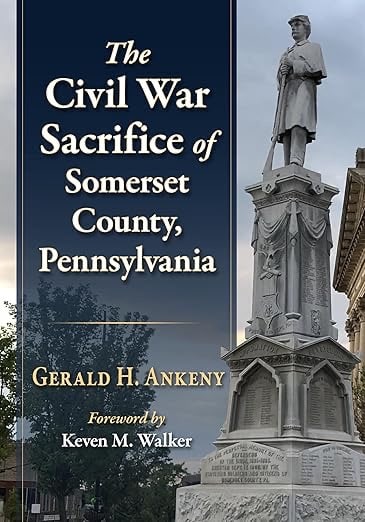
The Civil War Sacrifice of Somerset County, Pennsylvania. By Gerald H. Ankeny. Jefferson, NC: McFarland & Company, Inc., Publishers, 2025. Paperback, 313 pp. $49.95.
Reviewed by Evan Portman
Historians seldom inspect the Civil War’s impact on a small community, but that is just what Gerald Ankeny does in his book The Civil War Sacrifice of Somerset County, Pennsylvania. Located about 70 miles southeast of Pittsburgh, Somerset County sent thousands of its sons to war from 1861 to 1865. Ankney recovers their harrowing experiences in this study. While this volume will likely be most useful to genealogists and local historians, its appeal extends to anyone interested in the Civil War and Western Pennsylvania as well as the war’s impact on a small, rural community.
The Somerset County Soldiers’ Monument serves as the centerpiece of Ankeny’s research. He compares the monument to another commemorative landscape about 16 miles away: Flight 93 Memorial. Ankeny argues that both monuments commemorate “the price paid by ordinary Americans who died defending the United States” and both were “created and dedicated by people with living memory of those ordinary Americans and the days when they died.” (5)
Ankeny’s goals are twofold. On the one hand, he seeks to acknowledge the sacrifice made by each of Somerset County’s sons by “relating at minimum the facts and details of his final day of life.” (3) On the other hand, he tells the story of Somerset County’s role in the American Civil War at large. His approach is chronological, explaining Somerset’s place in the war from the firing on Fort Sumter in 1861 to Lee’s surrender at Appomattox in 1865. He follows the service of several regiments that contained a company (or more) of Somerset men, including the 54th and 142nd Pennsylvania as well as the 10th Pennsylvania Reserves. Ankney devotes his final chapter to discussing commemorative efforts of Somerset County veterans in establishing a GAR post and the Soldiers’ Monument in the decades after the war.
The book is not simply a chronicle, though. Ankeny weaves several themes throughout his narrative, including the war’s deadly toll, the suffering of Somerset’s soldiers on the front lines, and the affliction of its men and women at home. The book’s greatest contribution lies in its recovery of these stories. Ankney’s own experience in the military shines through in these passages, as he emphasizes the real and visceral cost of war.
One of the most compelling parts of the book is Ankney’s telling of the desperate stands made by the 142nd Pennsylvania at Gettysburg. After a hard march on the morning of July 1, Col. Chapman Biddle’s brigade, which included the 142nd Pennsylvania, engaged the Confederates twice that afternoon, first on McPherson’s Ridge and again on Seminary Ridge. The brigade was forced to retreat both times, falling back through the town of Gettysburg itself. Ankney explains the action clearly and concisely, focusing on the regiment’s role in the fighting while also contextualizing it in the broader scope of the battle.
Perhaps even more compelling is Ankeny’s description of Gettysburg’s toll on Somerset County. His meticulous research uncovers individuals like Joseph Specht, a single father in his mid-twenties from Somerset. Specht’s death at Gettysburg orphaned his seventeen-month-old son, Henry. Ankeny assures readers that Henry Specht lived a long and successful life, despite the loss of both his parents at such a young age. Raised by his aunt and uncle, Henry Specht married, became a teacher, and died during World War II at age eighty-two.
Ankeny also recovers the story of Sarah Jane Cummins, a Somerset resident and wife of Col. Robert Parson Cummins of the 142nd Pennsylvania. Mrs. Cummins departed Somerset County on July 4, 1863, as soon as she received word that her husband had been wounded at Gettysburg. “One can only imagine the depth of sorrow, despair, and horror felt by Sarah Jane Cummins when she arrived at her late husband’s shallow grave located amid the death and destruction covering the fields around Gettysburg,” Ankeny writes. (105) Before Mrs. Cummins arrived, the colonel had succumbed to his wounds in the Lutheran Theological Seminary on the morning of July 2. Cummins brought her husband’s body back to Somerset where she buried him next to his parents in the township’s Union Cemetery. He left behind seven children, “ranging in age from fifteen years down to four years,” while Sarah Cummins “proudly and honorably remained his widow until her death at age seventy-five.” (105)
Ankeny bookends his volume with reflections on his own visits to the Somerset Soldiers’ Monument and Flight 93 Memorial. He recalls the chilling experience of listening to recorded phone calls between the passengers of Flight 93 and their loved ones. Of course, the Civil War generation did not have the privilege of 21st Century technology, but Ankney attempts to restore their voices by relying on their first-hand accounts and telling their stories. The Civil War Sacrifice of Somerset County, Pennsylvania therefore remains a valuable entry in Civil War studies.


What a beautiful and unique project. It sounds like he really brings those individuals and their experiences to life.
Definitely a must have for me. William Spaugy, Company F, 142nd PVI was an ancestor of mine.
Very cool!
Evan – Thank you for reading my book, for sharing your thoughtful and positive review, and for remembering Somerset County’s Union soldiers. Jerry Ankeny
I very much enjoyed reading it! You’ve inspired me to check out the Somerset Civil War Soldiers Monument next time I’m in the area.