Book Review: Mollie Brumley’s Civil War: Surviving the Guerrilla War in Arkansas

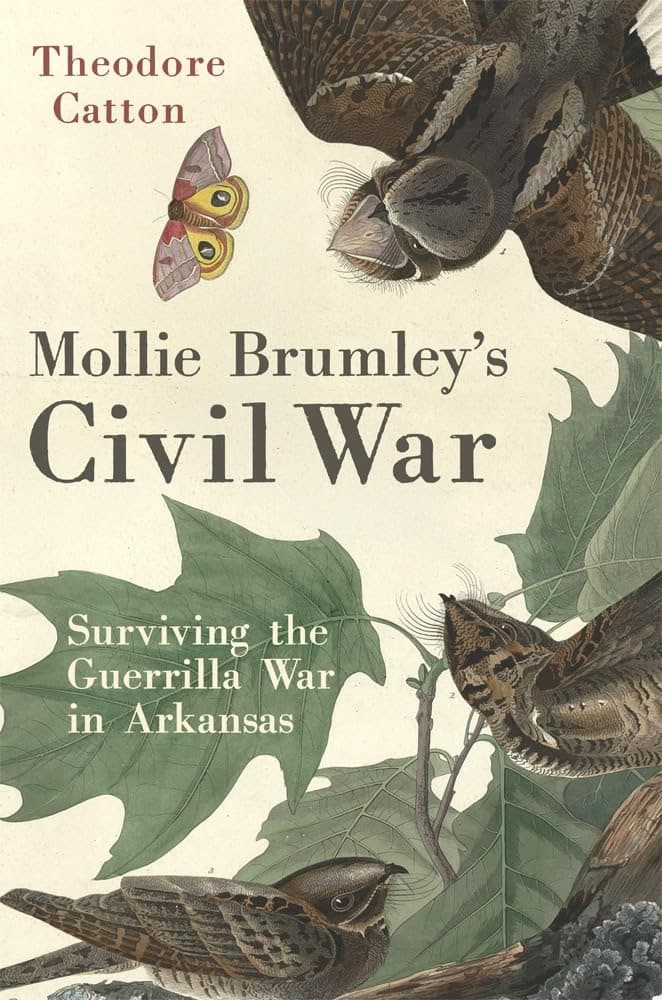
Mollie Brumley’s Civil War: Surviving the Guerrilla War in Arkansas. By Theodore Catton. Norman, OK: University of Oklahoma Press, 2026. Hardcover, 240 pp. $32.95.
Reviewed by Patrick Kelly-Fischer
Arkansas is one of the Civil War’s least-studied states. That is particularly true of the remote, rural region of north central Arkansas. The Richland Valley, in Searcy County, was home to fewer than 400 people at the time of the 1860 census. The area’s sparse population, disconnect from major transportation and communication networks, and proximity to Missouri all serve to make it an illuminating microcosm of how the Civil War played out away from the conflict’s major battlefields.
As the title suggests, Catton’s work primarily follows the story of Mollie Brumley. At the outbreak of the war, Brumley was a 13-year-old orphan, living with her aunt and uncle in the Richland Valley. By 1865, she would experience a vast range of the horrors that came with the Civil War, including the loss of a fiancé and then a husband.
The nearest major battle to the Richland Valley was Pea Ridge, more than 80 miles away. Even at that distance, Brumley’s experience shows the rippling impacts of that campaign, as well as other well-known battles in and around Arkansas, such as Pea Ridge, Price’s 1864 Missouri Expedition, and the fall of Vicksburg. The area’s remote location and lack of communication dramatically impacted the residents’ perception of the Civil War; unreliable news and uncertainty about the course of the war are regular themes throughout this book. Catton writes, “The people of Richland lived in a fog of war. The Ozark farmers’ communications from the outside world had not been robust to begin with, and when the communications network broke down in the early stage of the war the lack of information created anxiety and confusion.” (58)
In Catton’s telling, however, the most impactful national events weren’t major battles. Instead, they are the introduction of Confederate conscription, and the 1862 passage of the Confederate Partisan Ranger Act. In Catton’s telling, northern Arkansas was already somewhat divided between secessionist and Unionist sentiment, with a fair number of people who simply wanted to keep their heads down through the conflict. Both of these legislative developments accelerated the growing divides within Brumley’s previously tight-knit community, and the resulting irregular warfare rapidly drew more and more people into an increasingly chaotic and confused kaleidoscope of violence.
This is not, however, intended to be a military history. The book’s most valuable contribution to the field is its closely detailed examination of the many ways in which the war impacted the residents of one small region, well away from the heart of the conflict. Through the story of Brumley, along with her family and neighbors Catton highlights how quickly the social fabric of these communities frayed thin in the face of the Civil War.
Confederate homefront studies often focus on the areas where we have the most primary sources – namely, major cities such as Richmond. While that research is of course important, it offers a narrow view of the Confederate experience. From the nuances of 1860s’ subsistence farming, to the complicated network of family relationships that were strained (if not outright torn apart) by the growing guerrilla conflict, this work provides a detailed accounting of how one rural community suffered through the war. In Catton’s words, “Rather than seeing all her Richland neighbors as Unionist or Confederate, she started to see them all as equal victims of the war.” (151)
Catton draws on Brumley’s own 1902 autobiography, A Thrilling Romance of the Civil War, along with her letters, and a detailed study of the region’s other residents. Along with Brumley’s story, he weaves in the story of Parthenia Hensley, an enslaved woman living in Richland. This work has a little bit of everything: guerrilla warfare, the homefront experience, two romances, and a murder mystery. The result is an accessible, compelling narrative that’s easy and enjoyable to read, while offering a well-researched look at a little-studied part of the war.


My 2x great-grandfather’s sister Mary Tharp was married to a John Evans of Peter (1815-1898). They lived in Hardy County, Virginia (West Virginia). When the war began, John didn’t want to fight for either side, so the story goes that he built himself a wooden box- dimensions unknown- and took that box into the woods behind his home. The box basically became his home for the duration of the war. Obviously he didn’t live there 24/7, but the fact he went to that extreme illustrates how threatened he and his family felt about the war.