Echoes of Reconstruction: Frederick Douglass Set Forth His Hopes for Reconstruction in 1866
Emerging Civil War is pleased to welcome back Patrick Young, author of The Reconstruction Era blog.
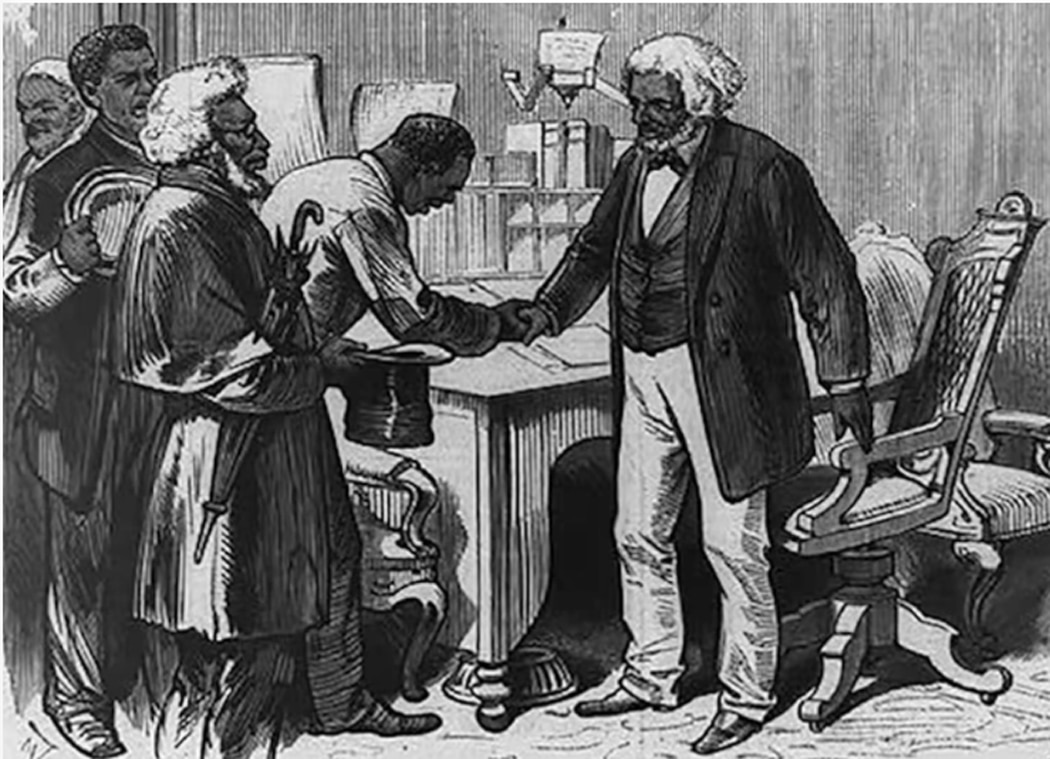
Frederick Douglass set forth his hopes for Reconstruction in a December 1866 article in the Atlantic Magazine. The post-war era was only a little over a year old, but Douglass perceived the accumulating impediments to setting African Americans on the same civic level as whites. White Southerners were not only trying to stop the extension of the franchise to Blacks, the right to sit on juries, the ability to get licensed as a professional; the white voters also wanted to block Black schoolchildren even from going to any schools, segregated or otherwise.
Over the previous half-decade, on the other hand, Douglass had seen a vast transformation of Northern racial attitudes, from a region where slave-hunters had roamed freely, capturing African Americans and transporting them to the South for enslavement, to recruiting and arming Black men with rifles to extinguish slavery as he said in a January 1864 speech. By early 1865, Douglass was even more encouraged because Abraham Lincoln had come to back the 13th Amendment abolishing slavery in all states, and the Federal government was setting up the Freedmen’s Bureau to feed, shelter, and educate Black refugees escaping from slavery. Much of the progress was put on hold when Lincoln was assassinated in April of 1865 and the Southern former slave-owning Vice President Andrew Johnson came to power.
In the opening of his 1866 Atlantic article, Douglass writes that he will discuss the “already much-worn topic of reconstruction.” This was only a year and a half after the war had ended, so it will strike a modern reader as astonishing that people were tired of discussing Reconstruction. For Americans, then as now, war could arouse great commitment, but what happened after the war was over tried the patience of the American people. With Blacks living under conditions of near-slavery, with their rights sharply curtailed by the “Black Codes” passed in the first post-war legislative term in many of the Southern state legislatures, and with the advent of terrorism in 1866 from the Ku Klux Klan and other paramilitary secret organizations, Northern whites seemed to falter in their commitment to create a color-blind civil society where all persons were protected.
Douglass wrote in December that the new Congress had to come to terms with “whether the tremendous war so heroically fought and so victoriously ended shall pass into history a miserable failure, barren of permanent results,—a scandalous and shocking waste of blood and treasure,—a strife for empire, …of no value to liberty or civilization,—an attempt to re-establish a Union by force, which must be the merest mockery of a Union,—an effort to bring under Federal authority States into which no loyal man from the North may safely enter, and to bring men into the national councils who deliberate with daggers and vote with revolvers, and who do not even conceal their deadly hate of the country that conquered them…” The fact that in the 1866 Southern electorate only the right of whites to vote was guaranteed and that these formerly disloyal white electorates had voted to elevate Confederates to Congress, greatly worried Douglass.
In spite of these negative augurs, Douglass also recognized that in the North, the electorate thoroughly rejected Andrew Johnson’s policy of alliance with the Southern white elite. Douglass wrote that; “One of the invaluable compensations of the late Rebellion is the highly instructive disclosure it made of the true source of danger to republican government. Whatever may be tolerated in monarchical and despotic governments, no republic is safe that tolerates a privileged class, or denies to any of its citizens equal rights and equal means to maintain them.”
The Black abolitionist said that the Southern elite was trying to restore a near-slavery for Black people. Contrary to the argument of many pre-war Abolitionists that slavery was impoverishing the United States, Douglass said that the United States saw its greatest prosperity in the fifty years before the war, when slavery was in full flower. That return to white prosperity was what opponents of Reconstruction hoped to secure by subjecting Blacks.. Those advancing equal rights in Congress were frustrated by “a treacherous President,” Douglass said, who “stood in the way; and it can be easily seen how reluctant good men might be to admit an apostasy which involved so much of baseness and ingratitude. It was natural that they should seek to save him by bending to him even when he leaned to the side of error.” But the November election swept that limitation away. Douglass wrote “But all is changed now. Congress knows now that it must go on without his [Johnson’s] aid, and even against his machinations.”
Congress must begin by not recognizing “[t]hese pretended governments” in the South, “which were never submitted to the people, and from participation in which four millions of the loyal people were excluded…,” Douglass said. These formerly Confederate states “should now be treated according to their true character, as shams and impositions, and supplanted by true and legitimate governments, in the formation of which loyal men, black and white, shall participate.” Douglass believed that the solution “is simply to establish in the South one law, one government, one administration of justice, one condition to the exercise of the elective franchise, for men of all races and colors alike.” He foresaw that soon Northern whites will tire of the protection of Southern Blacks and that the means of self-defense, the vote, should be placed in the hands of African Americans before the popular exhaustion with Reconstruction triumphs.
Without such a change, the United States might be plunged back into an armed conflict over the reimposition of slavery. “War begins where reason ends. The thing worse than rebellion is the thing that causes rebellion. What that thing is, we have been taught to our cost. It remains now to be seen whether we have the needed courage to have that cause entirely removed from the Republic,” wrote Douglass.
Sources:
Frederick Douglass “The Mission of the War” January 13, 1864
Frederick Douglass “Reconstruction” in the December 1866 Atlantic Magazine
Frederick Douglass: Prophet of Freedom by David W. Blight published by Simon & Schuster (2018)
Illustration of Frederick Douglass Greeting African Americans (1877)


What an amazing intellect. If Douglas had been listened to, and civil rights established under “one law” in the 1870s, we could have had a century of much less racial violence. It’s hard to even imagine what the US would have looked like, without our long legacy of slavery.
Quite right!
Just as he did during the Civil War, during the postwar years, Frederick Douglass continued to emphasize the urgency and necessity for guaranteeing civil and political rights for African Americans and all races. He realized that eventually the American electorate in the North would lose the commitment to protect those liberties as evidenced by his reference to the public already being tired of dealing with the Reconstruction issue already in 1866. Douglass was always the nation’s moral voice and did everything he could to keep the pressure on the nation’s leaders and the electorate.