Book Review: Shattered Courage: Soldiers Who Refused to Fight in the American Civil War

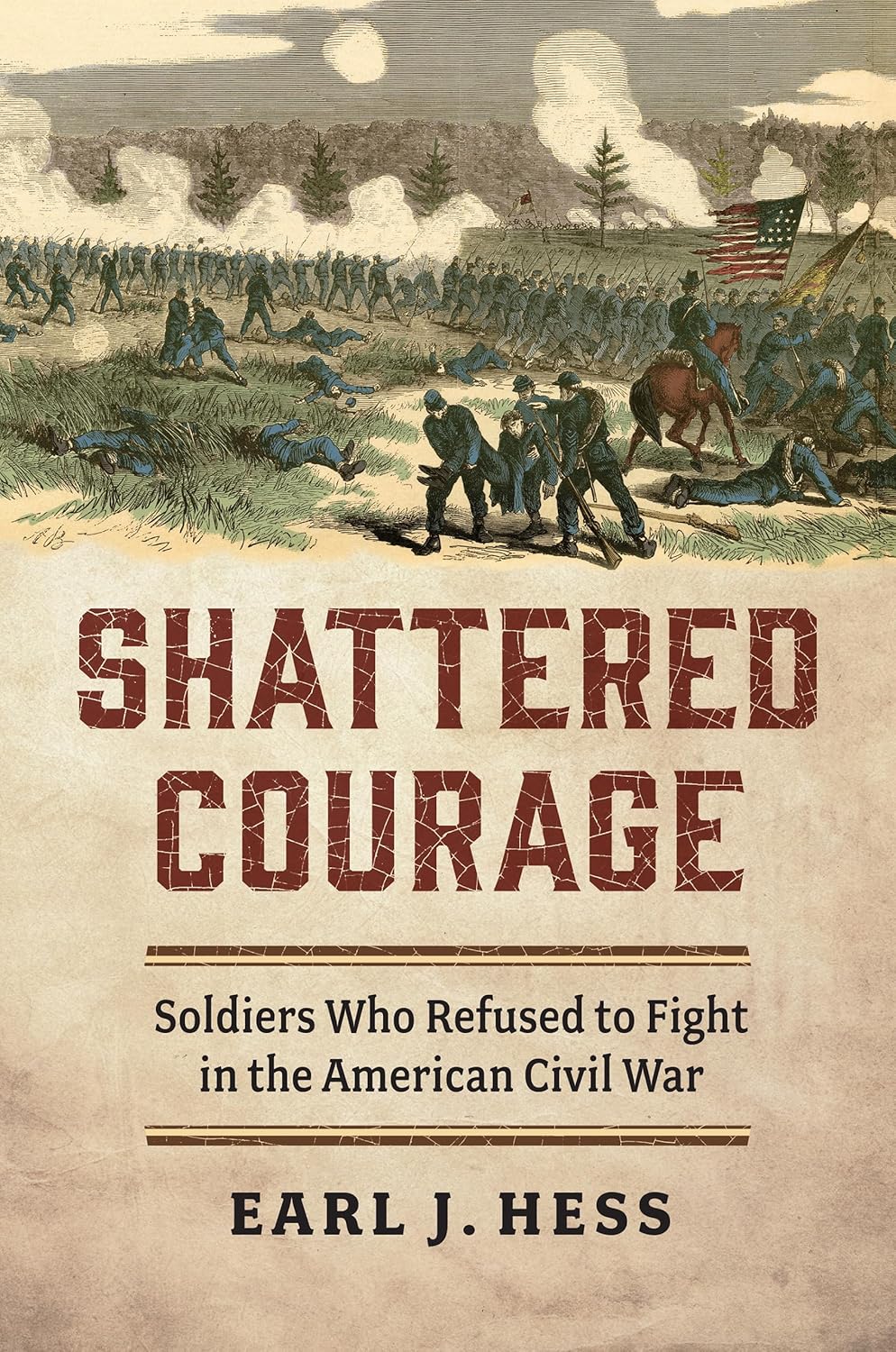
Shattered Courage: Soldiers Who Refused to Fight in the American Civil War. By Earl J. Hess. Lawrence, KS: University Press of Kansas, 2026. Hardcover, 266 pp. $39.99.
Reviewed by Tim Talbott
Just about everyone who reads military history has thought at one time or another how they would personally hold up in combat. Which would win out, fight or flight, or somewhere in between? Would I be able to perform my duties while under fire or would I freeze up or run away seeking safety? Would I bravely stand the test or would I show the “white feather,” be a skulker, or a coffee cooler? While historians have explored courage in Civil War soldiers at length and in many different studies, and have even touched upon courage’s antithesis, cowardice, within those studies, until recently, there has not been any in-depth scholarly book focused solely on cowardice during the Civil War.
Leslie J. Gordon broke the ice on the subject in 2025 with her book Dread Danger: Cowardice and Combat in the American Civil War (Cambridge University Press). Gordon’s fine book provides a case study of two regiments—the 11th New York Infantry and the 2nd Texas Infantry. However, its discussion was fairly limited to those two units and their specific experiences, and thus left much room for a fuller discussion on different aspects of cowardice as experienced by Civil War soldiers.
As he has so often done before, Earl J. Hess steps in to fill yet another Civil War subject void with his recently published Shattered Courage: Soldiers Who Refused to Fight in the American Civil War.
In the book’s Introduction Hess clearly explains that “I focus this book on men who were willing to serve in the army but who, in one way or another, were unwilling to fight.” Additionally, Hess notes, his study “deals with the breakdown of combat morale.” A significant amount of the book examines individuals and units who fled their battlefield experiences rather than face the uncertain results of combat. Similarly, Hess also looks at what he terms “combat reluctance,” which “refers to entire units that made some [tepid] show of obeying an unwelcome order to attack a strong position.” Hess admits that there is a “fine line between combat reluctance and the abject and obvious failure of a unit to meet the challenges of battle.” However, “in general, combat reluctance can be defined as hesitation to fight but not running away from an engagement.” (5)
Hess further defines those who ducked their duty as “bolters” and “habitual play-outs.” Bolters usually attempted to do their duty, but were either physically, mentally or emotionally unable to withstand their battlefield environments. Habitual play-outs were those who “typically did not attempt to withstand the rigors of battle but instead sought ways to avoid exposure to combat on a regular basis.” They feigned sickness, intentionally separated from their units, or used other convenient excuses to avoid combat dangers. Importantly, as Hess states, “I do not look upon bolters and habitual play-outs with judgment, condemnation, or criticism.” Not having experienced combat himself, Hess feels “it is important to approach the study of those who have undergone its trials with caution, compassion, and balance.” (8-10)
Shattered Courage contains eight chapters. The first six chapters: “Battle and Its Challenges,” “Combat Reluctance,” “Combat Failure—Officers,” “Combat Failure—Enlisted Men,” “Combat Failure—Units,” and “Punishment,” all follow the book’s primary theme extremely well. However, the last two chapters, “Encouragement,” and “Other Wars,” both obviously have connections with battlefield cowardice and courage, but they read a bit like add-ons.
The accounts that Hess incorporates into the book show his depth of research and come from a variety of primary sources such as the Official Records, soldiers’ letters and diaries, newspapers, regimental histories, and court martial records, among others. They show that no matter where soldiers served—the Eastern, the Western, or the Trans-Mississippi Theater—it was not uncommon for soldiers to default on their combat duties. Although little mention is made of cowardice within United States Colored Troops units, Hess does explain that the dearth of accounts results primarily from two factors. First, “limited literacy rates among Black soldiers compared to white troops severely reduces the body of personal accounts available. . .” Second, “the serious political, cultural, and moral ramifications of cowardice and bravery among the Federal army’s Black units” meant that cowardice was a rarely broached topic, especially in public consumption forums like newspapers. (199)
Shattered Courage: Soldiers Who Refused to Fight in the American Civil War is a much-welcomed study that helps us more fully understand the worlds of Civil War soldiers. Not all soldiers could be brave in every battle. Some faltered. As Hess concludes, “This book has looked at those previously obscure soldiers to examine the other side of combat courage. It offers them a balanced understanding, something many of their comrades and commanders also tried to do in their musings about the nature of courage and the limits of combat morale.” (202) Readers will find it well-researched, expertly written, and impressively informative.


This is a very interesting topic and Hess is becoming one of my favorite ACW authors. I was thinking about this exact issue while writing a piece on Pickett’s Charge. It seemed like soldiers had a unwritten rules about how much effort was “enough” in battle. There were times when surrender or retreat were accepted and not considered shameful. It wasn’t expected for men to just stand there and fight to the death (except under certain extreme circumstances). Several brigades showed strong “combat reluctance” during Pickett’s Charge and weren’t admonished afterwards. Of course, after the war there was some blame thrown around between Virginians and North Carolinians as to why the charge failed. But at the time, Pickett was the only one salty about it and Lee ordered him to destroy his (presumably) vindictive report.