“No Such Thing as Involuntary Treason”: The Meaning of Loyalty in the Grand Army of the Republic in the South
ECW welcomes back guest author Riley Sullivan.
The Grand Army of the Republic (G.A.R.) was the largest veterans organization that emerged following the end of the American Civil War. At its peak in 1890, the organization boasted 427,981 members in good standing according to the official report of the G.A.R.’s Twenty-Fourth national encampment.[1]
With such membership, the G.A.R. exerted a tremendous amount of political, social, and cultural influence. From lobbying for pensions for disabled veterans to encouraging communities to adorning the graves of fallen comrades on Decoration Day, the G.A.R. significantly affected the social fabric of the United States. As historian Johnathan Neu has duly noted, G.A.R. posts as late as the Progressive Era “deployed their venerated status to remake US society from the community level outward.”[2] Although the majority of G.A.R. posts were established in Northern states, many posts were also established in the South.
Unlike their Northern counterparts, the G.A.R. posts in the South often struggled to have a lasting impact on the communities in the region. While these posts in the former Confederate states were already at a disadvantage for being in hostile territory, a lack of interest from white Southern Union veterans also contributed to the shortcomings of the G.A.R. in the South. This partially proved to be the case because of the G.A.R.’s association with the Republican Party and being a racially integrated organization.
The exclusive nature of G.A.R. membership also proved to be an obstacle for the organization in the region. When examining the G.A.R. in Tennessee, this proved controversial as Article IV of the rules and regulations for the Grand Army of the Republic excluded a large fraction of Tennessee Union veterans from its ranks. As Article IV stated “no person shall be eligible to membership who has at any time borne arms against the United States.”[3] As this seems reasonable given the world view of Union veterans–one that was highlighted by their values of fraternity, charity and loyalty–for many Tennessee Union veterans they had first been conscripted into the Confederate service and later served in the Union army.
Following initial secession, many white Tennesseans who were sympathetic to the Union were cut off from the influence of the federal government. Although some white Tennessee veterans fled northward to enlist in the federal military, others remained at their homes, hoping to remain silent. Then on April 16, 1862, the Confederate Congress passed the first national conscription act in American history. Suddenly, large numbers of white Southerners Unionists were subject to conscription. As a result, thousands of Union veterans who had deserted the Confederate army and were later honorably discharged from federal service were barred from membership. Because of these factors, G.A.R. posts in the Tennessee initially struggled to take shape and nearly vanished with the policies of Reconstruction.
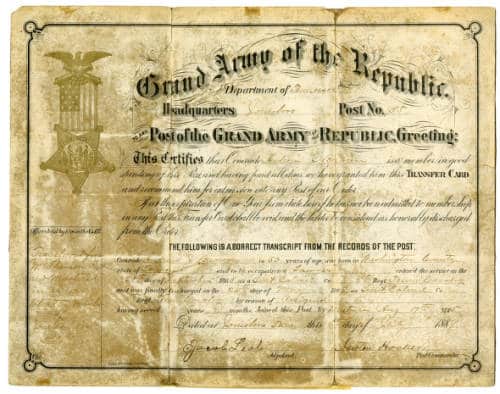
Although Reconstruction negatively impacted membership within the G.A.R. in the Tennessee, by the 1880s, historian Stuart McConnell characterized that the organization witnessed a “resurgence” as G.A.R. membership rapidly increased.[4] With this resurgence, Southern posts began to see renewed interest from Union veterans residing in those states. As new G.A.R. departments throughout the South began to form, these Southern members—lead by Tennessee—sought to revise Article IV to continue to facilitate this growth. What resulted was a major controversy that led to a heated debate amongst G.A.R. veterans on what constituted loyalty.
The controversy surrounding membership stemmed initially from G.A.R. posts and members from Tennessee. Although membership increased with the resurgence of the G.A.R., Tennessee leaders were unsatisfied with the progress as many Tennessee Union veterans were still skeptical of the organization that appeared to be associated with radical politics. In an initial attempt to boost enrollment, at the 1883 national encampment, A.W. Wills of Tennessee proposed that the national encampment for the following year be hosted in Nashville, Tennessee. Holding it there “would have the effect of enlisting every old soldier in Tennessee in our order.”
Continuing, Wills remarked that the state had over 30,000 soldiers that had served in the federal army and that the order “owe[d] more to the Tennessee soldiers” than any other state as they were “cursed by his neighbor, friend, and relative” for their loyalty to the Union cause.[5] Although some representatives at the national encampment were impressed, many were not, and the motion failed to gain enough support as they believed Tennessee to be hostile country.
Nonetheless, membership for the G.A.R. in Tennessee steadily increased, and by February 26, 1884, the Department of Tennessee and Georgia was formed. Even with this growth, the department boasted only 547 members of the possible tens of thousands of veterans cited by Wills.[6] To improve membership, representatives from Tennessee and other states now proposed that Article IV of the rules and regulations should be revised to state “no person shall be eligible to membership who has at any time voluntarily borne arms against the United States.”[7]
By inserting voluntarily, Tennessee veterans were specifically looking to ensure that many of their brethren who had been conscripted into the Confederate army would be eligible for membership within the G.A.R. Speaking on the issue, W. I. Marshall of Tennessee argued at the 1884 national encampment that since regions like East Tennessee–which harbored a significant number of Unionists–were cut off from Union armies until later in the conflict, “they were treated as citizens of the Confederacy, subject to its conscript laws.”[8] Attempting to demonstrate the true loyalty of these men, Marshall added that they only bore arms for the Confederacy “until such time as they might make their escape and find their way to our lines.”[9]
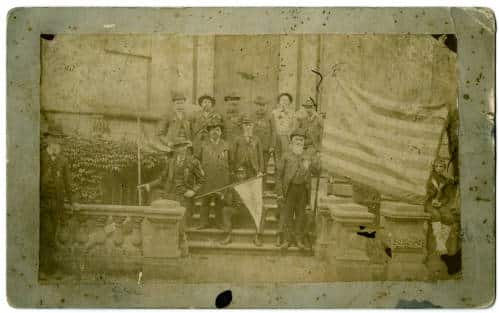
Other representatives voiced their support of the proposed revision to Article IV. C. M. Barnes of Arkansas argued that these men endangered their lives and property for their support of the federal government. Even a representative from Massachusetts, John G. B. Adams, supported this revision as the “men of Tennessee and the mountains of the South stood by the flag” and called on the encampment “to stand by them.”[10]
While each of these representatives were met by applause, hardliners met them with retorts. Louis Wagner of Pennsylvania led the opposition and made it clear that the G.A.R. “is an organization of men upon whom no stain of treason rests,” continuing to state that “men who fired figuratively or literally on the flag of our country, can never enter here.”[11]
As both sides continued to debate the issue, a committee was eventually established to consider the revision of Article IV with the proposed changes and release their opinion at the national encampment the following year. The following year, R. B. Brown delivered the committee’s decision and stated that “there is no such thing as ‘involuntary’ treason” and that it was the opinion of the committee that if they admitted anyone who was a “little loyal” to the Union cause, it would “be the destruction of the Order.”[12] Through this decision, Article IV remained unaltered and large numbers of white Union veterans in Tennessee—and throughout the South—remained excluded from membership within the G.A.R.
Although the Department of Tennessee continued to grow through 1890, thousands of white Union veterans in the state remained excluded from the ranks of the G.A.R. By answering this question of how loyalty was defined, the G.A.R. was dedicated to ensuring that their organization prevented any of these “traitors” from entering. Nonetheless, this episode demonstrates how the G.A.R., dedicated to promoting a legacy of the conflict that was centered upon loyalty and condemning all aspects of rebellion, excluded a significant group of white Tennesseans who had been conscripted into the Confederate army prior to their service for the Union.
Riley Sullivan earned his MA in History at Sam Houston State University and is a Professor of History at San Jacinto College in Pasadena, TX. He has published works on Civil War Memory that have appeared in the Tennessee Historical Quarterly. He is also a doctoral student in the Department of History at the University of Houston.
Endnotes:
[1] Journal of the Twenty-Fourth Annual Session of the National Encampment Grand Army of the Republic, Boston, Mass., August 13th and 14th, 1890, (Detroit, MI: The Richmond and Backus Co., 1890), 7.
[2] Jonathan C. Neu, Our Onward March: The Grand Army of the Republic in the Progressive Era, (New York, NY: Fordham University Press, 2025), 3-4.
[3] Rules and Regulations for the Government of the Grand Army of the Republic: As Revised and Adopted in National Convention, Cincinnati, Ohio, May 12th and 13th, 1869,” (Washington D.C.: Gibson Brothers Printers, 1869), 2.
[4] Stuart McConnell, Glorious Contentment: The Grand Army of the Republic, 1865-1900, (Chapel Hill, NC: University of North Carolina Press, 1992).
[5] Journal of the Seventeenth Annual Session of the National Encampment of the Grand Army of the Republic, Denver, Col., July 25th, 1883, (Omaha, NE: Republican Book and Job Printing House, 1883),157-158.
[6] Journal of the Eighteenth Annual Session of the National Encampment, Grand Army of the Republic, Minneapolis, Minn., July 23, 24, and 25, 1884, (Philadelphia, PA: Town Book and Job Printing House, 1884), 45.
[7] Ibid, 164.
[8] Ibid, 165.
[9] Ibid, 165.
[10] Ibid, 173.
[11] Ibid, 174.
[12] Journal of the Nineteenth Annual Session of the National Encampment, Grand Army of the Republic, Portland, Maine, June 24th and 25th, 1885, (Toledo, OH: Montgomery & Vrooman, Printers, 1885), 234.


This is a fascinating article. It is often in the things that we do not normally think about and consider that some of the most interesting history can be found. The plight of these Tennessee soldiers sounds like a veritable gold mine for research.