Book Review: Gettysburg Postcards: An Illustrated Guide

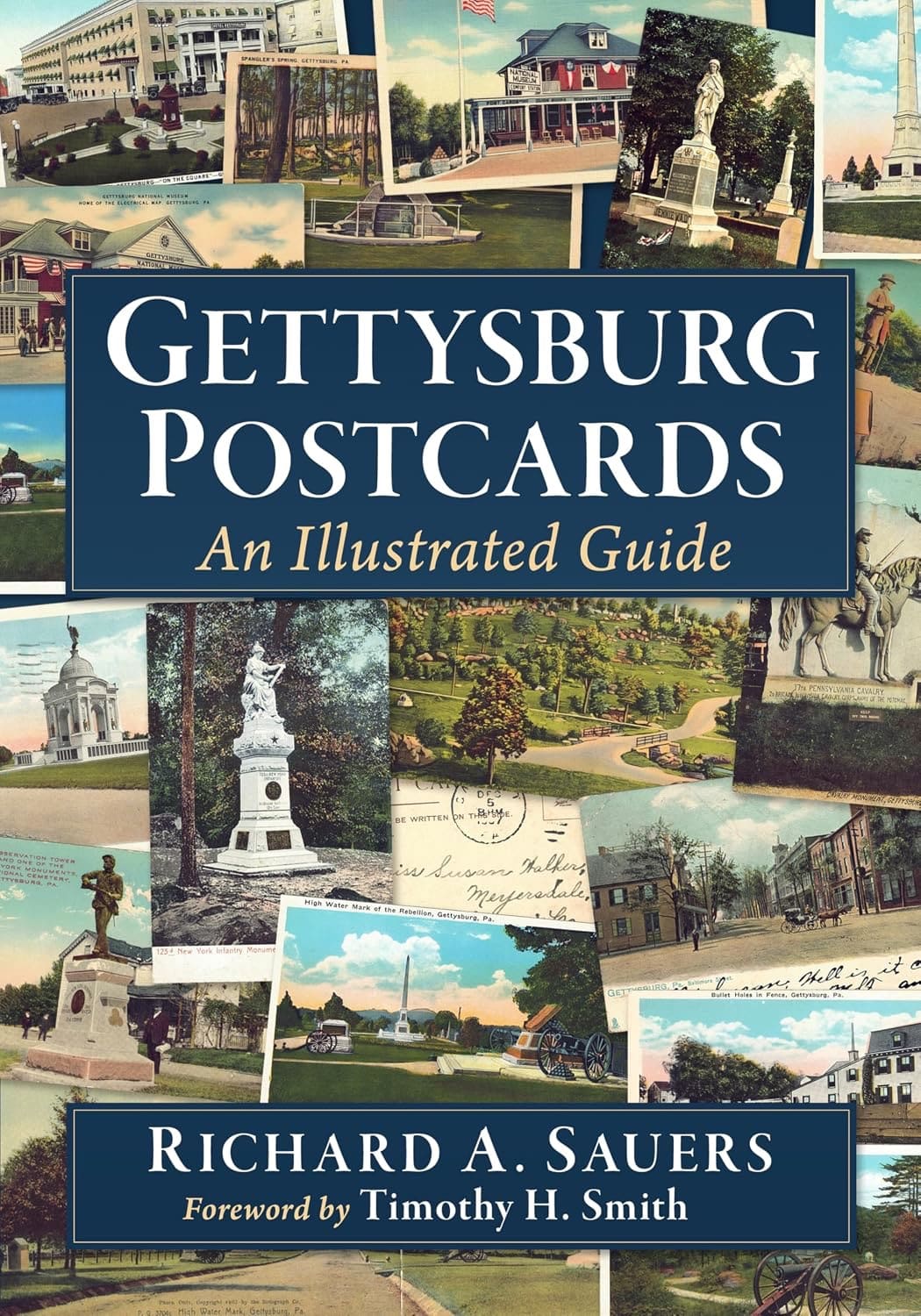
Gettysburg Postcards: An Illustrated Guide. By Richard A. Sauers. Jefferson, North Carolina: McFarland & Company, Inc., 2026. Paperback, 413 pp. $49.95.
Reviewed by Kevin C. Donovan
This book’s simple title hardly does justice to its contents. Indeed, this reviewer originally was somewhat put off by what at first glance appeared to be a hobbyist’s whimsical vanity project. Richard A. Sauers, a serious and prolific author whose Gettysburg-related books include A Caspian Sea of Ink: The Meade-Sickles Controversy and a comprehensive annotated bibliography of the Gettysburg Campaign, reveals in his introduction that since youth he has enjoyed collecting Gettysburg postcards. But what started as a childhood endeavor has spawned an interesting and historically useful work.
Gettysburg Postcards: An Illustrated Guide is not a scrapbook memorializing a bygone method of casual communication since overtaken by email. It is both a historical resource and a lesson in how history can be found in an unlikely place.
The author starts with a historical overview of the postcard itself, an innovation that ironically started in the same year as the Civil War. Sauers describes how postcards changed over time in format and appearance, a process driven in part by federal government regulation. Sauers then provides a brief discussion of the interesting link between the picture postcard industry and the development of the Gettysburg national military park, whose popular scenes furnished a fertile market for the burgeoning postcard business. Subsequent sections identify Gettysburg-specific postcard publishers and printers.
The book then addresses first the major, and then the smaller, publishers and distributors of Gettysburg-themed postcards over more than a century of operation. Each of these surprisingly large number of businesses is the subject of a brief history, including dates of operation, followed by a listing and description of the postcards printed by each company (e.g., format, colors used, type of illustration, size if not standard). The subject of each illustration appearing on the postcard is given, as well as the era during which the card was produced. Over 125 postcard illustrations—painted or photographic—are offered as examples of the work of these entrepreneurs. In all more than 2,600 postcards and their subjects are listed as published by the identified businesses. The chosen subjects provide a glimpse into what particular Gettysburg battlefield scenes were considered of most interest to the public as the years progressed.
All of the foregoing information certainly represents an important contribution by the author to the “discipline of deltiology (postcard collecting and study),” which Saucers observes “is beginning to be recognized as a valuable tool for learning about the past.” (3) Saucers then proceeds to establish his proposition by applying such to Gettysburg National Military Park.
The photographs and painted illustrations displayed on the numerous older postcards published in this work document the history of a changing battlefield park in a manner comparable to the “then and now” series of William A. Frassanito.[1]For example, the reader familiar with the modern battlefield will be surprised to see a postcard photo of two rare Whitworth Guns deployed facing the Union line from West Confederate Avenue next to Schultz Woods. Those guns have long since been removed by the National Park Service.[2] Yet their prior presence on the field as representative of the Hardaway (Alabama) Artillery’s July 2, 1863 position is captured by a postcard dated from what Sauers terms the “White Border Era (1916-1930).” (10, 117)
Another picture postcard reveals that the western face of Little Round Top and the adjacent Valley of Death once were filled with flowering Dogwood trees. Photos preserved on other cards reflect roads or paved paths through parts of the battlefield that now bear no trace of such intrusions. Multiple NPS battlefield tablets that once graced the field (and a postcard) no longer exist. Intrusive business establishments that jarringly appeared near sacred battlefield sites—including a cocktail lounge by the Eternal Light Peace Monument—are captured in the postcards’ vistas. Less offensive and more historic views—including a photo of a since-removed bullet-ridden fence and the historic Eagle Hotel—are preserved in other postcards. Some cards show how popular battlefield sites, such as Spangler’s Spring, Little Round Top, and the Brian Farm, appeared in decades past. Still other cards show how the town of Gettysburg itself appeared over the years. All told, the postcards—whose images indeed represent primary historical sources— offer valuable insight into how the battlefield park has been curated and changed over the decades.
In sum, Sauers’ theory that postcards can represent a source of historical knowledge is well supported by his use of that medium in presenting an unusual history of the Gettysburg National Military Park. What at first appeared to be simply a quirky study of one author’s youthful niche interest proved to offer an intriguing portrait of the history of a modern military battlefield park, while simultaneously encouraging further study of a communications medium that time seemed to have passed by.
[1] William A. Frassanito, Gettysburg, Then & Now: Touring the Battlefield With Old Photos, Gettysburg: Thomas Publications, 1996.
[2] The two guns have not been relocated to Oak Ridge (where two Whitworths currently reside), but apparently remain in NPS storage. “Mystery of the Whitworth Guns,” Gettysburg Witness Trees, https://www.gettysburgwitnesstrees.com/main-map/3-shultz-woods/03-04-hardaway-artillery-trees/mystery-of-the-whitworth-guns/.


Fifty dollars?
Welcome to costs associated with small print runs, large format pages, and illustration heavy books.