Book Review: Reconstruction In Mississippi, 1862-1877

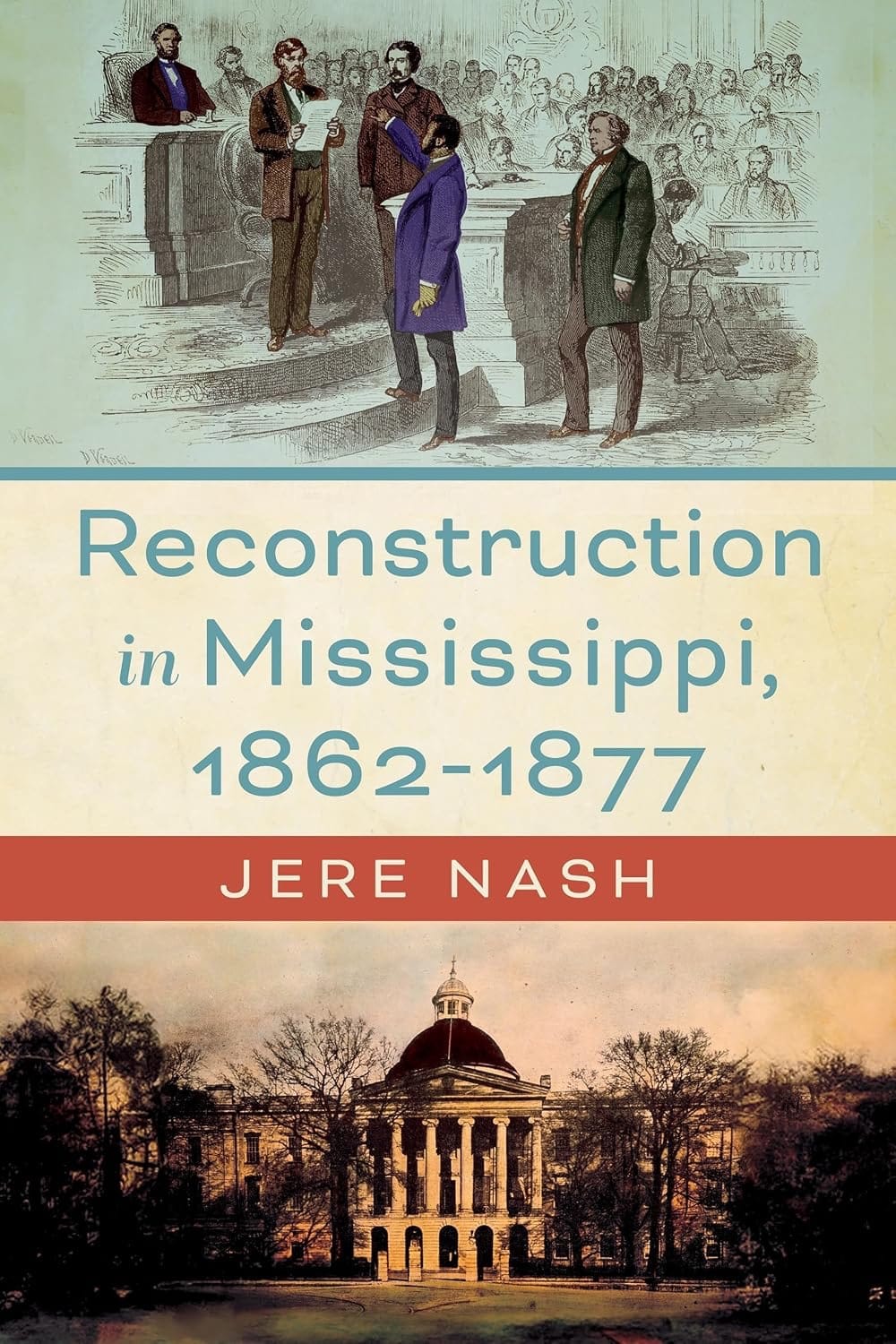
Reconstruction In Mississippi, 1862-1877. By Jere Nash. Jackson, MS: University Press of Mississippi, 2025. Hardcover, 353 pp. $35.00.
Reviewed by Heath Anderson
From the heart of the Confederacy to the centerpiece of biracial democracy during Reconstruction, few states can claim a more central role in the debates over race, citizenship, and the meaning of American democracy that defined the Civil War era than Mississippi. As Jere Nash’s Reconstruction in Mississippi, 1862-1877 argues, Reconstruction was a struggle over nothing less than “the meaning of freedom” (xiv) in the aftermath of slavery, with the state serving as the arena in which Black and white Mississippians sought to realize competing visions of their reunited republic.
As the first comprehensive treatment of these years since 1979, Nash’s work provides a synthesis of recent scholarship, a corrective to historical myths, and a compelling analysis of how the underlying issues of Reconstruction remain relevant for understanding American democracy today. Placing individuals and events within a broader national narrative, Reconstruction in Mississippi offers an accessible account of this complex period, demonstrating the value of state case studies for understanding American history.
The book is divided into twelve chapters and can be understood in three main parts. In chapters 1-4, Nash examines wartime Mississippi and the changes unleashed by the collapse of slavery that Black Mississippians embraced and white Mississippians refused to accept. For Black Mississippians, emancipation meant the opportunity to choose where they worked, reunite their families, educate their children, and become full citizens. Conversely, most white Mississippians considered free Blacks “stolen property” (73), and viewed emancipation as an insidious effort to “degrade the Caucasian race.” (56) It was this spirit that led them to pass the infamous Black Codes in 1866 and resist Reconstruction.
In analyzing this racial tension and its consequences, Nash makes one of his strongest contributions to the literature. For Nash, race informed virtually every Reconstruction-era debate because those debates turned on a question vital to Mississippi’s—and the nation’s—future: who was American democracy for? He argues that the Civil War “settled two issues: secession and slavery” (17), but it did not settle what kind of social order would replace slavery and who would define it. Chapters 5-8 explore how these questions were answered on the ground in Mississippi through Black political mobilization, the state’s transformative 1868 Constitution, and the rise of organized white resistance.
Mississippi’s 1868 Constitution is the hinge of Nash’s book. Enacted by a biracial convention under the protection of the U.S. Army, the document did far more than secure Mississippi’s readmission to the Union. By ratifying the Fourteenth Amendment, guaranteeing the right to vote for all men, and establishing a system of public education, it fundamentally restructured society, replacing the state’s slaveholding oligarchy with a participatory democracy dedicated to individual freedom and equal citizenship. Within five years of Appomattox, a coalition of Black and white Mississippians had written “the only constitution in [Mississippi’s] history that was free of racial discrimination and that had been approved by the voters.” (114)
The implications of these changes were not lost on white Mississippians. In chapters 9-12, Nash demonstrates that the violent campaigns they waged against Reconstruction in the 1870s were a deliberate effort to dismantle the more inclusive polity that freedpeople and their white allies were building and to reestablish white supremacy as the foundation of Mississippi’s political and social order.
Importantly, Nash does not portray the triumph of Mississippi’s white “Redeemer” Democrats in the pivotal election of 1875 as inevitable or even complete. Despite the horrific massacres of Black Mississippians at Vicksburg, Meridian, and Clinton, Black turnout remained remarkably high, with voters rallying around the charismatic leadership of figures such as the formerly enslaved Charles Caldwell, thereby demonstrating their commitment to exercising their rights as American citizens. Indeed, freedom had so transformed Mississippi that only the combination of persistent political organizing, outright fraud, racial violence, and a growing national consensus that Reconstruction had run its course provided white Democrats with the opportunity to sweep back into power.
The lasting impression of Nash’s book is that Reconstruction was a dynamic process in which different groups of Americans debated the meaning of freedom, citizenship, and the principles underlying our democracy. As Nash writes in his epilogue, viewing Reconstruction in this way reveals that, for “the next 100 years” (30), false narratives about Black inferiority and the era’s supposed evils filled Mississippi textbooks, obscuring that much of what we take for granted in our democracy today—free and fair elections, public education, and equality before the law—was the product of biracial Reconstruction governments.
Ultimately, Reconstruction in Mississippi helps us see that the “tragedy” of Reconstruction was twofold: most white Mississippians were unwilling to recognize formerly enslaved people as their equals, and generations of students were educated by works that ignored or excused this reality.
Dr. Heath M. Anderson teaches history and civics at Wright State University’s Center for Civics, Culture, and Workforce Development. His research and teaching focus on the Civil War and Reconstruction era, Black politics, and, more broadly, on how Americans have contested the nation’s founding ideals in moments of crisis.


You should be aware that the “Black Codes” were invented in the North, and were fully in place in the North prior to the Civil War. These included no citizenship or right to vote for blacks, no interracial marriage, and severe restrictions on owning property. No black person could bear witness against a white, and several states simply banned blacks from taking residence at all. In fact, everything in the Black Codes of the pre-war North was in the Black Codes of the postwar South, often called Jim Crow. For that matter, a huge percentage of the Black Codes remained in place in Northern states for over a century after the war. Someone should write a book about that…
There’s an interesting but overlooked dynamic here. It’s easy to see this as a “black vs. white” struggle, but as you and the author mentioned, the only constitution in Mississippi’s history that was free of racial discrimination and that had been approved by the voters was passed by “a coalition of Black and white Mississippians.” Did the whites who supported this constitution only do so because they were compelled by an occupying army? Did something change that converted a large portion of the white population to the redeemer side? (I believe) Mississippi has long had the highest percentage of black residents of any U.S. state. Why weren’t black voters able to overcome a divided white voter base?
Speaking of things Mississippi, a few years ago I attended the annual Eudora Welty Lecture in DC, where the introduction given by Ann Patchett, and the talk of that year’s winner, Elizabeth Strout, were equally thought-provoking. So with Heath Anderson’s stellar review of Jere Nash’s ground-breaking study of reconstruction in Mississippi. They both deserve to be widely read.