New York’s Privately Armed Pirate Hunter: Henry W. Johnson’s 1861 Cruise
In 1861, the United States Navy was stretched to the limit. In April, Fort Sumter was fired upon, Abraham Lincoln declared a blockade of the Confederate coastline, and Jefferson Davis announced he would issue letters of marque and reprisal for privateers to prowl the ocean. Most ships of the United States Navy were deployed overseas and needed to be recalled, and Federal ships struggled to support relief efforts for Forts Sumter and Pickens. As 1861 progressed, the few available Federal ships were dispatched to implement the blockade. Few warships were free to hunt privateers and the Confederacy’s first commerce raiders, much less appease calls by New York’s maritime elite to protect civilian ships in the Atlantic, Caribbean, and Gulf of Mexico. As a result, New York’s leaders took matters into their own hands and dispatched a pirate hunting vessel named Henry W. Johnson to protect their commercial interests.
In the war’s first months, there was indeed a Confederate threat at sea through both privateers–privately armed and outfitted vessels–and commerce raiders–commissioned warships manned and operated by governments. Both privateers and raiders targeted enemy merchant fleets, hoping to economically impact the course of the enemy’s war preparations. The practice of privateering was outlawed by most European powers in 1856, but the United States was not party to that agreement and Europeans quickly announced that the Confederacy could thus not be held to “the doctrine of no privateering.”[1]

Confederate agents soon flooded Confederate offices with applications for letters or marque, with many ships outfitting in New Orleans, Charleston, and in North Carolina waters. In May and June, Calhoun captured six Federal merchants, several on their way to New Orleans anyway with cargo. The privateer Music captured another, and Ivy bagged three more, all “in the name of Jefferson Davis.”[2] Several privateers operated off North Carolina until blockaders bottled Hatteras Inlet. Off Charleston, the pilot-boat turned privateer Savannah captured one merchant in June 1861 before being captured by USS Perry. The privateer Jefferson Davis cruised for seven weeks in mid-1861, becoming “a word of terror to the Yankees” by capturing nine ships, though several prize crews were captured in turn or destroyed their prizes under threat of capture.[3] Jefferson Davis grounded and was lost trying to enter St. Augustine, Florida, that fall. The tiny Charleston privateer Dixie captured three prizes in four weeks, though one was recaptured by blockaders. Petrel never captured anything, immediately running into, and fighting a losing battle against USS St. Lawrence. The crew surrendered and was imprisoned, as was the crew on the privateer Beauregard.
Compounding the issue of privateers, the Confederacy successfully deployed its first commerce raider, CSS Sumter, in mid-1861. The ship escaped the New Orleans blockade. Sumter gained a reputation as “the ‘hope of the Confederacy,’” capturing vessels in the Caribbean and Brazilian coast in the summer and fall of 1861 before crossing the Atlantic, reaching Gibraltar in January 1862.[4] It captured 17 ships, burning seven, bonding nine possessing neutral cargo on the promise they would pay the Confederacy a fee at the end of the war in exchange for being released, and sending one with a prize crew to the Confederate coast where it “fell into the hands of the blockading squadron.”[5] Sumter’s career proved commerce raiding worked.
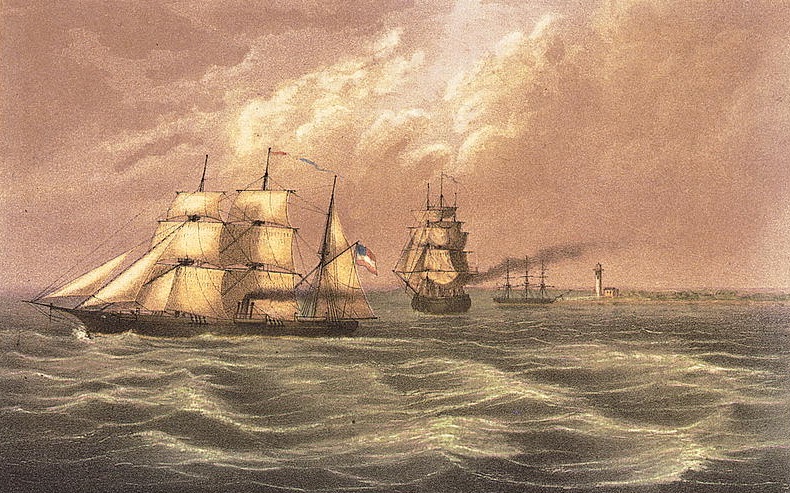
Amidst the height of Confederate privateering and as CSS Sumter began its raiding career, New York’s business leaders desperately wanted action. Not trusting the blockade quite yet, and after being told the Federal fleet was focusing on the coastline and not hunting raiders, New York’s leaders took matters into their own hands in the form of the ship Henry W. Johnson.
Details of Henry W. Johnson’s anti-Confederate cruise are sparse, but an overall picture of its owners, intent, and activity can be tracked with the handful of documents available about the ship. The idea of a civilian ship cruising against Confederate vessels came from justification from the New York City board of maritime insurance underwriters. Before the war, this group dispatched and maintained a vessel that cruised the Bahamas “for the purpose of preventing shipwrecks, as far as possible, and rendering such advice and assistance as may be in your power to masters of vessels stranded or otherwise in distress.”[6] The group wanted to insure ships carrying insured cargo were more likely to reach their destination.
Hostilities did not change the intent of their action, but the board wanted to better guarantee protection of their insured vessels and cargo. On paper Henry W. Johnson was simply making a journey to the Bahamas to serve as the board’s next ship to aid as needed. But with Confederate raiders and privateers afoot, the stakes were raised and the vessel was privately armed “with rifled cannon and small arms.”[7] One account that appeared in a Confederate newspaper claimed the vessel was armed with three cannon, two of which were 18-pounders.[8]
The ship was chartered by the insurers on May 20, and outfitting began.[9] In command was Moses Hoyt, an experienced mariner. Navy Secretary Gideon Welles, cognizant that he did not have enough ships, sanctioned the insurers’ actions. Supporting this departmental approval, Hoyt was commissioned as an acting master in the Federal navy, lending more legitimacy to the venture and providing the ship with some legal protections that came with having a naval officer in charge of a vessel in a war zone. The insurers even requested Welles furnish them with copies of navy regulations and signal books so he could better communicate with any blockading vessels he might encounter.[10]
Tracking Hoyt’s movements is difficult, but the occasional mention in a newspaper helps put the pieces together. Hoyt initially took his ship south into the Caribbean to search for Confederate privateers in that sector. At some unspecified date, the ship made port at the island of St. Thomas in the then Danish-controlled Virgin Islands.[11] From there, Henry W. Johnson turned north and cruised to Nassau, in the Bahamas, where Hoyt docked it on August 10. A Royal Navy officer from HMS Challenger boarded and inspected the ship and crew when it arrived.[12]
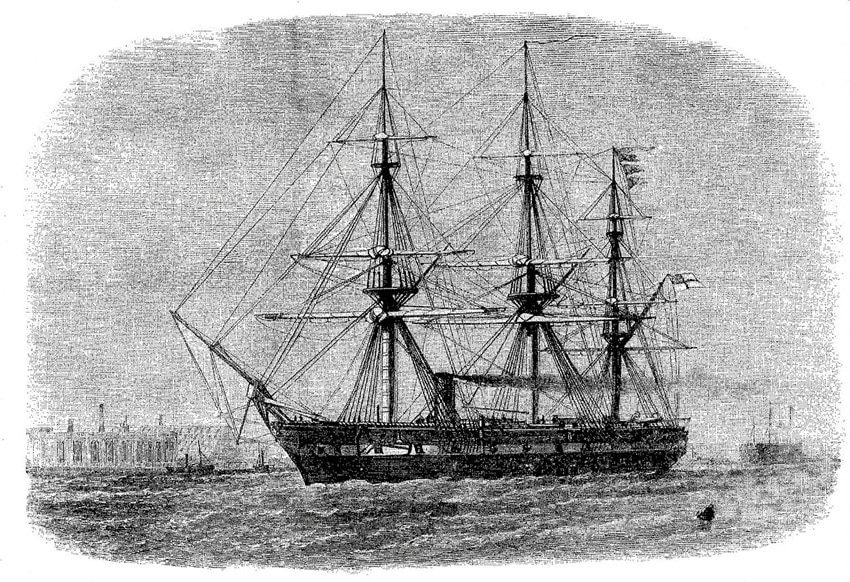
In late August, Henry W. Johnson was cruising off Florida’s southern tip along its coral reef.[13] The ship then turned south and patrolled Cuba’s coastline, even docking in Havana for a time and communicating with the US consul about Rebel shipping patterns.
Henry W. Johnson departed Cuban waters and made its way to Key West to provide reports on how “several Rebel vessels” in Cuba were “loading for Southern ports” packed with upwards of 40,000 muskets, rifles, and revolvers.[14] From there, it returned to Nassau in mid-November, where Hoyt hoped to “meet the pirate vessels [Confederate privateers] said to be cruising about the Bahama Banks,” before turning north back to New York.[15]
On November 26, 1861, after “cruising about the West Indies for pirates” for several months, Henry W. Johnson docked in New York City.[16] Though the ship never sighted any Confederate raiders or privateers, it demonstrated the lengths New York’s maritime oligarchs wanted to guarantee safer shipment of goods and cargo by sea to both stabilize the economy and keep insurance rates (and payouts) low. As the Federal fleet grew, steps like this became less necessary, but in the war’s first year many saw Henry W. Johnson’s cruise as implementing a safeguard when the Federal government seemed incapable of doing so itself.
Endnotes:
[1]Aug. 23, 1861, Diary of Charles Francis Adams, 1823-1880, Adams family papers, Massachusetts Historical Society.
[2]William Morrison Robinson Jr. The Confederate Privateers (New Haven, CT: Yale University Press, 1928), 42.
[3]“The War on the Seas,” Charleston Mercury, Charleston, SC, Aug. 26, 1861.
[4]R.F. Armstrong, Dec. 1898, “The First Confederate Man o’War and Pioneer Commerce Destroyer,” OM: Routine Operations, Subject File of the Confederate States Navy, 1861-1865, M1091, RG 45, U.S. National Archives.
[5]R.F. Armstrong, Dec. 1898, “The First Confederate Man o’War and Pioneer Commerce Destroyer,” OM: Routine Operations, C.S. Subject File.
[6] Lathrop, Smith, Jones, Lathers, and Edwards to Hoyt, June 6, 1861, Official Naval Records of the War of the Rebellion, Series 1, Vol. 1, 31.
[7] “The Henry W. Johnson,” New York Times, June 28, 1861.
[8] “The American Schooner,” Daily Courier, Charleston, SC, September 4, 1861.
[9] “Movements of Steamers,” Fall River Daily News, Fall River, MA, May 20, 1861.
[10] Lathrop to Welles, July 6, 1861, ORN, Series 1, Vol. 1, 37.
[11] “The American Schooner,” Daily Courier, Charleston, SC, September 4, 1861.
[12] “The American Schooner,” Daily Courier, Charleston, SC, September 4, 1861.
[13] “Arrived,” Daily Herald, New York, NY, September 4, 1861.
[14] Welch to Lathrop, November 9, 1861, ORN, Series 1, Vol. 1, 203.
[15] Welch to Lathrop, November 9, 1861, ORN, Series 1, Vol. 1, 203.
[16] “New York, Nov. 26,” Daily Union and Advertiser, Rochester, NY, November 26, 1861.


Facinating.
Apparently the Henry W. Johnson was not the only early war U.S. privateer. The Quaker City was chartered & armed by the Union Defense Committee of the City of New York on April 25, 1861. The private warship captured several Southern merchant vessels before being purchased by the U.S. Navy.
Yes, the Union Defense Committee was originally formed to help facilitate the formation of New York Militia regiments in response to Lincoln’s call for volunteers in April 1861. Chartering ships to transport the new regiments was part of the job but they quickly went beyond that to charter ships to patrol Chesapeake Bay and for blockade duty.
Very interesting article. Thanks.