War Is Hell, But Even Hell Has Rules: Military Necessity & Its Moral Limits Per the Lieber Code
War means killing, maiming, suffering and destruction. Abraham Lincoln knew this. In a July 1862 exasperated response to a Louisiana citizen who complained about the harshness of Lincoln’s war policy, Lincoln retorted: “would you prosecute it [the war] in future, with elder-stalk squirts, charged with rose water?”[1]
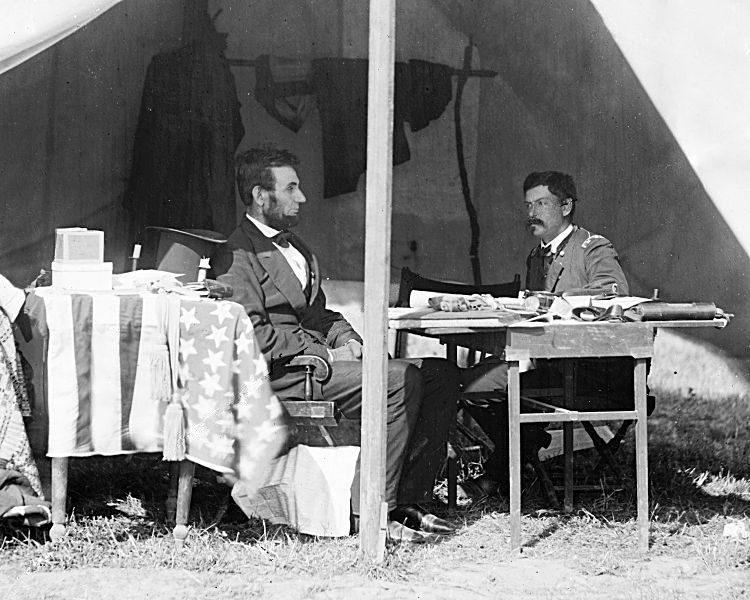
Yet few would argue that the violence necessarily attendant to war must have some limit, lest the country descend into barbarism. The commander of the Army of the Potomac certainly thought so. In a pedantic July 7, 1862 letter presented to the President at Harrison’s Landing, Maj. Gen. George B. McClellan lectured Lincoln that the war “…should be conducted upon the highest principles known to Christian civilization… It should not be at all a war upon population, but against armed forces and political organization. Neither confiscation of property, political executions of persons, … or forcible abolition of slavery should be contemplated for a moment… [P]illage and waste should be treated as high crimes; all unnecessary trespass sternly prohibited, and offensive demeanor by the military towards citizens promptly rebuked.”[2]
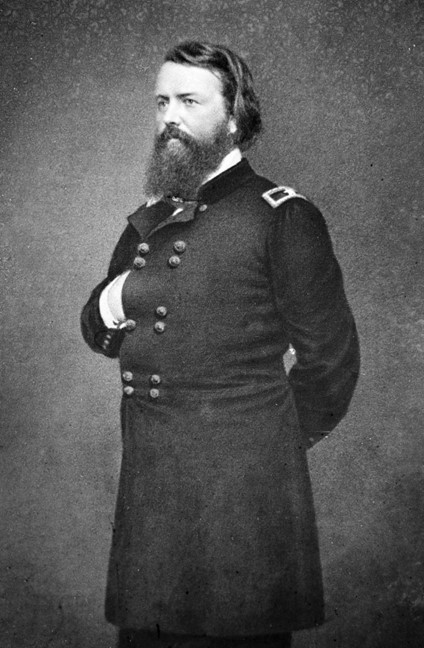
Meanwhile, McClellan’s rival Maj. Gen. John Pope even then was preparing to adopt a “hard war” approach, one expressly targeting civilians. A series of General Orders directed his men to “subsist upon the country” (i.e., Southern civilians) and retaliate against the populace for any sabotage in their midst, even without any proof of individual complicity. Pope even threatened to execute civilian rebel sympathizers found within his lines. Pope believed that such measures were justified by military necessity.[3]
Thus, in later crafting his code Francis Lieber had before him sharply contrasting theories as to how the war should be conducted.[4] As seen before, the Code’s Article 5 proclaimed that “To save the country is paramount to all other considerations.” But surely that did not mean that no restraints would be placed on the conduct of U.S. soldiers? This is how Lieber’s Code laid out the rule of what “military necessity” justified, and the limits of that doctrine.
Article 14.
Military necessity, as understood by modern civilized nations, consists in the necessity of those measures which are indispensable for securing the ends of the war, and which are lawful according to the modern law and usages of war.
Comment: This Article defines “military necessity” in broad terms, yet with reference to the “laws of war.” That body of customarily accepted principles included a variety of provisions limiting the application and targets of violence in war.[5] As the Code put it in its Article 30, “the law of war imposes many limitations and restrictions on principles of justice, faith, and honor.”
Indeed, the Order under which Lieber was operating had instructed that the code of regulations being crafted must stay within those limits of conduct “as authorized by the laws and usages of war.”[6]
Article 15.
Military necessity admits of all direct destruction of life or limb of armed enemies, and of other persons whose destruction is incidentally unavoidable in the armed contests of the war; it allows of the capturing of every armed enemy, and every enemy of importance to the hostile government, or of peculiar danger to the captor; it allows of all destruction of property, and obstruction of the ways and channels of traffic, travel, or communication, and of all withholding of sustenance or means of life from the enemy; of the appropriation of whatever an enemy’s country affords necessary for the subsistence and safety of the army, and of such deception as does not involve the breaking of good faith either positively pledged, regarding agreements entered into during the war, or supposed by the modern law of war to exist. Men who take up arms against one another in public war do not cease on this account to be moral beings, responsible to one another and to God (emphasis supplied).
Comment: Here, Lieber appears to adopt somewhat of a middle ground between McClellan’s and Pope’s approaches. The Code acknowledges that war justifies harsh measures, yet —in language that calls to mind McClellan’s appeal to conduct war upon the highest Christian principles—insists that at all times soldiers must remain moral beings. This provision appears to set the army on a track of at least some restraint. It seems to foretell a true civilizing of war, rejecting William T. Sherman’s simple “war is hell” theory.
Article 16.
Military necessity does not admit of cruelty – that is, the infliction of suffering for the sake of suffering or for revenge, nor of maiming or wounding except in fight, nor of torture to extort confessions. It does not admit of the use of poison in any way, nor of the wanton devastation of a district. It admits of deception, but disclaims acts of perfidy; and, in general, military necessity does not include any act of hostility which makes the return to peace unnecessarily difficult(emphasis supplied).
Comment: Again, here we see that the Lieber Code appears to urge a somewhat “softer” approach to war. Not only does it expressly disclaim “cruelty,” but the Code urges every manner of restraint that will permit a “return to peace” without bitterness.
Article 68.
Modern wars are not internecine wars, in which the killing of the enemy is the object. The destruction of the enemy in modern war, and, indeed, modern war itself, are means to obtain that object of the belligerent which lies beyond the war.
Unnecessary or revengeful destruction of life is not lawful.
Comment: Once again, the Code stresses the goal of limiting the fatal violence of war.
Summary: If one were to stop reading the Code at this point, it would certainly seem that the Code’s primary object was civilizing war-making. While acknowledging war’s inherent harshness, the Code demands restraint and morality, while it requires that combatants always focus upon what conduct will best ensure a return path to peace. The question is whether the remainder of the Code would live up to these lofty-sounding principles.
This post is part of a series.
[1] “Abraham Lincoln to Cuthbert Bullitt, July 28, 1862,” House Divided: The Civil War Research Engine at Dickinson College, https://hd.housedivided.dickinson.edu/node/40493.
[2] “General McClellan Letter to President Lincoln on His Evacuation from the Peninsula Campaign,” The Kolbe Foundation, https://kolbefoundation.org/gbookswebsite/studentlibrary/americanpapers/civilwar/mcclellanletterlincoln.htm.
[3] John J. Hennessy, Return to Bull Run: The Campaign and Battle of Second Manassas (New York, Simon & Shuster, 1994), pp. 14 – 19; Daniel E. Sutherland, “Abraham Lincoln, John Pope, and the Origins of Total War,” The Journal of Military History, Vol. 56, No. 4, pp. 577 – 578, 583 (Lexington, VA, Oct. 1, 1992).
[4] The War of the Rebellion: A Compilation of The Official Records of The Union and Confederate Armies, Series III, Vol. 3 (U.S. Government Printing Office, Washington, D.C., 1880 – 1901), pp. 148 – 164. Frances Lieber commenced work on the Code in December 1862. John Fabian Witt, Lincoln’s Code: The Laws of War in American History (Free Press, New York, NY, 2012), pp. 229 – 231.
[5] For example, according to Emer de Vattel, an 18th century authority on the laws and usages of war, women and unarmed, unoffending “peasants” were not to be abused and must be permitted to hold onto their property. Emer de Vattel, The Law of Nations (LF ed.) 1797, Sections 145, 147, https://oll.libertyfund.org/title/whatmore-the-law-of-nations-lf-ed.
[6] The War of the Rebellion: A Compilation of The Official Records of The Union and Confederate Armies, Series III, Vol. 2 (U.S. Government Printing Office, Washington, D.C., 1880 – 1901), p. 951.


Another excellent entry in this series! Forgive my ignorance, but did the Confederates have an equivalent to the Lieber Code?
Thank you. The CSA had no counterpart to the Lieber Code. It did presumably apply the Old Army Articles of War, but that did not address all of the topics of the Code (which made necessary the latter).
What I will remember from studying the Code is it’s concept of proportionate response, which was certainly not something the Napoleonic Wars of Lieber’s youth embraced.
Really enjoying this series. Thanks, Kevin.
Brian, thank you for reading.
I have a disturbing image of Union bummers in Georgia carrying in their pockets the Lieber Code, and referencing it each time they robbed a henhouse.
One wonders how much ordinary soldiers knew, or cared, about the Code, or even knew that the Code existed.
To be addressed……
thanks Kevin, another good one.
What’s your legal opinion of the United States’ “hard war” against the Confederacy in 1864 … specifically, Sheridan’s campaign in the Shenendoah and Sherman’s campaign after taking Atlanta — were they within the bounds of Lieber articles 14 and 15 … or, assume you are a JAG serving on Grant’s and/or Sherman’s staff … how might you advise them prior to these campaigns … today, military staffs have JAGs assigned whose job is exactly that — advise the commander on operations from a law of war and/or a policy perspective.
Mark, thank you & short answer – I think that the Code would justify their actions. As we will see in later posts, despite the high-sounding language of some parts of the Code (the ones we are discussing first), in fact other parts of the Code justified “hard” war. There are some specific hard and fast rules (no torture, no use of poison, no assassination), but as we will see the rules are so “flexible” virtually anything else goes.
Your observation about the importance of JAG legal advice to combat forces reminds me of an incident from my own distant past. The U.S. JAG School is located next to the University of Virginia Law School. While a student at UVA I was asked to give a law school tour to a JAG guest, the JAG for the Israel Defense Forces. He had written what I recall were essentially the rules of engagement for the then recent Israeli invasion of Lebanon. I wonder if he was familiar with the Lieber Code.
Thank you for reading.
The most egregious violations of the Lieber Code are to be found in the records of the Provost Marshal of the U.S. Army. Taking civilian hostages was not uncommon and there are many documented cases of civilians being executed without trials or any proof being brought against them.
Hostages were specifically allowed by the Leiber Code (articles 54/55), and were to be treated humanely – and they were quite rare during the Civil War. Civilians who were executed after a court martial trial were almost always persons who had been caught as bushwhackers or spies not in uniform and thus not entitled to treatment at Prisoners of War – see articles 81-85.
This is where I’m confused. Lincoln’s official policy was that the states hadn’t seceded, he was dealing with an armed rebellion of individuals within those states. He didn’t recognize the Confederacy as a government. So what was the distinction between a “bushwhacker not in uniform” and a uniformed Confederate soldier? They are both U.S. citizens in rebellion against their government, just wearing different clothes. Why would one be entitled to treatment as Prisoners of War and not the other? For example, in McClellan’s first campaign in northwestern Virginia, he addressed John Pegram as “Styling himself Lieutenant-Colonel, P. A. C. S.” so as not to acknowledge the rank as legitimate. He added, “I will treat you and them with the kindness due to prisoners of war, but it is not in my power to relieve you or them from any disabilities incurred by taking arms against the United States.” Many of these men from the mountains of western Virginia were probably not wearing uniforms in early July 1861.
This replies both to Mark and to M.A. The issue of how to handle “irregular” combatants was a major concern for U.S. military authorities from early in the war. Should captured irregulars be treated as POWs, or summarily executed as “bushwhackers” (or whatever perjorative term you prefer to use). Moreover, as M.A. points out, how does one define a a rebel “soldier” as opposed to a “bushwhacker,” and again, why should that matter? At the time of the Civil War Americans honored Revolutionary War figures such as Francis “The Swamp Fox” Marion & Thomas “the Carolina Gamecock” Sumter, both of whom engaged in irregular warfare. Why should Confederate irregulars be treated differently?
The problem was so serious that in August 1862 Gen.-in-Chief Henry Halleck asked Lieber prepare a paper on the subject, seeking to provide guidance to field commanders confronted with irregulars. Later, Lieber also addressed this thorny issue in his Code, which will be the subject of a future post in this series.
As for uniforms, Lieber made this observation in his 1862 paper on irregular warfare: “The Southern prisoners made at Fort Donelson, whom I have seen at the West, had no uniform. They were indeed dressed very much alike, but it was the uniform dress of the countryman in that region. Yet they were treated by us as prisoners of war, and well treated too.” So, again, what makes a soldier, as opposed to an irregular? We shall see in a future post.
Thank you for the clarification, Kevin and I’m looking forward to your future post on the subject!