Echoes of Reconstruction: The Hamburg Massacre From One Of Its Perpetrators
Emerging Civil War is pleased to welcome back Patrick Young, author of The Reconstruction Era blog.
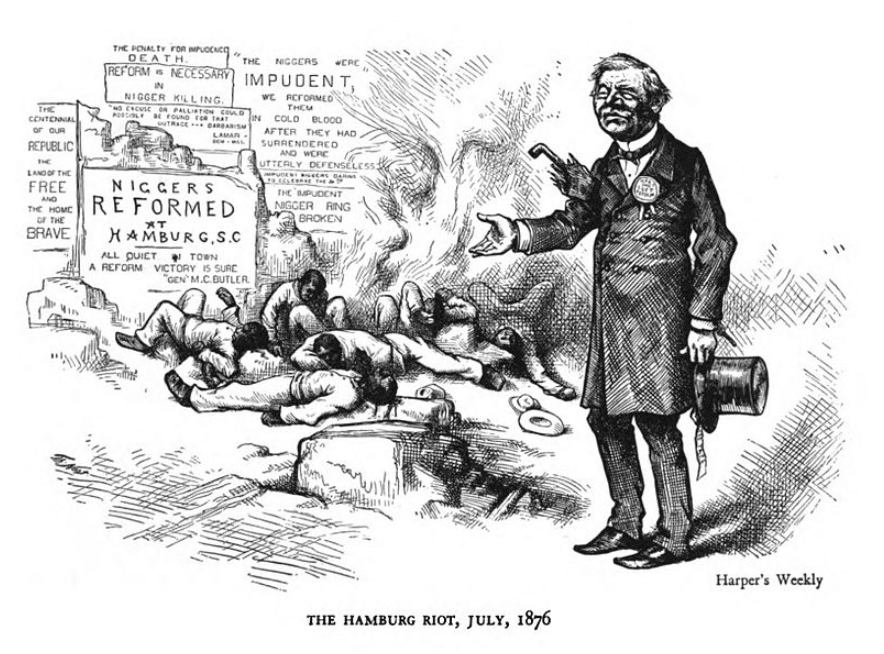
Here is how the Red Shirts, a clandestine group that supported General Wade Hampton’s campaign for governor of South Carolina, celebrated the 100th Anniversary of the signing of the Declaration of Independence in 1876. The account comes from Benjamin Tillman, a 28-year-old member of the Red Shirts.
Benjamin Tillman would become one of the most powerful men in South Carolina by the end of the 19th Century. In 1890, he was elected governor of the state, and he became a United States Senator from 1895 until 1918. Tillman was born in the Edgefield District and grew up on his family’s plantation where 86 slaves were held. In 1864, when he was only sixteen years old, he joined the Confederate Army. A tumor developed and Tillman was not able to perform active service. After the war he was given large amounts of land from his family, and while the family’s former slaves were now “Emancipated,” Tillman used the whip to speed up production on his plantation.
Tillman was very unhappy with the extension of voting rights to Blacks after 1867, and in 1873 he and other Confederate veterans joined the Red Shirts, a secret paramilitary group hoping to intimidate the local Black community. They placed themselves under the command of two Confederate Generals, Martin Gary and Matthew Butler. The local band of Red Shirts was called the Sweetwater Sabre Club. In 1876, the Red Shirts recruited Confederate General Wade Hampton to run for governor as a Democrat with the hope that his successful election would lead to the restoration of White Supremacy.
One of Tillman’s first actions that caught the eyes of many approving South Carolina whites was his participation in the Hamburg Massacre. In 1909, Tillman made a keynote at the Red Shirt reunion in which he recounted the gallant actions of the white minority’s conquest of the Black majority starting with the Hamburg Massacre in 1876. In July of that year many towns held parades and celebrations for Independence Day, the one hundredth anniversary of the Declaration of Independence. Tillman recounted the festivities of the Centennial year in his speech at the reunion. He said that “the final struggle for mastery culminated” in 1876, after which democratic rights were taken from the Black community.
Tillman told his audience that; “Altogether, in 1874 and 1876, I was a participant in four race riots. All of these were most potent influences in shaping the conflict between the whites and blacks and producing the gratifying result which brought the white man again into control of his inheritance.” Now, of course, African Americans made up a majority of the population of South Carolina, but Tillman and his audience believed that the state was their inheritance.
Tillman, because of his power, could speak freely to the Red Shirted audience. Other participants were afraid to speak truthfully about what had happened, but Tillman said that “I have nothing to conceal about the Hamburg riot. I told the republicans in the senate that we had to shoot negroes to get relief from the galling tyranny to which we had been subjected…” Tillman described the Hamburg Massacre “as this tragic episode in the struggle for white supremacy” as a turning point for white control of the state.
The immediate cause of the massacre was a traffic dispute. On July 4 the local militia, led by a Black man, were parading in the streets of Hamburg. Tillman said that “as was usual a very large proportion of the negro population were admiring spectators.” As they were carrying out their drills, two white men in a wagon came up the street and demanded that the militia get out of their way. The commander ordered his men to level their muskets at the men and the white men said they would shoot the first man who did any harm to their horses. The captain then ordered his men to halt and he opened his ranks so that the buggy could pass.
While this might seem like a minor incident, Tillman saw it as a major opportunity. He recalled that; “It had been the settled purpose of the leading white men of Edgefield to seize the first opportunity that the negroes might offer them to provoke a riot and teach the negroes a lesson; as it was generally believed that nothing but bloodshed and a good deal of it could answer the purpose of redeeming the state from negro and carpet bag rule.” The father of one of the young men asked for prosecution of the head of the militia.
A call went out for the Red Shirts to assemble. Tillman says that “It was our purpose to attend the trial to see that the young men had protection and, if any opportunity offered, to provoke a row, and if one did not offer, we were to make one.” The Red Shirts were under the command of former Confederate General Matthew Butler. He had commanded a brigade under Wade Hampton and then a division in the last days of the war, and was very close to the former Lieut. General Wade Hampton. When they got to the courthouse, the case was postponed due to the potential for violence. Butler found out that the militia was in the nearby company armory. The general sent a message to the militia that they “were a menace to peace and good order, and that the whites having lost all patience were resolved to put an end to his outrageous and insolent conduct.” This surrender was refused by the Black men.
The building was surrounded by approximately seventy armed white men. The number of men on each side was roughly similar, but, said Tillman, “the difference in the blood and the color of the skin far more than made up the odds in the armament.” After the resistance of the militia was broken, Tillman recounts that “the whites began to search all of these buildings and very shortly a negro man was discovered in hiding. He was dragged out while squalling at the top of his voice through fright. He was shot by some one who in the excitement and anger forgot himself and, though not seriously wounded, his screams and cries resounded so as to be heard for half a mile around.” At around the same time, word came that one Red Shirt had been killed. McKie Meriwether was a man of approximately 25 years of age who fought for white control accompanied by his father. Tillman says that Meriwether might have been killed by one of the militiamen or that he was shot in a friendly-fire incident.
The news that a white man had been killed had a great effect; “If the white men were angry and determined when they began that bloody business, this sad and unexpected death added ten-fold fury to their feelings…As soon as it was entirely dark the negroes in the armory took advantage of the opportunity to make their escape down the steps of which I have spoken and to flee up the river. Some of them were too much frightened to make this attempt and sought concealment in the cellar and other hiding places in the wooden shanties. Some of them ripped up the floors and hid under them. The whites from Augusta brought over at Gen. Butler’s request a small piece of artillery. This was loaded with small pieces of iron (no regular balls were available) and fired off in front at the Sibley building. After two discharges there was no further firing from the negroes, as all who could had fled and the town was deserted. The square which was entirely surrounded by this time was searched thoroughly. Every nook and corner of every building was examined by the whites who broke in the doors with axes. Prisoners to the number of some thirty or forty men were captured, and as soon as taken were placed under guard on River street some 75 yards above the wagon bridge.The number of whites had increased immensely by this time, mainly from Augusta…”
The town marshal, a Black man, tried to run but according to Tillman fifty white men fired at him, killing him.
After capturing a number of Blacks, the Red Shirts went after whites they could not control. Tillman says; “The searching was ended by breaking in the front door of Louis Schiller’s store, which was also his residence. Schiller was a low Jew who had joined the negroes and had been given office by them, having held the position of county auditor until the county of Aiken was set apart. We wanted to hang him, as the resentment against white scalawags was intense. He had been born and raised in Hamburg and had really sold himself to the negroes. We did not find him in the house, but learned afterwards that the poor wretch escaped us by climbing through a trap door which led out on the roof and that he was lying behind a parapet on top of the house while execrations against his name and the purpose to swing him were being expressed by the white men below.”
James McKie, a relative of Meriwether complained to Hillman that they needed to execute more Blacks to make up for Meriwether’s loss. Hillman took a party to settle up with the Blacks. “The party made their way to the place where the negro prisoners were held, and Henry Getzen, who lived two miles from Hamburg and who knew all of the negroes in the town and neighborhood, was asked to designate those of the meanest characters and most deserving of death…As fast as he would select from among the prisoners those he thought ought to be killed- all militiamen-they were taken off a little ways down the street and shot. After five had been thus dealt with the little squad of white men who were still remaining in town seemed satisfied and it was decided that the rest of the negroes, some 25 or 30 in number, should be allowed to go…If young Meriwether had not lost his life I do not think any of these last negroes would have been killed, but the purpose of our visit to Hamburg was to strike terror, and the next morning (Sunday) when the negroes who had fled to the swamp returned to the town (some of them never did return, but kept on going) the ghastly sight which met their gaze of seven dead negroes lying stark and stiff, certainly had its effect.”
The Hamburg Massacre had its effect and the local Black population stopped their organizing. Wade Hampton became the next governor.
Sources:
- Struggles of 1876 : How South Carolina was delivered from carpet-bag and negro rule : Speech at the Red-Shirt Re-Union at Anderson by Benjamin Tillman
- Wade Hampton: Confederate Warrior to Southern Redeemer by Rod Andrew Jr. published by The University of North Carolina Press (2009)


Now I get it, this is the history that Donald Trump complains makes white Americans feel bad about themselves and shouldn’t be told.
Thanks for reading and commenting. Good observation.
Thanks, Pat. It was a good and timely piece. As for the Beardian analysis by carsonforardsbcglobalnet – please – so out of date and of secondary importance.
The degree of irrational rage that people like Gary, Tillman and Butler retained, and loosed on their fellow residents is so utterly tragic. The Edgehill area of SC was an especially violent hotbed of “Redeemer” fervor. I’m stunned that the militia companies just didn’t shoot down these damn terrorists, they had more than enough legal justification.
Thanks for commenting John.
Patrick,
Your exposure of such cruelty makes one cringe. A part of history of the South and Reconstruction that is overlooked in the general histories of the period. No one should be afraid to confront and open these terribly dark corners of the post Civil War South. Thank you for doing so. The callous and brutal behavior cited makes me sick,
Very good contemporaneous book on South Carolina during Reconstruction, “The Prostate State”, James Shepherd Pike, Massachusetts native, reporter/journalist for the Washington Tribune, critic of the South and ardent Republican for decades until becoming disillusioned with Reconstruction. Wikipedia has a good entry for him. His book is a balanced and factual look at the pathway of Reconstruction in South Carolina, written after Greeley lost the election and then died; Pike was sent to SC as a reporter c. 1873. It is not a book that either side of this discussion would have expected. The issue not mentioned by other commenters, or by Pike, is that the point of abrupt abolition was to create a Republican voting bloc in the South, an area that otherwise would definitely not have been one, to support the continuation of the very high Morrill Act tariff rates, the source of US Treasury revenue and the primary economic cause of the War. Secession eliminated not only the increase in rates but also elimination of US tariff income altoghether. Lincoln chose to solve that with ‘a quick War’. The unlawful deaths at Hamburg deserve to be met with expressions of shock and horror but the total context of how Reconstruction created such an environment is never mentioned. It should also be mentioned that Lincoln favored a ‘soft recovery’ for the South; that all changed on a dime with his assassination, an event greatly regretted at that point by the South. Also, “Empire of Cotton”, Sven Beckert, gives a stunning overview of how the international market for British cotton textiles ruled the economics of Britain, the US, and the rest of the pre-War trading world in the 19th century. Chapter 4 gets into the details of the control center in Birmingham, England, and the actors in the US.
You write: “the point of abrupt abolition was to create a Republican voting bloc in the South.” If it was, then why weren’t any Blacks able to vote in 1863 when Lincoln abruptly ended slavery?
Hi, Patrick, the Emancipation Proclamation didn’t free anyone because the Confederacy had seceded. That’s why the 13th and 14th Amendments had to be written and passed as legislative law.
Oops – that’s “The Prostrate State”, not ‘the prostate, etc….