Book Review: The Emerson Circle: The Concord Radicals Who Reinvented the World

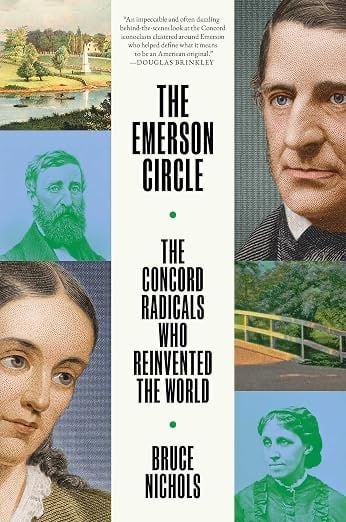
The Emerson Circle: The Concord Radicals Who Reinvented the World. By Bruce Nichols. New York: Avid Reader Press, 2026. Hardcover, 348 pp. $22.66.
Reviewed by Max Longley
Bruce Nichols is a longtime publishing executive from New England. In this book, Nichols shifts from being a publisher to being an author, and he profiles several key New England intellectuals who lived at least part of their lives in Concord, Massachusetts. Nichols draws upon archival collections in Massachusetts, the published works of the Emerson Circle, and the copious secondary literature.
Though the intellectuals of the Emerson Circle lived in Concord with a capital “C,” Americans at this time were not living in concord with a lowercase “c.” Indeed, to their critics North and South, then and later, these intellectuals shared the blame for bringing about the Civil War. They seemed to exemplify the “New England fanatics” of Southern demonology – supporters of the “isms” of abolitionism, feminism and socialism, disavowing their Calvinist theological heritage while retaining the zealous self-righteousness associated with their Puritan ancestors. No wonder the South seceded when they faced such implacable foes!
This, at least, is how their enemies in the South saw New England intellectuals, and many outside the South had a similar viewpoint. But Nichols’ perspective is different. Although he is not specifically writing a Civil War book, Nichols gives us a sympathetic portrayal of these cultural figures who played important roles in the Civil War era. With one significant exception, they were all abolitionists, assisting people who were fleeing from slavery as well as publicizing the evils of that system.
I noted that there was one exception to the abolitionism of these radicals. That exception was Nathaniel Hawthorne, whose jaundiced view of New England life and history is (or was) familiar to many American students. What Hawthorne had in common with the other Concord radicals was his writing talent and his struggle to earn a living through his writing. Unlike the others, Hawthorne was able to supplement his income through federal patronage jobs, courtesy of proslavery Democratic presidents. Hawthorne wrote the campaign biography of his college classmate Franklin Pierce of New Hampshire and won diplomatic positions under the Pierce administration. Not only did he criticize the original Puritans in The Scarlet Letter, Hawthorne gently (or not so gently) mocked the utopian pretensions of his fellow New England intellectuals, who inherited the world-reforming Puritan mantle.
Bronson Alcott was one of the people Hawthorne had in his sights. Like Hawthorne, Alcott tried to earn a living by writing, but with his limited income his wife and children had only a modest lifestyle. In conformity with the stereotype of New England radicalism, Alcott lived for a time on one of the communes established by reformers in those days, but the commune was not successful. Alcott’s daughter Louisa May had greater literary success than her father, nostalgically portraying life with her family in the autobiographical novel Little Women. Unfortunately, if we are to believe Emerson’s account, Bronson Alcott’s abolitionism coexisted with a nasty racism. Alcott supposedly wanted to take extreme measures to whiten the country: “polygamy might be introduced” for Whites, while Blacks would “be made the eunuchs.” Whites would increase, Blacks would decrease. (200)
One of Alcott’s friends was Henry David Thoreau, who had a more pleasant, more practical attitude than Alcott – although Thoreau’s practical streak is not part of the Walden author’s proto-hippie reputation. Thoreau’s inventiveness helped to improve the products at his family’s pencil factory. He often hired himself out as a surveyor and laborer while living in the countryside around Concord. But he made his reputation as a writer/naturalist, showing both a scientific and a literary interest in nature. He combined abolitionism and anarchism in his civil-disobedience protest against the Mexican-American War, justifying his stand in an essay which inspired later civil-disobedience campaigners.
Of the intellectuals in the Emerson Circle, it was Margaret Fuller who ended up with the most real-world political and military experience. In addition to her books, this pioneering feminist established herself as a journalist thanks to a native New Englander who, because of his views, would have fit in with the Emerson Circle had he lived in Concord. I refer to Horace Greeley, who grew up in New Hampshire and moved to New York City, where he ran one of the most successful and influential newspapers of the Civil War era, the Tribune. As an editor, Greeley echoed New England radicalism, denouncing slavery and promoting feminism – the latter largely through Fuller’s articles. To complete the New England radical stereotype, Greeley also helped publicize the socialist ideas of the Frenchman Charles Fourier, whose eccentric views made Karl Marx’s rival version of socialism appear, in comparison, plodding and pedestrian (Greeley later hired Marx himself as a Tribune correspondent).
Margaret Fuller was a zealous supporter of the liberal revolutionary movement in Europe. Recovering from an ill-advised affair with a married banker, Fuller went to Rome to cover, and participate in, a revolution against the Pope. While in Rome, she married one of the revolutionaries, and upon the failure of the revolution she sailed with her new family to America, intending to publish her account of the revolt. Her ship sank within sight of the American coast in 1850. Refusing rescue because she did not wish to abandon her husband and child, the feminist champion drowned along with her family (her manuscript sank to the bottom, as well).
In his day, the biggest New England intellectual was Ralph Waldo Emerson. He not only rejected traditional New England Puritanism, he rejected Unitarianism – abandoning plans to be a minister of that liberal Christian denomination because he thought even the mildest versions of Christianity were too fundamentalist. Emerson promoted his spiritual and social views in published essays and in well-attended lectures. Public lectures were the podcasts of the time – someone like Emerson, with interesting ideas and good presentation, could make respectable earnings from audiences who actually left their homes and came in person to buy tickets to hear a good speaker.
To Civil War buffs, Emerson is famous for what he supposedly said about John Brown – that the hanging of the militant abolitionist would “make the gallows as glorious as the cross.” Or maybe Emerson said “glorious, like a cross.” (234) Whatever the phrasing, such remarks contributed to many Southerners’ paranoid, secession-provoking belief that all opponents of slavery were militants trying to stir up revolt.
Nichols’ account shows that the New England intellectuals in the Emerson circle had their own peculiarities – but abolitionists went to war against the slave system with the intellectuals they had, not the intellectuals they wanted to have.


Luckily the Union ultimately went to war with the larger battalions. I had an extensive exposure to this collection of self important quacks and hilariously failed utopians throughout my high school, college and post graduate work. I have to admit my jaundiced view of them is affected by my Mid-Atlantic upbringing. But if I wanted aphorisms, give me Ben Franklin any day, rather than Emerson’s rehashing of Alexander Pope. And Lincoln’s pragmatic idealism and political subtlety was superior in every way to the hectoring of the righteous. I wonder if Fuller’s manuscript dragged her down…😃Naah, that was unkind…
As a person who once lived and worked in Concord Massachusetts and knew people who were flocked to the town to see the homes of the aforementioned, your review really hit close to my heart and mind. Thank you for this thoughtful review of the book. You’ve inspired me.
I enjoyed this review so much I may be disappointed in the book!
I’ll be reading it though, and plan to follow up by reading some of the more radical writings mentioned here. Thanks for highly engaging review, that also stands on its own as a summary of so many colorful characters.
Louisa May Alcott’s “Transcendental Wild Oats” is a satirical memoir of the commune in Harvard, Mass. Its jokiness barely masks the fury she felt towards her father.
I worked in Concord for six years, actually on Walden St., and took the kids swimming in Walden Pond for a field trip.