Book Review: The Forts Henry and Donelson Campaign: February 6-16, 1862

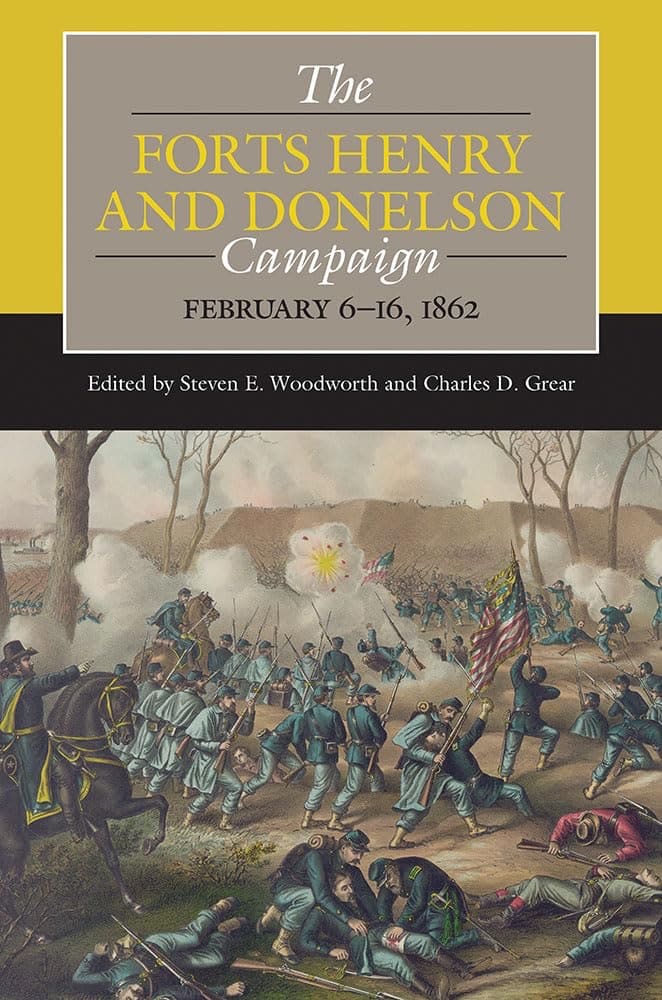
The Forts Henry and Donelson Campaign: February 6-16, 1862. Edited by Steven E. Woodworth and Charles D. Grear. Carbondale: Southern Illinois University Press, 2026. Softcover, 164 pp. $24.95.
Reviewed by Thomas M. Grace
For a number of years now, students in my Civil War and Reconstruction course have benefited from reading Steven E. Woodworth’s This Great Struggle: America’s Civil War.[1]It is a spirited, Western-theater-centric text that they find engaging and easy to comprehend.
In Woodworth’s latest entry to the field, The Forts Henry and Donelson Campaign: February 6-16, 1862, co-edited by regular and fellow contributor Charles D. Grear, they turn their attention to the twin Confederate defeats that the volume’s essayists, and virtually all historians of the conflict, agree doomed rebeldom. Woodworth’s concise introduction establishes that loss of the forts “was the turning point of the war.” (3)
These two February 1862 battles, the first fought on the Tennessee River, and the second on land and on the Cumberland River, have not lacked the attention of historians, including definitive treatments authored by Benjamin Franklin Cooling and Timothy B. Smith.[2] However, editors Woodworth and Grear show that they, and five other contributors to this series, “Civil War Campaigns in the West,” have much to add to the existing scholarship.
Opening the collection, and building on the work of environmental scholars, former National Park Service historian Michael Burns asserts “that nature influenced the progress and outcome” of the battles. His illuminating article “Natural Chaos,” explores the effects of the region’s dominant waterways. Burns also cites the terrible winter conditions endured by enlisted men of both armies, and how weather limited the strategic choices of U.S., but especially, Confederate generals. (8) Indeed, Burns points to the heavy rains and the resulting high water that flooded and rendered Fort Henry indefensible, and which overflowed streams and interfered with retreat routes from Fort Donelson. Combined with the abrupt temperature fall of nearly sixty degrees Fahrenheit, Burns concludes that “water” affected “the outcome of each operation” (19) and swayed the thinking of the vacillating rebel commanders as they debated the wisdom of a breakout from Donelson amid awful conditions.
In a segue piece “Joint Command,” educator Blakeney K. Hill gives the complicated backstory of the construction of the U.S brown-water navy, without which neither fort could have been taken. Hill, taking issue with some historians, credits Lincoln’s first secretary of war, the widely discredited Simon Cameron, with establishing a unified command system that integrated army and navy operations and led to the surrender of the river forts. The author may have overlooked the pioneering work of John D. Milligan, Gunboats Down the Mississippi, a monograph that would have helped to inform and confirm his discussion of Cameron’s role.[3]
In the anthology’s longest contribution, Jonathan M Steplyk organizes his account of the land battle for Fort Donelson around the theme of surprise and security. Steplyk argues, as do other historians, that U.S. Grant, the Federal army commander at the battle, succumbed to overconfidence, thereby being surprised by the morning assault of February 15 launched by Confederate General Gideon Pillow. At the same time, by attending to basic security needs, Federals “blunted Confederate surprise but did not thwart it.” (76) Grant, the Union’s preeminent offensively minded general, ultimately prevailed by ordering counterattacks, including an assault against the Confederate right. Having little regard for the widely criticized Pillow, Grant despised his enemy strategically but failed to take him seriously tactically. Grant compensated for his momentary inattentiveness. The aggressive thrusts he ordered by General C.F. Smith helped seal the fort’s fate.
“C.F. Smith’s Attack at Fort Donelson,” Woodworth’s own clearly written contribution, credits the former regular army lieutenant colonel for acting with alacrity and tactical innovation, comparing the successful ten-regiment advance, which included the 2nd Iowa as the spearhead, with Emory Upton’s better known 1864 assault at Spotsylvania Courthouse, Virginia. Smith’s effective onslaught, made over hundreds of yards of thick underbrush, across undulating terrain, impelled the Confederate command of Pillow and John Floyd to capitulate. The pair passed military authority for the surrender of the garrison to General Simon Buckner and fled east to Nashville.
Additional essays by Grear, about how Texas reacted to the capture of Fort Donelson, Sheilah R. Elwardani, whose contribution concerns the role of Confederate Brigadier General Gabriel Wharton in the battle, and Brian S. Wills, who writes of the escape of Nathan Forrest’s Tennessee cavalry from the nearly encircled fort, round out the volume, the eighth in the series. I noticed only one error. Wills’s piece on Forrest mistakenly lists Columbus, Mississippi when he meant to refer to the river bastion of Columbus, Kentucky. (43)
While there is some unavoidable overlap, the essays all serve to better inform students about these pivotable battles that opened the way into the southern heartland. The collection includes notes and is enhanced by four maps, photos of various commanders, and several wartime engravings.
Thomas M. Grace earned a BA in History from Kent State University and a PhD in History (2003) from the State University of New York (SUNY) at Buffalo. His principal area of interest is the American Civil War. He has lectured widely, has taught at Cornell University ILR program (Buffalo), D’Youville University, and SUNY/Erie and authored Kent State: Death and Dissent in the Long Sixties (UMass Press, 2016). He is editing a nearly completed manuscript on the 98th Ohio, tentatively titled, Citizens and Soldiers of the Upper River Valley. His articles and reviews have appeared in The Nation Magazine, America’s Civil War, The Register of the Kentucky Historical Society, Ohio Valley History, the Civil War Monitor, Civil War News, and the Journal of American History.
[1] Steven E. Woodworth, This Great Struggle: America’s Civil War (Lanham, MD: Rowman & Littlefield Publishers, 2011).
[2] Benjamin Franklin Cooling, Forts Henry and Donelson: The Key to the Confederate Heartland (Knoxville: The University of Tennessee Press, 1987); and Timothy B. Smith, Grant Invades Tennessee: The 1862 Battles for Forts Henry and Donelson (Lawrence: University Press of Kansas, 2021). Other book-length examinations of these battles by historians include Stephen D. Engle, Struggles for the Heartland: The Campaigns from Fort Henry to Corinth (Lincoln: University of Nebraska Press, 2001); Spencer C. Tucker, Unconditional Surrender: The Capture of Forts Henry and Donelson (Abilene, Tx: Mc Whiney Foundation Press, 2001); and Kendall Gott, Where the South Lost the War(Mechanicsburg, Pa: Stackpole Books, 2003).
[3] John D. Milligan, Gunboats Down the Mississippi (Annapolis: United States Naval Institute, 1965).


I enjoyed this review but am skeptical of the claim that “virtually all historians of the conflict” agree that the fall of Forts Henry and Donelson “doomed rebeldom.” That’s quite a claim, considering the fact that the war continued on for another three years and some change. I have heard this argument before, but am surprised to hear it’s so ubiquitous.
I would say the falls of Forts Henry and Donelson, although not a kill shot to rebeldom, were a serious and permanent dismemberment of it.
Ehhh … I think if more had gone right for the Confederacy in the Western Theater, this would not appear to be as much of a setback. If the Confederacy had won a decisive victory at Shiloh for example, and Grant’s army was effectively destroyed, would the loss of Forts Henry and Donelson even matter?
M.A. — I agree with you, I was just describing what actually happened. The Confederates never again controlled the Tennessee and Cumberland rivers, and Nashville. These places, like New Orleans, were dismembered from the Confederacy for good.
The nature of the war in the Western and Trans-Mississippi could have been different if the Confederates had deflected Grant at either Forts Henry and Donelson (which they possibly could have), at Shiloh, or at Pea Ridge where they outnumbered the Union force. It’s a lot of coulda, woulda, shoulda in 1862 out West for the Confederates and they had a multitude of problems (poor organization, poor leadership, logistical and manpower issues, etc.) that contributed to their inability to deflect Grant at Donelson (could have happened, I think), deflect or crush him at Shiloh (not likely to happen in my opinion, but we’ll never know), or a victory at Pea Ridge (really should have happened, in my opinion).
Excellent review that just caused me to put this book on my birthday suggestion list for my children to give me. Like M.A., I was struck by the same comment and the claim that the fall was “the” turning point of the war. While certainly a turning point, many would argue that Antietam, Gettysburg, Vicksburg, Atlanta (others?) were also turning points. I will be interested in reading Mr. Woodworth’s explanation.
Can a Turning Point be something other than a battle?
In the West, the first serious threat to Confederate expansion was Lyon’s capture of Camp Jackson in May 1861 near St. Louis in Missouri. The second significant event was U.S. Grant’s occupation of Paducah Kentucky in September, virtually ending the northerly expansion of the Confederacy to the natural boundary of the Ohio River. George H. Thomas subsequently broke the Confederate Defensive Line [which ran west from Cumberland Gap to Fort Columbus] via the Battle of Mill Springs in January 1862. And U.S. Grant conducted a joint operation with Foote’s gunboat flotilla in February 1862 that drove the Confederates southward…and allowed Foote’s gunboats to operate in enemy territory as far south as Muscle Shoals Alabama. Virtually the beginning of the end.
I glad to see that C.F. Smith, one of my favorite figures in the CW is highlighted. He died in a stupid accident. I believe that if he had lived, he would have played a prominent part on the Union army.
You’re probably right. He was a good man and excellent officer. Grant’s team would have been even more potent.