War Is Hell, But Even Hell Has Rules: Raising the “Black Flag” Per the Lieber Code
This post is part of a series.
Consistent with the benign principles we saw expressed by certain sections of the Lieber Code[1] discussed in prior posts, in this post we explore how the Code expressly promised humane treatment to any helpless enemy, including those captured, as well as the wounded. Yet, as we also have seen, on occasion the Lieber Code undermined its own supposed benevolent nature by adding exceptions to its high-sounding principles. This post explores more of these contradictions.
Article 67.
The law of nations allows every sovereign government to make war upon another sovereign state, and, therefore, admits of no rules or laws different from those of regular warfare, regarding the treatment of prisoners of war, although they may belong to the army of a government which the captor may consider as a wanton and unjust assailant.
Article 71.
Whoever intentionally inflicts additional wounds on an enemy already wholly disabled, or kills such an enemy, or who orders or encourages soldiers to do so, shall suffer death…
Article 75.
Prisoners of war are subject to confinement or imprisonment such as may be deemed necessary on account of safety, but they are to be subjected to no other intentional suffering or indignity…
Article 76.
Prisoners of war shall be fed upon plain and wholesome food, whenever practicable, and treated with humanity…
Article 79.
Every captured wounded enemy shall be medically treated, according to the ability of the medical staff.
Comment: These provisions collectively promised humane treatment to helpless enemy, including POWs. These articles support the idea of the Lieber Code fostering the waging of a civilized war. But, as shown in other parts of the Code discussed below, the trick to obtaining such humane protection was whether U.S. forces would deign to take prisoners in the first place. Certain provisions of the Lieber Code made that result questionable, at least in certain circumstances.
Article 60.
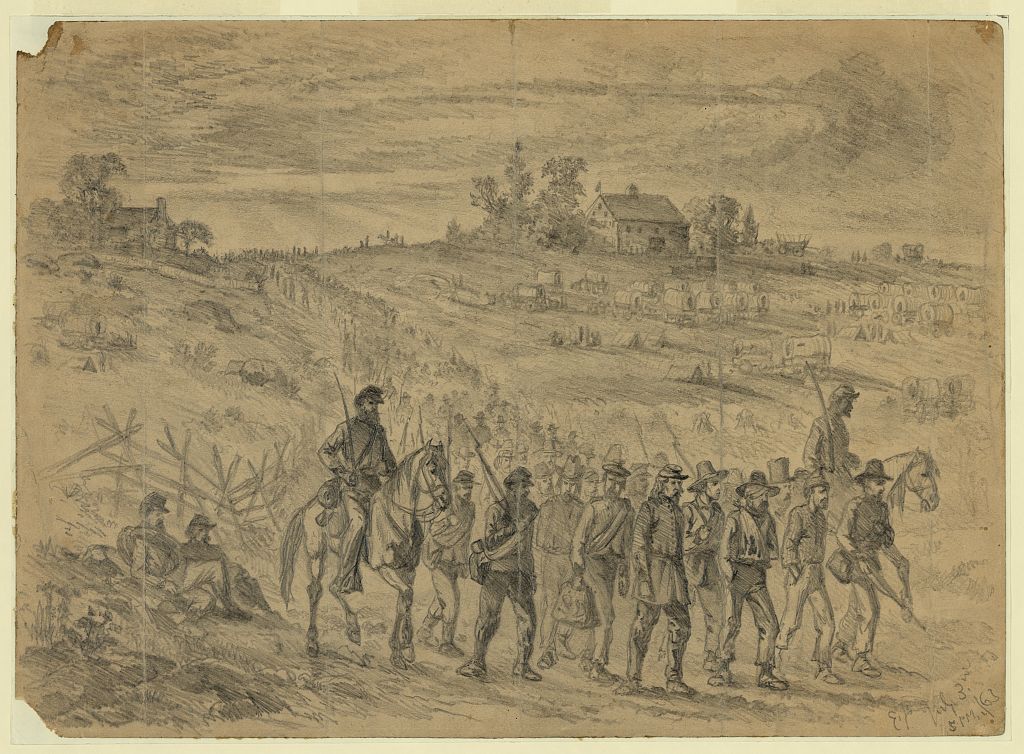
It is against the usage of modern war to resolve, in hatred and revenge, to give no quarter. No body of troops has the right to declare that it will not give, and therefore will not expect, quarter; but a commander is permitted to direct his troops to give no quarter, in great straits, when his own salvation makes it impossible to cumber himself with prisoners (emphasis supplied).
Comment: Pursuant to this Article, a commander could order his troops to give no quarter if in the officer’s judgment it was neither practical nor wise to take prisoners. This presumably gave license, for example, to a calvary force raiding behind enemy lines simply to kill all who stood in its way, even if a surrender were offered.
This article also might justify the killing of those trying to surrender to any U.S. unit that was cut off and threatened with annihilation or capture, or even one operating at great risk behind enemy lines. Would this Article have justified William T. Sherman refusing to take prisoners while on his risky March to the Sea,[2] or Ulysses S. Grant adopting the same course while he had flung himself deep into Confederate territory at the outset of his final Vicksburg campaign? Why did the Lieber Code not simply direct U.S. commanders who could not afford to be encumbered with prisoners to take the enemy’s parole and let them loose?
Article 61.
Troops that give no quarter have no right to kill enemies already disabled on the ground, or prisoners captured by other troops.
Comment: This is one of the odder articles contained within the Lieber Code. As noted, Article 60 permits a commander to “direct his troops to give no quarter,” i.e., to take no prisoners, killing all enemy before them. Yet Article 61 forbade the killing of any enemy “already disabled on the ground.” Hence, apparently it was permissible to shoot a Confederate who had raised his hands in surrender, but not to finish him off if he fell to the ground only wounded.
Moreover, under Article 60 a commander was only permitted to give a no quarter order “in great straits, when his own salvation makes it impossible to cumber himself with prisoners.” When could such a situation involve “prisoners captured by other troops,” who presumably were not simultaneously “in great straits”? What did the phrase “other troops” even mean? Could the commander of one regiment in a column order no quarter, while another regimental commander with the same force enforce a different decision?
Article 62.
All troops of the enemy known or discovered to give no quarter in general, or to any portion of the army, receive none.
Comment: The phrase “or to any portion of the army” would implicate Confederate soldiers who generally took prisoners, but refused to give quarter to U.S. Colored Troops.
Article 66.
Quarter having been given to an enemy by American troops, under a misapprehension of his true character, he may, nevertheless, be ordered to suffer death if, within three days after the battle, it be discovered that he belongs to a corps which gives no quarter.
Comment: Article 62 allowed an order of no quarter to be given against CSA soldiers known to have given no quarter to, among others, African Americans soldiers. This Article could have been applied to Nathan Bedford Forrest’s men (due to their actions at Fort Pillow), or to William Mahone’s men (for conduct during the battle of the Crater).
In addition, an enemy could be put to death—even belatedly— based not on his own established individual misconduct, but “guilt by association,” that is, “he belong[ed] to a corps which gives no quarter.”[3] Nor was there any stated requirement that the condemned soldier be given any type of hearing before his execution.

Summary: The Lieber Code Articles discussed herein provide a mixture of the humane and the brutal. On the one hand, generally all helpless enemy were to be treated with reasonable compassion, being allowed to surrender without harm and then afforded good treatment including a guarantee of proper food. Moreover, the wounded were to be protected from further harm and provided with medical treatment.
Yet the Code held out the prospect of raising the “black flag” in a number of situations, even with respect to soldiers who already had been taken prisoner. The Lieber Code almost seems to present itself as having multiple personalities.
[1] The War of the Rebellion: A Compilation of The Official Records of The Union and Confederate Armies, Series III, Vol. 3 (U.S. Government Printing Office, Washington, D.C., 1880 – 1901), pp. 148 – 164. See e.g., Code, Article 15 (“Men who take up arms against one another in public war do not cease on this account to be moral beings, responsible to one another and to God”).
[2] While today the success of Sherman’s March to the Sea seems inevitable, at the time it was perceived by Abraham Lincoln as a terrible risk. Lincoln even included in a draft of his December 6, 1864 Annual Message to Congress an assurance directed to the Northern public that the Union cause could “if need be, survive the loss of the whole detached [Sherman’s] force…” Noah Andre Trudeau, Southern Storm: Sherman’s March to the Sea (Harper Perennial, New York, 208), p. 360.
[3] The Lieber Code was not the first time a no quarter, or “black flag” policy was raised. In 1861 Thomas J. “Stonewall” Jackson had urged adoption of such a policy, although he later retracted the proprietary of such an approach. James I. Robertson, Jr., Stonewall Jackson: The Man, The Soldier, The Legend (New York, MacMillian Publishing USA, 1997), pp. 234-235, 514-515.


Very interesting analysis as always. I find that some of these provisions are almost impossible to enforce. For example, articles 62 and 66 – who’s discretion is it when determining whether or not the enemy previously “gave no quarter”? In your examples of Fort Pillow and the Crater – did officers give those men orders to fire on wounded USCT, or did some of the men do so on their own? If the men acted on their own, would the articles still apply? It leaves a huge amount of room for interpretation. Are you aware of any further commentary on this policy? Or were there ever any military trials related to officers who tried to justify no quarter under the Lieber Code but were subsequently found to be in the wrong?
Certainly these rules leave much to individual (officer) interpretation. And the Code does not specify at what level of command a no quarter order must issue.
There still is controversy over Fort Pillow and who was responsible for what happened there. I never have looked into the source of the Crater atrocities. And no, I am not aware of anyone actually relying expressly on the Code and ordering no quarter. That is part of the problem in tracking down who relied on the Code. When an officer in, say, 1864, claims that his action is justified by the “laws of war,” is he referring to the generic laws of war or the Lieber Code specifically?
All great questions
Thanks Kevin — more good stuff.
You’ve got an interesting 21st-century take on regulating warfare … however, I believe both Vattel and Lieber would disagree with your premise that there is a genuine contradiction between humane benevolence and harsh violence … Lieber’s purpose was not to draft an aspirational charter of philanthropy, but to establish pragmatic, enforceable limits around the conduct of war— translating Vattel’s 18th-century Law of Nations treatise into binding positive law for United States soldiers in the field.
Within their shared tradition, humane restraint and sharp measures are not at odds with one another, but serve as the left and right guardrails of military behavior: banning senseless violence stops an army from degenerating into an undisciplined mob, while authorizing harsh necessity and retaliation forces the enemy to respect the laws of war … far from displaying a “split personality,” General Order No. 100 was a unified, hardheaded effort to keep battlefield violence within defined legal boundaries.
I agree with you 1000%
I disagree. What I’ve seen so far is a code that is so vague it can be interpreted (or stretched) to fit any situation. It’s up to the commander on the field to decide whether the code’s guardrails apply. I can easily see a situation in which, if both sides follow this code, articles 62 and 66 lead to a spiral of brutal retaliations. All it takes is one side to give “no quarter” or be perceived to have given no quarter (again, it’s unclear when this applies) to allow the other side to retaliate, which then gives permission to the other side to retaliate against them, etc., etc., and then suddenly “no quarter” becomes the status quo. It’s a good thing neither side really followed this, honestly, or the war would have become very brutal indeed.
“It’s a good thing neither side really followed this, honestly, or the war would have become very brutal indeed.” – yes, and that was Lieber’s point of codifying the widely understood international law of military retaliation. Retaliation limits the violence of warfare by forcing the side first considering a violation of the law of war to consider what the result would be if they take such a heinous action. The United States would have been well within its rights to authorize retaliation against the Confederacy for their extra-juridical murder of Black soldiers (which is even mentioned specifically in the Lieber Code), but the U.S. government never acted on that policy for fear of what the consequences would be on the battlefield. The Code worked as it was intended, even though it was at the expense of justice for Black soldiers. Another example: in late 1861 (if I recall right) Lincoln threatened to hang a captured rebel captain from the privateer Savannah as a pirate, but when Davis announced the Confederate government would execute a like number of U.S. officers, Lincoln backed down. Another example, in 1863, Lincoln threatened to execute captured Confederate officers in retaliation for against any U.S.C.T officers who were hanged in accordance with the Confederate government’s policy of treating such officers as persons inciting a slave insurrection. The Confederate government backed down and never implemented that policy, at least officially. It was essentially the Cold War idea of M.A.D. for the 19th century. the Aaron Sheehan Dean’s book, “The Civil War and the Limits of Destruction” is a good introduction to the topic of retaliation. Hope that is helpful!
Thanks, M.A. … I’m a little unclear on what you are disagreeing with, because the hypothetical spiral into “no quarter” you describe is the exact lawless outcome the Lieber Code was written to prevent.
A few quick points of reality from the text and the 19th-century battlefield:
Guardrails do not remove commander discretion; they define its limits ….every operational code from 1863 to modern Rules of Engagement relies on commander judgment … Lieber’s contribution was establishing that a commander’s discretion is not boundless …. it is legally bounded by positive law.
The Code explicitly stopped the retaliation spiral ….Articles 62 and 66 did not give a blank check for revenge … Article 27 explicitly states that retaliation must never degenerate into mere vengeance, and Article 28 requires caution and specific authorization … without codified limits on lex talionis, retaliatory violence in a brutal civil war truly becomes limitless.
Operational judgment is not a loophole …. to your point about vagueness, no field order can—or should—attempt to pre-script every split-second tactical decision on a chaotic battlefield. … militaries rely on the professional judgment and character of its officers to interpret and apply General Orders to realities on the ground … they provide the broad operational guardrails, and the commander exercises discretion within those bounds …. that isn’t “stretching the code to fit any situation”… it is the fundamental nature of command … the Lieber Code didn’t eliminate officer judgment … it ensured that judgment was hemmed in by enforceable legal boundaries rather than unchecked personal whim.
The historical record disproves the premise that “neither side followed this” … that claim ignores why Lincoln commissioned it in the first place — specifically to establish a legal framework to protect captured Black Union soldiers from Confederate threats of enslavement or summary execution (e.g., Lincoln’s Order of Retaliation) …. far from being ignored, General Orders No. 100 became the global foundation for the Hague and Geneva Conventions precisely because 19th-century armies recognized it as an effective, practical restraint on total barbarism.
Codifying the harsh realities of war alongside its limits isn’t an invitation to brutality—it is the only mechanism that keeps an armed conflict from descending into mutual annihilation.
I don’t know enough about military law to really continue this conversation with you guys, unfortunately. I’m looking at this from a purely layperson point of view
For M.A. Kleen, I am a layperson as well — just an older one 🙂 … but you raise just the sort of questions that a young Civil War company commander or senior NCO might ask when given a copy of the Lieber Code … and then told by his Colonel to read it, understand it, and ensure his soldiers conducted themselves accordingly … much more complex than any general order we would give soldiers today.
Excellent discussion, both in the post itself and the comments. Can only add that little has changed in 160+ years. When I attended Infantry Officers courses at Ft. Benning in the 1980s, we fussed over the same issues. There are no longer issues of black troops. But, in the 1980s and still today, Army officers fuss over who is an enemy combatant and who is not all the time. The problems and the rules are centuries old. Much depends on the quality and character of the officers and NCOs.
Tom