Book Review: Mercy in Disaster: Abby Hopper Gibbons’s Journals and Letters from Four Years of Civil War Nursing

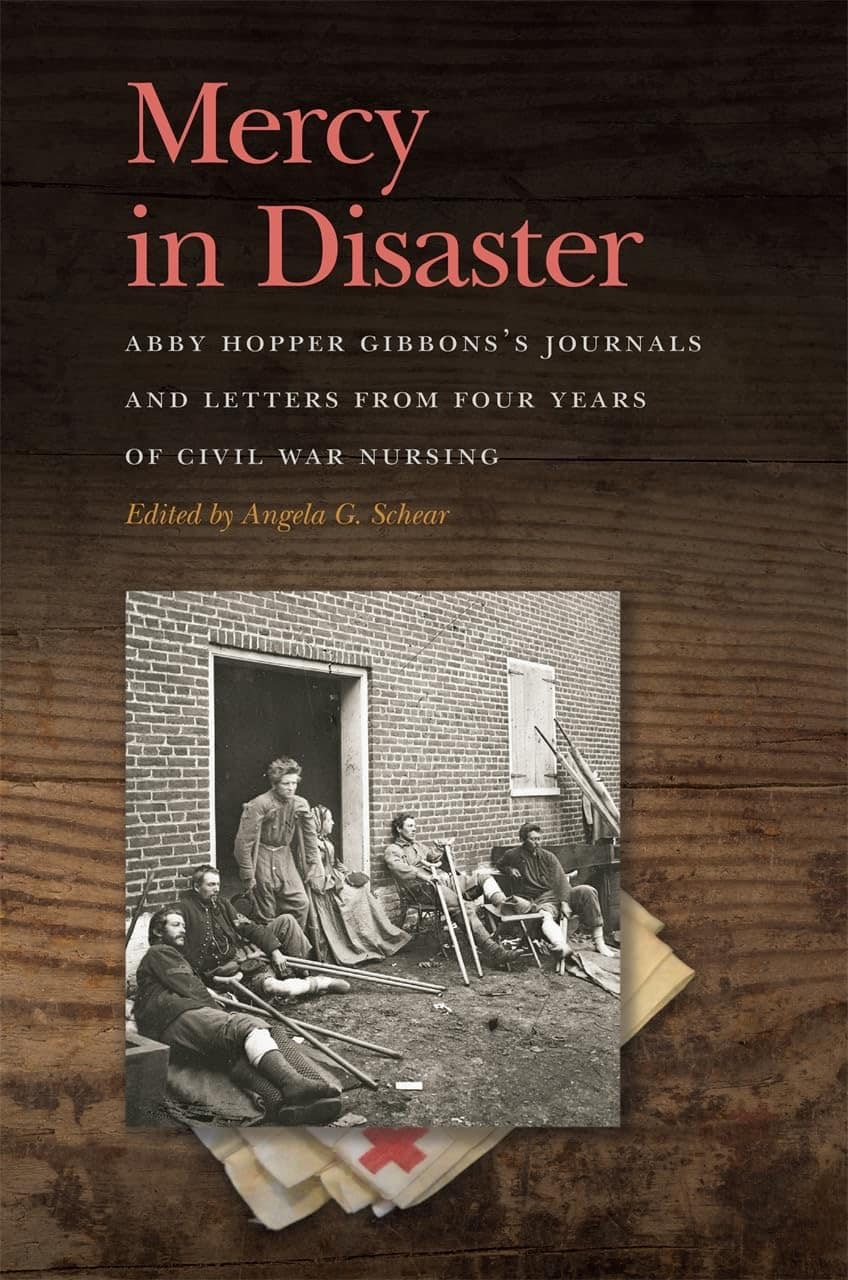
Mercy in Disaster: Abby Hopper Gibbons’s Journals and Letters from Four Years of Civil War Nursing. Edited by Angela G. Schear. Athens, GA: University of Georgia Press, 2026. Paperback, 312 pp. $29.95.
Reviewed by Brianna Frakes
Photography is perhaps one of the greatest tools Civil War enthusiasts have. It helps us today to visualize what the war and the people who fought in it looked like, bringing to life the real tragedy and horror of the nation’s bloodiest conflict. One photograph in particular—found on the cover of Mercy in Disaster—provides a unique window beyond the battlefield’s front lines, revealing some of the deeply human stories that enrich our understanding of the Civil War’s reach and lasting impact.
Many readers and Civil War enthusiasts are likely familiar with this 1864 photo of wounded soldiers posing with crutches and their injuries from the battles of the Wilderness and Spotsylvania Court House. Seated among them in the background is an unassuming woman with a canteen on her lap, recently identified as Abby Hopper Gibbons. She is the focus of Mercy in Disaster, a compelling and informative edited work of Gibbons’s Civil War letters and journals. The book’s editor, Angela Schear, is herself a Gibbons descendant. Schear works diligently to bring Gibbons’s experience during the war years to life as she traces her journey and thoughts through Gibbons’s well documented written record.
Organized into eleven chapters that follow the chronology of the Civil War, Schear takes us into Abby Gibbons’s world, allowing her own words to narrate her story and experiences. She was born in Philadelphia in 1801 to a Quaker family. It was in this context that Abby likely gained a passion for fairness, equality, hard work, and persistence in accomplishing and fighting for justice. Described as more of an organizer than an activist, Abby was an active participant in several social reform movements prior to the Civil War, notably the Women’s Prison Association (WPA) and educational and school reform for German immigrants. She also was invested in the abolitionist movement and emancipation efforts, owing in part to her father’s commitment to emancipation and her husband’s (and ultimately her) participation in anti-slavery societies and conferences.
Gibbons had a proclivity for doing the necessary work to enact change and improve lives, while choosing not to involve herself in the political sides of reform movements. In this sense, she found herself assisting in places that needed real help, sometimes far away from the spotlight campaigns and events of the Civil War. Two notable moments were her time in Winchester, Virginia, in 1862, and at Point Lookout, Maryland, in 1862 and 1863.
After the First Battle of Kernstown in the spring of 1862, Abby traveled to Winchester to help the small town’s stretched resources in caring for the hundreds of Union casualties. It also provided her with a crucial opportunity to meet and engage with the Union wounded as well as free and enslaved Blacks in western Virginia. This moment spoke to her lifelong commitment both to humanitarian efforts and advancing the cause of freedom.
Her time at the Point Lookout hospital complex—Hammond General Hospital—exposed, in many ways, her fervor for helping those in actual need and the challenges faced in doing so. During her roughly twelve-month service at Point Lookout (she served this in three non-consecutive stints), Gibbons documented the gender dynamics of the hospital with its male doctors and the place of women on the medical front lines. Perhaps most notable were her run-ins and disagreements there with Dorothea Dix. Both women vied for control over the hospital, and ultimately Gibbons left Point Lookout in the fall of 1863 because of Dix.
Abby’s time in both places and her writings on her experiences there provide important windows into several key themes that historians have focused on with greater attention in the past several decades: humanitarian efforts and their intersection with war; the evolving role of women on the homefront and the battlefront, and those caught in the nexus of the two; the on-the-ground efforts of the abolitionist movement; and growth of medical care in the mid-nineteenth century. Her extensive writings help us understand today a more personal side of the war and the impact of a single individual on these broader topics.
Mercy in Disaster is an important and useful firsthand account of the war years, told through Abby Hopper Gibbons’s own words. Scholars, enthusiasts, and those seeking to learn about the Civil War through an individual’s experience will find this book useful. The annotations throughout the chapters are helpful, identifying the people, places, and events mentioned and abbreviated, allowing the reader to capture a fuller picture of Gibbons’s observations and impressions. The brief introductions to each chapter provide a general overview of the primary texts’ topics, although this reader would have liked some greater framing of how Abby’s experiences fit within the larger context of the war, the Union’s emancipationist efforts, and the broader social reform initiatives across and throughout the Union and Confederacy. This would provide a stronger and deeper interpretation of Gibbons’s lasting importance to the Civil War era and make a more robust case for why she was described after her death as “one of the most remarkable women of the century.” (2) Overall, though, this book will be a worthy addition to many of Emerging Civil War readers’ libraries.
Brianna Frakes is an historian of the Civil War era and an assistant professor in the Salmon P. Chase Center of the Ohio State University. She received her Ph.D. in history from the University of Virginia. Her first book, No Safety for Union Men, examines the on-the-ground experience and evolution of Union military occupation in Virginia during the Civil War and Reconstruction years and will be published by Fordham University Press.


It is fascinating the details these photographs hide. I’ve seen this one many times and it never occurred to me to wonder who the woman was – turns out she has an incredible story. Thank you for highlighting this.