Book Review: Many A Hand: Michigan and the Civil War

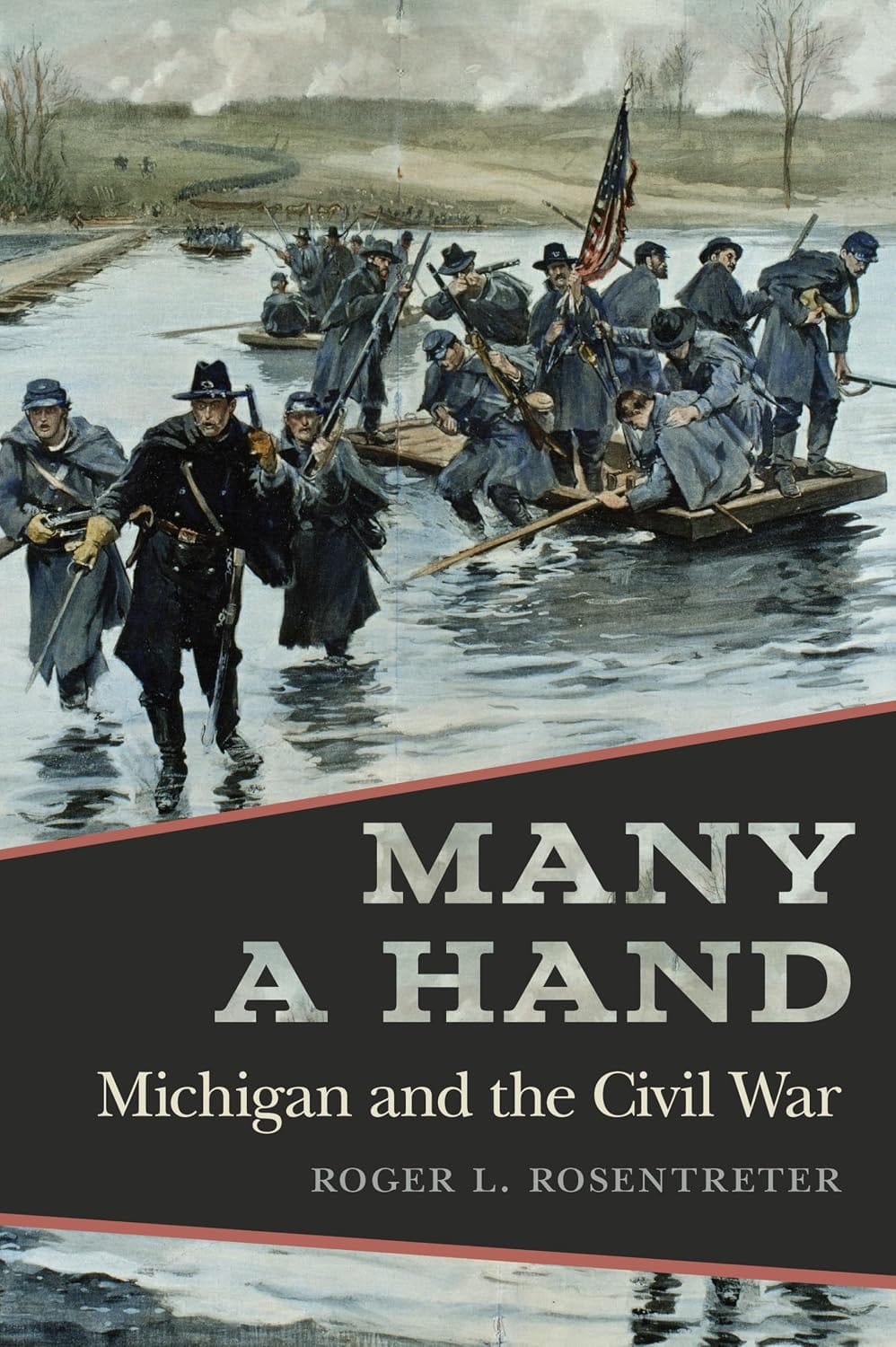
Many A Hand: Michigan and the Civil War. By Roger L. Rosentreter. East Lansing: Michigan State University Press, 2026. Paperback, 392 pp. $39.95.
Reviewed by Mark Hoffman
Several important books about Civil War Michigan have been published in recent years. Some of them broadened our understanding of the role of African American and Native American soldiers from Michigan, introduced us to new voices of everyday life during the war, documented key Michigan routes and figures along the Freedom Trail, or highlighted the role of Detroit in the Civil War era. Several others focused on the role of specific Michigan communities or key military and political figures from Michigan.
Until now, however, we lacked a broader modern account of how the men and women of Michigan endured four difficult years of war. Fortunately, Roger Rosentreter has filled that void with a well-researched and written book about the experiences of Michiganians during the Civil War. He makes a convincing case that they produced “an enduring legacy both at home and on the battlefield.” (xiii)
As expected, much of the book focuses on military operations and Michigan’s military units. Rosentreter describes the service of some of the most famous, including the Michigan Cavalry Brigade, the 24th Michigan Infantry, and the 4th Michigan Cavalry. He also places the spotlight on other important units that are less well known today. I particularly enjoyed chapters on the 25th Michigan Infantry at Tebb’s Bend (defending against Brig. Gen. John Hunt Morgan’s 1863 raid) and the contributions of Michigan’s special units such as sharpshooters and engineers.
The author’s greatest contribution with this book, however, might be the inclusion of the many other aspects of Michigan’s experience during the war. For example, Governor Austin Blair is highlighted for his leadership in rallying the state to the Union cause in 1861 and through the difficult years that followed. The chapter describing the long struggle of Michigan African Americans to be accepted as soldiers is particularly well done. The important experiences of Michigan women–both soldiers and civilians–are well-documented and Rosentreter emphasizes the often-overlooked leadership role many had in relief efforts. Interestingly, a chapter even highlights a Michigan military officer’s role in efforts to reduce the incidence of venereal disease among Union soldiers in Nashville, Tennessee.
Rosentreter also includes war-time accounts of little-known Michiganians. Among the most interesting is the service and death of sailor William Gowin of the USS Kearsarge during its famous battle with the Confederate raider CSS Alabama. Readers will also greatly appreciate the chapter on how Michiganians reacted to the assassination of President Abraham Lincoln, as well as Michigan connections with the resulting capture and execution of the conspirators.
Overall, the author provides a powerful description of how men and women from Michigan contributed to Union victory. Primary sources provide rich accounts that are put into context through skillful narrative. This approach provides an informative and readable account.
There is a difficult balance when writing a book that is accessible to the general Civil War community and also provides new information or interpretation for the more informed audience. Roger Rosentreter’s latest work is an excellent example of succeeding in both endeavors and is a very welcome addition to the bookshelf of students of both Michigan history and the Civil War.
Mark Hoffman is a retired government administrator, including eight years as deputy director and acting director of the Michigan Department of History, Arts and Libraries. He is a life-long student of the Civil War and author of “My Brave Mechanics”: The First Michigan Engineers and Their Civil War (Wayne State University Press, 2007) and Among the Enemy: A Michigan Soldier’s Civil War Journal (Wayne State University Press, 2013).


Michiganders were hard fighters and earned the nickname “wolverines” well. But did the author talk about the political situation at home? Did most of Michigan support the war or was there a strong Copperhead contingent? I always assumed it was solidly Republican but I’ll admit I haven’t read much about the state.
Was the 10th Michigan Infantry mentioned? I have a distant cousin who was a Captain in that unit and would love to learn more about his and the unit’s service.
Oh wow, I had Professor Rosentreter for Michigan history at MSU back in 1997 or ’98! He was an AMAZING professor — that was one of my favorite classes there. Can’t wait to read this!