Echoes of Reconstruction: Senator Ben Tillman Explains Why the Vote Was Taken Away from African Americans in South Carolina
Emerging Civil War is pleased to welcome back Patrick Young, author of The Reconstruction Era blog.
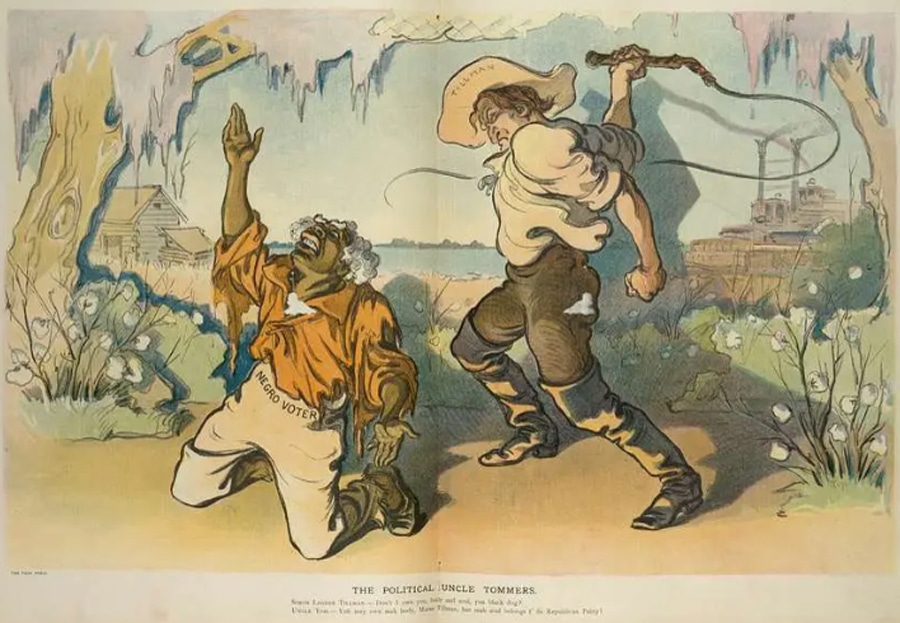
Benjamin Tillman, better known as “Pitchfork Ben,” was a former Confederate who had risen to prominence as one of the most ruthless partisans of white supremacy in the whole country. Tillman was elected governor of South Carolina and later became a senator from the same state. In a speech in 1903, Tillman sketched out his involvement in the violent suppression of the Black vote when he was in his twenties as a member of the Red Shirts, a secret white supremacist underground. The Red Shirts were allied with former Confederate Lt. Gen. Wade Hampton in his successful campaign for governor in 1876. In his speech at a Red Shirt reunion, Tillman recounted being involved in four “riots” in which his followers beat and killed Blacks to keep them from voting during the election of 1876. The Red Shirts were not trying to hide their terrorism in 1903, they were proud of it.
Senator Tillman made a speech in the Senate in 1900 in which he explained how the white minority had deprived the Black majority of South Carolina of their right to vote under the 14th and 15th Amendment. Tillman’s remarks can be found in the Congressional Record beginning at page 3218.
In his 1900 speech, Tillman is taking Republican Senator John Spooner to task over Spooner’s claim that the Civil Rights Act and the 14th Amendment and related laws were passed when the Black Codes were legislated at the former Confederate state level to prevent Blacks from being recognized as citizens. These Black Codes were passed by all-white legislatures in the immediate aftermath of the collapse of the Confederacy in 1865 to maintain white control over the Black population.
Senator John Spooner was a teenager when the Civil War broke out. By the time he was 20 years old, Spooner was a captain commanding a company in the 50th Wisconsin Volunteer Infantry. By the 1890s he was in the political ascendancy in Wisconsin. A lawyer, he was considered to be one of Congress’s leading experts on the Constitution. He lent his voice towards protecting the limited civil rights of Blacks.
Tillman’s response to Spooner’s objections to taking away the right to vote from African Americans says that stuffing the ballot boxes was the only way for the white minority to claim superiority over the Black majority.
The words below are from Tillman’s argument in the Senate on March 23, 1900 with my commentary: “I will, briefly…recapitulate the conditions which brought about the necessity for stuffing ballot boxes, for shooting negroes, and for using violence and fraud in taking charge of our State government in South Carolina. The Senator, I suppose, did not understand me to say that such conditions exist there now, because I have never made any such acknowledgment. not help it; and no legislation which can be enacted can help it.”
Tillman next recounts the popular myth of “White Redemption” in which white voters “redeemed” their states from Blacks and Republicans. In states like Mississippi and South Carolina where Blacks outnumbered whites, “Redemption” took place through violent means.
“I proclaimed the fact that in 1876, when we had stood eight years of carpetbag government and there was nothing left us of our civilization unless we rose in our might and took the government back from the carpetbag horde of thieves and scoundrels and their scalawag allies, the native-born rapscallions, who had been foisted upon us at the point of the bayonet-when government ceased to yield protection, when there was semianarchy, when 8,000 armed negro militia were parading up and down the roads, threatening our wives and our children and our homes, when at night burning houses were lighting up the horizon in almost every county, when the conditions were so appalling that any kind of government, any military despotism, was preferable to that, we made up our minds that the fourteenth and fifteenth amendments to the Constitution were themselves null and void; that the acts of Congress under them placing our State under carpetbag rule were null and void; that oaths required by such laws were null and void, we resolved that the intelligence, the wealth, and the patriotism of the State, belonging only to the white people, should seize the government from the horde of ignorance and vice; that we would not longer tolerate bribe-takers on the bench and thieves in our high places; that life was not worth having on the terms and under the conditions forced on us.”
Tillman takes President Ulysses S. Grant to task for using the Enforcement Act of 1870 to send a few hundred Federal troops into South Carolina to arrest violent Klansmen. Tillman states that “the whites did not hesitate…to carry the elections in any way that was found necessary.” In other words, to use fraud and intimidation to win.
“We swore by the memories of revolutionary sires that we would redeem our State from the grasp of aliens and negroes, and we did it; and I have no apologies to make for it. If you contend that no indictment of Republicans can come from South Carolina, I will tell you that the Republican party was responsible for that condition of things; I will tell you that Grant, who was then President, sent the army there to hold down the whites and perpetuate the condition of misrule and anarchy and robbery which prevailed, and where the troops were the white majorities, the Democratic majorities, were the greatest-not by reason of the presence of the troops, but because the whites did not hesitate to vote early and often and to carry the elections in any way that was found necessary.”
Tillman makes an appeal to the traditions of the South that taught that “slavery was not wrong.”
“…[L]et it not be forgotten that in dealing with the race question in the South those of the Southern people who were engaged in the civil war, the Confederate war, had inherited those slaves. They had been taught from childhood that the existence of slavery was not wrong, morally or legally. The author of the Declaration of Independence was a slaveholder; the Constitution recognized slavery; and after the strife was over and the issue had been settled by the sword, the question as to the disposition of the emancipated slaves was, of course, a very perplexing one.”
Tillman concludes by arguing that the real motive in Republicans “putting white necks under black heels” was “revenge” against the South for the Civil War and a desire to keep Republican rule intact.
“The Senator says that but for the enactment by the Southern legislatures of the “black codes,” in which there was to be a practical restoration of slavery under the guise of liberty, there would have been no enfranchisement of the ex-slaves; that they would not have been given the ballot. History does not state that, and the condition of politics at the time does not warrant it.”
“…There was first a desire of revenge by putting the ex-slaves in control of the Southern States and putting white necks under black heels. There was next a desire to perpetuate the domination of the Republican party in the United States…”


Good post. I remember seeing that cartoon before.