Book Review: Catholics, the Civil War, and the Problem of the Lost Cause

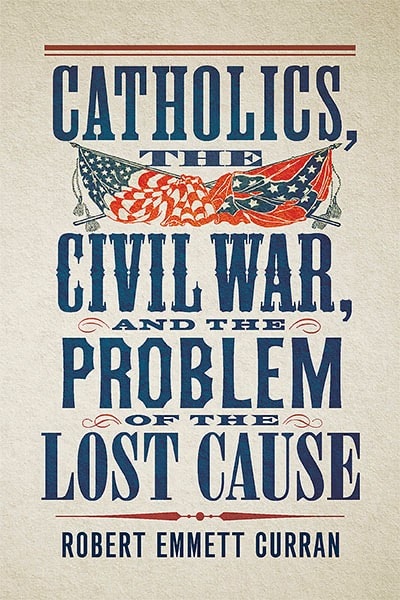
Catholics, the Civil War, and the Problem of the Lost Cause. By Robert Emmett Curran. Washington, D.C.: Georgetown University Press, 2026. Paperback, 255 pp. $34.95.
Reviewed by Max Longley
On May 15, 2026, Pope Leo XIV issued an encyclical which should catch the attention of those interested in the intersection of religion, slavery and the Civil War. I cannot summarize Magnifica Humanitas here, though I note that that the encyclical warns of “various forms of servitude directly linked to the digital economy.” Going back in time to trace the Church’s grappling with slavery, including the older chattel variety, the encyclical denounces Church leaders who were complicit in the institution, and adds: “It was only in the nineteenth century that a formal, absolute and universal condemnation of slavery was clearly articulated, notably under Pope Leo XIII.” In short, “it took eighteen centuries for [human dignity’s] full incompatibility with slavery to be explicitly recognized,” and “the memory of past complicity and blindness in the face of the injustice of slavery becomes a call to vigilance.” Whatever one might say on the theological level, on the practical level the Catholic Church’s clergy, accompanied by the laity, indeed were often complicit in chattel slavery.
The presence of slavery in the United States Catholic community often has attracted the attention of historians. And after the legal abolition of slavery, the U.S. faced the problems of racial caste oppression, in dealing with which the Catholic Church also faced challenges.
Author Robert Emmett Curran is a Georgetown University Professor Emeritus who has written multiple works focused on the history of American Catholics. Catholics, the Civil War, and the Problem of the Lost Cause addresses another aspect of that subject. Curran’s experienced scholarship is on exhibit in his first eight chapters, as he relates the pro-slavery and pro-Confederate leanings of White Catholics in the Middle South before and during the war, and the experiences of Catholics caught up in the midst of a conflict where the demand to choose sides did not always respect religious freedom. Curran further explores how after the war, though they did not originate the “Lost Cause” myth, many White Southern Catholics embraced the same.
Curran makes great use of diocesan and university archives as he sheds lights on these important historical issues. Curran focuses on Southern White Catholics in the traditional Catholic “heartland,” including Maryland and Kentucky, though scholars have shown that the growing Catholic North had its own problems with racial caste.
The ninth and concluding chapter of the book is basically about modern politics, and may be safely skipped in terms of the core target analysis of the study.
Catholic Lost Cause devotees were simply a subset of reactionary White Southerners–Catholic, Protestant, Jewish. But the most infamous contribution Catholics made to the Lost Cause was of course Father Abram J. Ryan, “the poet-priest of the Confederacy,” who Curran notes promoted Confederate nostalgia in poetry, journalism, and in quasi-barnstorming travels. Curran also identifies some additional neo-Confederate clerics who were not as flamboyant as Ryan. I could not find in Curran a reference to the most infamous of the Catholic neo-Confederates (next to Fr. Ryan): Virginia politician Anthony Michael Keiley and his younger brother Benjamin Joseph Keiley, bishop of Savannah, Georgia. The Keiley brothers gave many a pollical speech promoting the Lost Cause. The Bishop even bashed Teddy Rooevelt for dining at the White House with a Black man (Booker T. Washington). They would have made interesting copy for Curran.
Curran focuses on the bad stuff–the Catholic racists. He does not discuss other kinds of events, like this. But that is part of the limitation of the subject matter.
In sum, however, this book is an important contribution to the history of the interaction of Catholicism with slavery and racial injustice in America before, during and after the Civil War. Although even after Professor Curran’s fine research, it is clear there is still more discussion and analysis to be done.


If the premise is that there’s something about Catholicism that made Catholics uniquely supportive of slavery and racially prejudiced, that is a wild claim. It seems more likely that if a majority in a certain region supported or opposed slavery, than a majority of Catholics in that region shared those beliefs. For its part, the Catholic Church has, throughout history, condemned chattel slavery and taught that, where slavery exists, for the enslaved to be treated with dignity and afforded human rights. In 1435, Pope Eugene IV issued Sicut Dudum, calling for inhabitants of the Canary Islands to be freed from slavery. In 1537 Pope Paul III issued Sublimis Deus, condemning the enslavement of native peoples. In 1639 Pope Urban VIII issued Commissum Nobis, strongly condemning the enslavement of Indigenous peoples in the Americas. There are plenty of other examples if you’re willing to look. As a Catholic, I can say confidently that Catholics as a whole aren’t known for zealously following the Church’s teachings. As a former Jesuit, the author should know that too.