Book Review: Henry Eustace McCulloch: Texas Ranger, Legislator, Civil War General

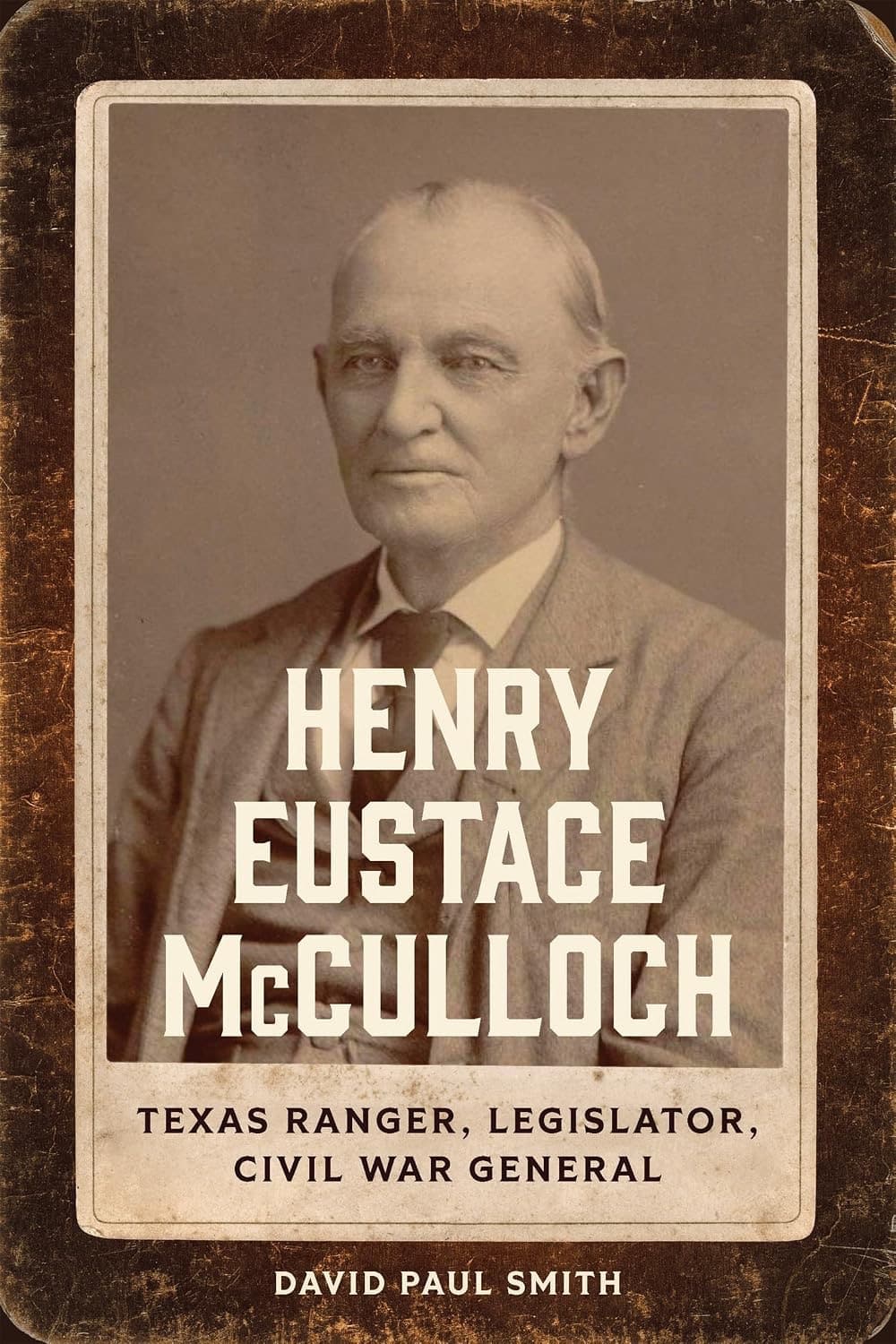
Henry Eustace McCulloch: Texas Ranger, Legislator, Civil War General. By David Paul Smith. Baton Rouge: Louisiana State University Press, 2026. Hardcover, 312 pp. $49.95.
Reviewed by Jonathan Steplyk
Students of the Civil War may recognize Benjamin McCulloch, the famed Texas Ranger who, as a Confederate general, was killed at the battle of Pea Ridge. Less well known is his younger brother Henry McCullouch, also a distinguished Ranger and subsequent Rebel general, making them the only pair of brothers among Confederate generals. Historian David Paul Smith brings the younger McCulloch to the fore in a new biography, a project years in the making, Henry McCulloch having been the subject of Smith’s Master’s thesis. Reconstructing Henry’s life was no easy task, as McCulloch left few reminiscences and burned his own personal papers, requiring Smith to mine McCulloch’s correspondence with others and the recollections of his subordinates. The result is a biography of a highly capable and respected leader of men who often played a more obscure, but essential supporting role to better known historical figures.
Henry McCulloch was born in Tennessee in 1816, the ninth of thirteen children of Alexander McCulloch, a veteran of the battle of Horseshoe Bend. Henry learned many skills of the frontier from his older brother Benjamin, whom he described as “both a father and a brother, and to him I owe for all that I am or have been.” (6) The McCullochs were neighbors to David Crockett, and Ben and Henry had hunted with the famed frontiersman’s sons, so when Crockett set out for Texas in 1835, the brothers were eager to follow. Upon reaching Nacogdoches, the pair learned the Texas Revolution had begun. Ben prevailed upon his younger brother to return to Tennessee, wishing to keep him out of harm’s way and insisting he should help their family. Henry reluctantly agreed to delay his emigration to Texas, while Ben joined the Texian forces. Ironically, illness prevented Ben joining Crockett at the Alamo, sparing him that fate and allowing him subsequently to fight in the decisive Texian victory at San Jacinto.
Henry returned to Texas in 1837, and for the next two decades, service in various Ranger companies tasked with defending the frontier was a major part of the McCulloch brothers’ lives. The early Texas Rangers were the primary defense against the fierce Comanche raids, and Henry distinguished himself as a skilled leader and Indian fighter, often serving as a lieutenant under John Coffee “Jack” Hayes and fighting alongside other legends such as “Rip” Ford, “Bigfoot” Wallace, and his brother Benjamin. The Rangers were called out in response to the Great Commanche Raid of 1840, and the brothers were in thick of the fighting at the Commanche’s decisive defeat at the battle of Plum Creek. Ben and Henry again served as Rangers in the Mexican War, with Ben achieving still greater acclaim fighting under Zachary Taylor, while Henry helped conduct defense of Texas’s western frontier.
An intensely loyal adopted Texan and a Southern Democrat, Henry McCulloch signed the call for a Secession Convention and actively supported the Confederate cause. Henry owned at least three slaves during his life, and Smith notes there is no evidence he ever questioned the “peculiar institution.” McCulloch also joined many fellow frontier Texans in complaining of the federal government’s perceived neglect in defense against Indian attacks, a grievance which follows denunciation of Northern antislavery efforts in the state’s secession declaration.
Henry McCulloch’s most prominent Civil War role was commanding the brigade that attacked U.S. forces at Milliken’s Bend, Louisiana, June 7, 1863. The Union outpost was no longer key to Ulysses S. Grant’s supply lines for the Vicksburg siege, and Smith argues Richard Taylor, McCulloch’s superior, ordered the attack hoping for an easy victory over a presumably understrength force. Attacking at night, McCulloch’s four regiments pressed through a tangle of hedges to strike federal forces consisting of several newly raised black regiments and one white regiment. Fierce hand-to-hand combat characterized much of the battle. By dawn, the Rebels pressed the federals to the riverbank and came close to breaking them, only to be driven back by salvos from Union gunboats. Milliken’s Bend proved crucial in proving to many Americans the bravery and fighting spirit of black soldiers, with McCulloch noting they had “resisted…with considerable obstinacy.” (140) Smith concurs with Linda Barnickel’s study of Milliken’s Bend[1] that the Rebels did not seem to have engaged in the same no-quarter policy toward black soldiers as in subsequent battles, especially given the killed-in-action percentages compared to those in the Fort Pillow massacre.
Most of McCulloch’s subsequent Confederate service was in command of the Northern Sub-District in Texas. Here he achieved considerable success in mobilizing supplies, often detailing soldiers to assist in farming and cattle drives. McCulloch also faced the challenge of bringing in deserters, conscripts, and suspected Unionists, many of whom took refuge in the Texas brush.
David Paul Smith’s biography of Henry McCulloch offers a portrait of an extraordinary man who lived in extraordinary times yet was, as one admirer suggested, “quiet and unpretentious.” (215) McCulloch was highly esteemed by his fellow Texans and rubbed shoulders with many Texas luminaries, yet he often served in a supporting capacity that attracted comparatively less attention. For Civil War scholars, Henry McCulloch’s story is notable not just for his battlefield service in the Trans-Mississippi but especially his role in mobilization and administration on the Texas home front. Such efforts do not garner the same fanfare as campaigns and battles yet are essential and foundational, an appreciation growing among historians and readers. Additionally, Henry McCulloch’s remarkable roles throughout the history of his adopted state make this book essential reading for students of the Texas frontier.
Dr. Jonathan M. Steplyk is the author of Fighting Means Killing: Civil War Soldiers and the Nature of Combat, a contributor to the Civil War Campaigns in the West series, and a former historical interpreter at Harpers Ferry and Cedar Creek National Historical Parks. He currently teaches at the University of Texas at Arlington and Tarrant County College.
[1] Linda Barnickel, Milliken’s Bend: A Civil War Battle in History and Memory (Louisiana State University Press, 2013).


Accolades to Brother Jonathan!
Another book to buy from LSU Press. Thank you for the nice review!