Book Review: The Confederacy Myth: How an Insurrection of Slaveholders Tried to Destroy the United States

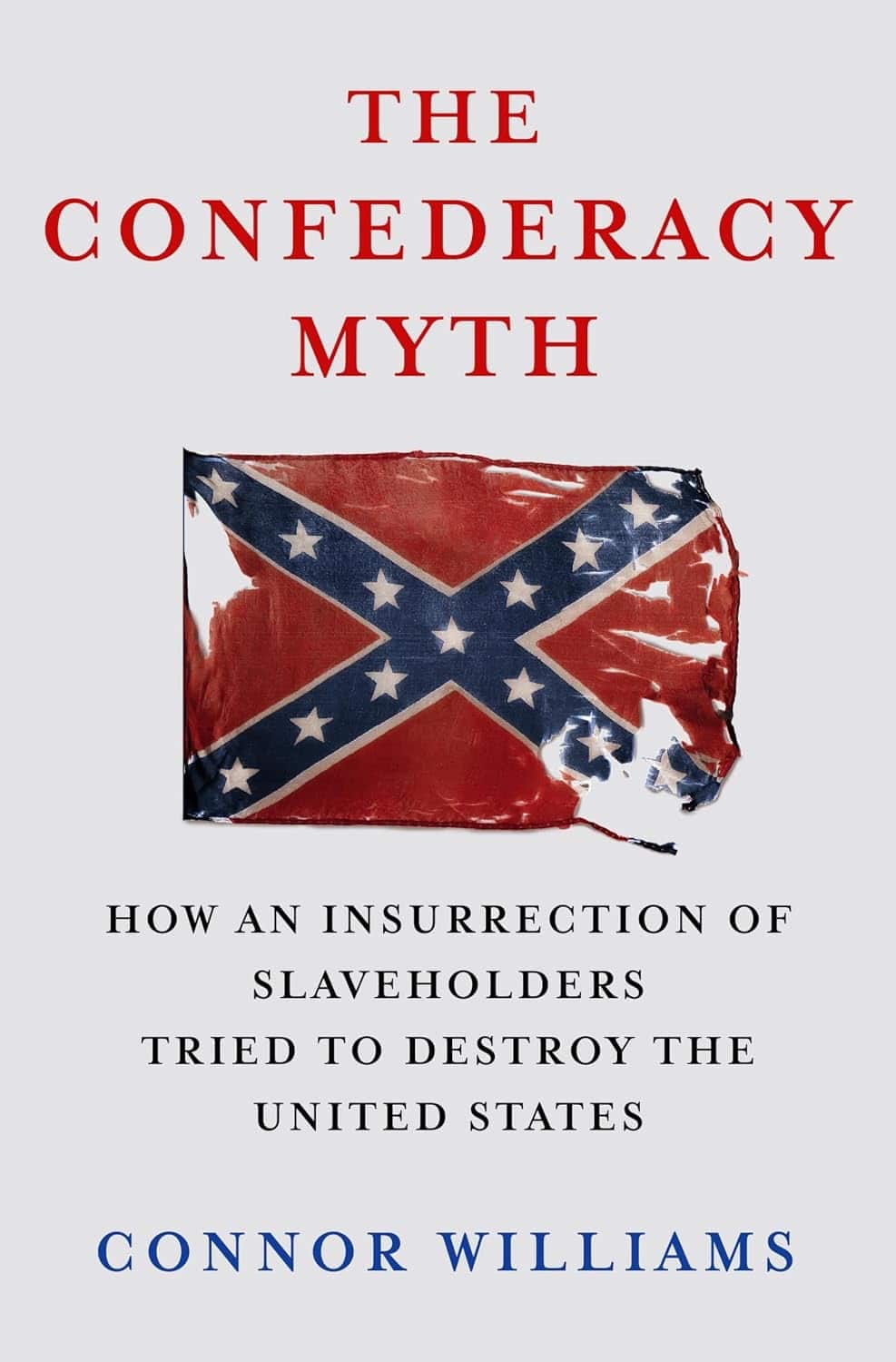
The Confederacy Myth: How an Insurrection of Slaveholders Tried to Destroy the United States. By Connor Williams. New York: St. Martin’s Press, 2026. Hardcover, 304 pp. $30.00.
Reviewed by Samuel Flowers
By the title alone, one can correctly assume that this interpretation of the American Civil War will ruffle some feathers. That being said, Connor Williams is most likely used to this kind of contention. Back in 2021-2022, he served as lead historian for the United States Congress’ Naming Commission, which changed the names of several military bases from their original Confederate namesakes. This book seeks, in some ways, to provide a deeper explanation and exposé of the former rebellion and what most of the public seems to get wrong.
The Confederacy Myth is not the first book in the historiography of debunking Lost Cause myths, but it certainly adds to the existing scholarship by Gary Gallagher, Alan Nolan, Edward Bonekemper, and David Blight. Although one may argue that the recent scholarship is saturated with subjects of Lost Cause or memory, Williams seeks to salvage a memory of the conflict that seems to be bubbling beneath the surface of Southern nostalgia. According to Williams, The Confederacy Myth argues that the Lost Cause radically concealed major tenets of why secession occurred, how the South was governed and waged war, and how vital slavery was to its survival. The introduction aims to change the public’s perception of the Confederacy. Instead of a Southern independence movement fighting valiantly for state sovereignty, Williams deems it a fringe-led slaveholder insurrection that pursued a violent defense of chattel slavery.
The book is divided into five chapters and a conclusion that outlines the basic myths of the Lost Cause. The first two chapters focus on the buildup to the Secession Crisis and the crisis itself. Williams starts off by arguing that the Lost Cause idea of the South being trampled by an abusive federal government is flawed due to the political and legal benefits that the United States provided to the institution of slavery. Rather than focusing solely on the secession documents to explain why the Confederacy was formed, the author debunks the myth that secession was a legal option for the Southern states. To do this, Williams lays out the pre-war opinions of the doctrines of nullification and secession, ranging from James Madison and Andrew Jackson to the failed Nashville Convention of 1850. These, according to Williams, argue that the concept of leaving the Union was considered unconstitutional and illegal by both the Framers and other nineteenth-century contemporaries.
The third chapter examines the respective strategies of the Confederacy and the United States, stating that the United States’ evolution toward emancipation was just as significant as military attrition and policies toward prisoner exchanges. Williams, in Chapter Four, focuses more on the war itself and states that Confederate victories, although substantial, were greatly disproportionate to the Union military’s success across all theaters. The last chapter looks at the legitimacy, or lack thereof, according to Williams, of the Confederacy as a nation. Williams understands that the Lost Cause seeks to argue that the Confederacy, as a rebellion, should be seen as legitimate, like the colonists of the American Revolution, but disagrees. In both the introduction and the final chapter, he asserts that this comparison is flawed, given that the British did not recognize the United States until the war ended in 1783, not 1776.
In conclusion, The Confederacy Myth explicitly seeks to debunk Lost Cause myths, almost to the point where it can be speculated that Williams is writing from a biased and political standpoint. Although this is more than likely bound to occur and will elicit some discomfort, this book seeks to probe both the public and historians about what exactly our priors are about the history of the Confederacy, what it stood for, and how it is remembered. The Lost Cause, even in the twenty-first century, continues to shape understandings of secession, strategy, motivation, leadership, and nation-state legitimacy. Connor Williams is blunt in recognizing the Confederacy as nothing short of a slaveholder’s insurrection, but still asks the reader to nationally regain the memory of the war and examine the nation’s most tumultuous era through the sources and quotes of those who lived it.
The Confederacy Myth will be released in mid-October 2026.


If this author really does try to pretend that legality of secession was settled prior to the Supreme Court’s decision in Texas v White, 74 US 700 (1869), and claims the Framers considered it to be so, I hope he explains how the New England states threatened James Madison with secession over his decision to invade Canada in the War of 1812. The generation that drafted, debated and ratified the Constitution –including Madison–was still alive and clearly there were leaders in those states who didn’t consider it “unconstitutional and illegal.” If he claims this was NOT a hotly debated issue of Con Law in the 9th century, he is as reliable a “historian” as Nicole Hannah-Jones. Which is to say, not at all. As a Government major and graduate of a Top 10 law school, I believe it was not legal, but any claim that the argument was some kind of baseless fiction cooked up by southerners during the Secession Crisis is itself baseless fiction. Based on this review, and the author’s own past, I’d put this slop up there with “The 1619 Project.”
Mr. Robertson appears to be unaware of the letter that James Madison wrote to Nicholas Trist in 1832, during the nullification crisis, in which he says, “It is high time that the claim to secede at will should be put down by the public opinion; and I shall be glad to see the task commenced by one who understands the subject.” A Google search based on that text will turn up a number of websites with the full letter, but here is one of them:
https://teachingamericanhistory.org/document/letter-to-nicholas-trist/
JFE
Agreed. More woke drivel.
How many times can the Lost Cause be resuscitated and then knocked down again? Yes, the Union forces in the Civil War were the good guys. Yes, slavery was the dominant or primary cause of the war. Yes, there was a line of historical interpretation, particularly in the South, called the Lost Cause. Yes, the Lost Cause was incorrect nonsense. Yes, it is a fascinating study for historiography. But what impact does it have today? This review talks about what the public gets wrong that the book seeks to correct. What does the public get wrong and why is the Lost Cause responsible? Did the Lost Cause force American students today to think that American whites invented slavery (a belief that apparently is held by a majority or near majority of American students)? I believe that Chris Mackowski stated in an earlier post that the Lost Cause makes it difficult to discuss race in this country today. With respect, how can that be true? Jubal Early was not a Christ-like figure impacting untold generations into the future.
Can the author, Mr. Williams, cite any college or public school curricula in the last 50 years that espoused the Lost Cause? Any serious historical studies in the last 50 years? Any mainstream magazine or newspaper or TV show in the last 50 years? Any movie (other than the execrable “Gods and Generals”)? The only impact the Lost Cause really has today is to provide cover for political excess. When the Stonewall Jackson statue in Charlottesville was shipped to Los Angeles and displayed after being degraded, it was an in-your-face political statement. Any criticism of that can be countered by saying that Jubal Early is running our lives. It’s easier to fight the villains of the past than to face very real issues today. People want a “Selma moment,” but Selma was 65 years ago or over three generations ago. History formed us, but it does not control us.
I can’t wait to not read another far left, righteous cause myth, biased author.
Kudos to Messrs. Robertson, Olson, Henck and Harvey, who said it all before me, and so well. So, no need to add much beyond shame on St. Martin’s Press, a fine house, for publishing such expensive toilet paper, and one small but important observation: No matter what the South did, there was no intention to destroy the United States. No attempt was made to harm it or change its government. Secession is a leaving, not a destruction. So…bosh. Well, it’s not coming out until mid-October, so there’s still time to stop it. Perhaps we can get one of those judges who keep defying the Supreme Court and issue corrupt rulings intended to limit the President’s delineated powers, or to continue the massive voter fraud of mail-in voting, to issue one of their injunctions against this book.
Thank you for your review. I am looking forward to reading it. I wonder if those grousing about whether we “need” another book about the Lost Cause will be equally vocal about the next book that covers some unexamined fifteen seconds of such and such square yard of the Wheatfield at Gettysburg. As to relevance: we currently have a Secretary of Defense who circumvents the clear will of Congress to rename military installations after officers who fought against the United States Army, and school boards in Virginia who are currently trying to force Black children to attend schools named for men who fought to keep their ancestors enslaved. The Lost Cause continues to have a hold on a sizable minority of the American public – even on some who frequent the comment section of Emerging Civil War.
What is the “Lost Cause”? Is it anything that shows the Confederacy or its symbols in a positive light? Is it portraying Southerners as anything other than mustache-twirling villains, the boogie men of American history? If simply displaying a Confederate flag is “Lost Cause” than the term truly has no meaning.
That is a great point. The fixation on the Lost Cause as the cause of all ills is used as a cudgel to beat down any attempt to honor the courage of the ancestors of a significant part of the American population. The Lost Cause should certainly be examined as historiography, but that is not how it is being used. We live in a complex society with a complex history. Do we really want to go down a road where Shenandoah County naming its high school after Stonewall Jackson or someone flying a Confederate battle flag to honor his ancestors is de facto white supremacy? How far do we want to go down that road? Should Japanese Americans be forced to attend a school named after FDR, who put their grandparents or great-grandparents in concentration camps? Should girls have to attend schools named after noted misogynists like JFK or MLK? Should Hispanics serving in the military be forced to go to a military installation named after Dwight Eisenhower, whose administration instituted “Operation Wetback”? I make this point not to denigrate any of the men I just mentioned, all of whom were great Americans, but to note that our history is not tidy. I care about this issue because using people from the past as strawmen to knock down in order to score political points is a recipe for disaster for our country.
I agree that the term “The Lost Cause” can be a slippery one, but since this is a community of emerging scholars, I presume that we know what historians mean by the term “The Lost Cause.” It usually includes the following tenants: 1) that secession and the war was brought on by differences over constitutional issues rather than slavery, 2) that the Confederacy was a unified nation in which white people loyally supported the war effort and where black people loyally served their enslavers 3) That Confederate soldiers unfailingly fought heroically and were not defeated on the battlefield but only by overwhelming U.S. superiority in resources, 4) that the Congressional program of Reconstruction was misguided and a disaster for the South. There are a number of excellent books on this topic that I’d be happy to recommend, but usually the starting point is David Blight’s “Race and Reunion: The Civil War in American Memory.”
It’s fascinating that there are such violent reactions to a book no one has read, including from a graduate of a „top 10 law school“. As a graduate of a Top 2 law school (Harvard, not Yale), I suggest that we hold off comments until we have read the book. As far as the Lost Cause myth, we should stop talking about it when people stop flying the Confederate battle flag, a symbol not of heritage but of white supremacy.
“when people stop flying the Confederate battle flag, a symbol not of heritage but of white supremacy.” Some say. others do not agree. The problem with so-called universal symbols is they are often not so universal. I practice law. I would never go into court saying, “Well, Judge everyone know the flag represents white supremacy.”
Tom
Rather than debate if the planet needs another book on the Lost Cause, the better question is whether or not Dr. Williams’s book makes a new argument. Based on this review, it doesn’t appear that he has. He fails that standard by fighting an ideological civil war backward into the 1850s instead of analyzing the post-1865 machinery that actually manufactured the myth. Re-litigating the antebellum unconstitutionality of secession or cataloging Confederate theater attrition simply retreads well-worn ground settled decades ago—not much new here.
The Lost Cause was never sustained by sound constitutional theory or battlefield arithmetic. It was a post-war creation authored by Jubal Early, the Southern Historical Society, and Southern veterans’ organizations—a civic religion that sought to portray Confederate wartime sacrifice and a sound ass-whooping in the best possible light. By fixating on why the rebellion was illegitimate from 1861 to 1865, the author misses the critical historical question of how a defeated slaveholders’ insurrection successfully captured the national commemorative memory.
Perhaps the better book would examine how the Lost Cause has been progressively dismantled and fallen from public favor over the past half-century—because outside a dwindling cadre of nutty holdouts, you simply don’t see the battle flag flying from front porches, pickup trucks, or state capitols the way you used to.
There are several commenters who oppose the publication of this book(!) because they say that the “Lost Cause” is long dead and that it has no impact on modern America. It does inside the Defense Department, the largest department of the Federal government. Sec. of Defense Pete Hegseth recently renamed forts and posts after Confederate generals. He has invited Reverent Doug Hegseth to address the Pentagon. Hegseth is a well-known lost causer. https://thereconstructionera.com/defense-sec-pete-hegseths-pastors-view-on-the-civil-war-and-emancipation-part-1/
One of the most influential Tech Bros Philosophers, Curtis Yarvin, has been retailing Lost Cause “philosophy” about Blacks being better off if they had not been freed during the Civil War.
https://thereconstructionera.com/curtis-yarvin-historian-for-tech-bros-says-blacks-were-better-off-with-slavery/