Book Review: Apocalyptic Abolitionism: How Millennialists Helped Abolish Slavery and Reform America

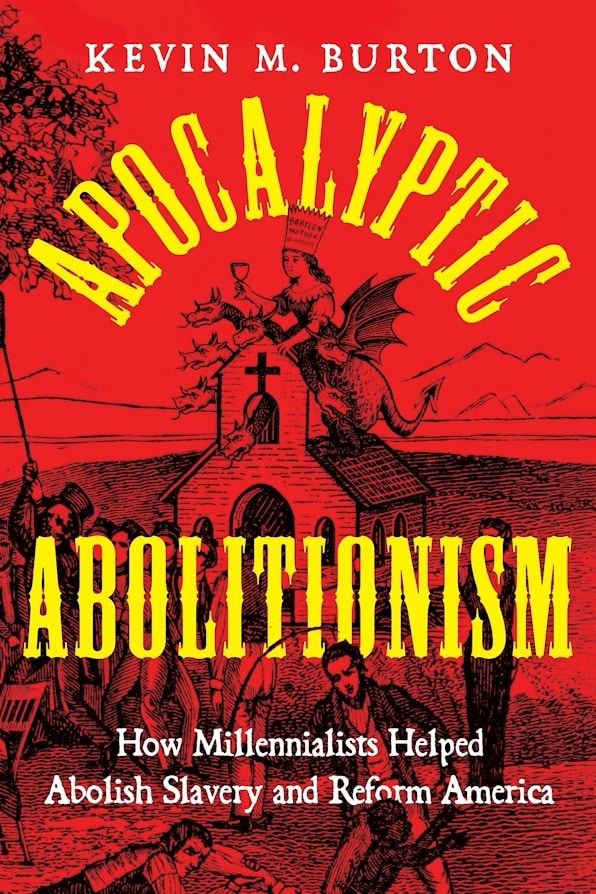
Apocalyptic Abolitionism: How Millennialists Helped Abolish Slavery and Reform America. By Kevin M. Burton. New York: New York University Press, 2026. Paperback, 317 pp. $30.00.
Reviewed by Max Longley
The “Great Disappointment” is an event which made a great splash in American history. The term refers to the fact that certain Protestant religious leaders in the North, known as “Millerites” (after American clergyman William Miller), predicted that Christ would return to Earth in 1844. By October 1844, when the prophecy had not panned out as the Millerites expected, they were disappointed, if the reader will allow a slight understatement.
I personally associate this historical event with a sketch by the British comedy team “Beyond the Fringe.” Several religious types gather on a mountaintop, expecting the end of a world at a specific date and time. When the world does not end, one of the disciples hopefully suggests that the prophecy was scheduled according to the time in a later time zone. When that rationalization fails, the group leader simply tells everyone to come back “same time tomorrow.”
This old sketch captures some of the historiography of the Great Disappointment – an example of the excesses of revivalism (especially in upstate New York’s so-called “Burned Over District,” an area of particularly intense religious revivalism movements) in the antebellum North.
The Millerites who survived the Great Disappointment were one of the streams feeding into the subsequent foundation of the Seventh Day Adventist denomination. Author Kevin Burton teaches at a Seventh Day Adventist seminary, where he runs the Center for Adventist Research. Burton often seems to take a “feature-not-bug”approach to the Millerites. In his book, he focuses on Millerites’ abolitionism and their influence in the abolitionist movement, which he sees as quite positive. Indeed, their prominent involvement in the movement did not escape the contemporary notice of slavery’s defenders, who explicitly linked abolitionism with Millerism as well with other radical movements of the time. Burton explains that to the enslavers, abolitionists in general were a species of deluded radical, so associating them with other sets of deluded radicals was an understandable approach, as part of an effort to attack their credibility.
But Millerites were not deluded radicals to Burton. As he explains, precisely as a result of their apocalyptic beliefs they were particularly active in the abolitionist movement. It would be unduly derogatory to say that the Millerites acquired this influence by “boring from within,” but Burton, in his impressive archival and newspaper research, finds multiple examples of Millerites in influential positions in the abolitionist movement during the lead-up to the Great Disappointment.
The non-Millerites did not seem to mind having their support. What mattered was antislavery zeal, and Millerites surely had this, sparked strongly by their own particular theology. The Millerite approach to abolitionism was, first, Christ was returning on a specific date, and soon. And when He got back, He would want to discover His followers fighting slavery with all they had.
(One might also focus on Christ’s Biblical warnings that His return would be unexpected, thus requiring constant watchfulness and preparation – as with the wise virgins. If any abolitionist took this angle, Burton does not go into it.)
Plenty of non-Millerite abolitionists also felt urgency. With Millerite help, both groups encouraged Protestants to “come out” of (aka secede from) lukewarm, soft-on-slavery churches and form radical antislavery churches. Combining the come outers with “traditionally antislavery sects” would probably lead to “between two hundred thousand and three hundred thousand abolitionists between 1845 and 1860.” (218) Burton also discusses how in their anti-slavery zeal some abolitionists, Millerite and non-Millerite, actually petitioned Congress for Northern political secession as an apparent complement to religious secession. The argument was that it was morally wrong to remain in the company either of pro-slavers or those who simply did not care enough about slavery to fight against it. Millerites also joined in founding the zealously antislavery Liberty Party. Burton both documents and cheers all this.
Interestingly, Burton also cheers the post-Great-Disappointment backlash. When Millerites realized that the timetables were off and that they were as ignorant as anyone else of the date of Christ’s return, they began thinking long term. The Millerite Liberty Party supporters merged with the more pragmatic Free Soil Party, which in turn was subsumed into the Republican Party, under whose auspices Lincoln made his Emancipation Proclamation.
In a sense, then, Burton wants to praise the quite different responses of Millerites pre-and post-Great Disappointment. Before the Great Disappointment, due to Christ’s imminent return on a specific timetable, Millerites embraced abolitionism as a movement that—based upon their religious belief in the imminent return of Christ—of necessity had to be uncompromising, urgent, and in a great hurry. Post-Great-Disappointment, some Millerite abolitionists accepted a more deliberate, calculating movement toward progress. And, as Burton reveals, the Great Disappointment can be credited with both developments!
Burton mostly organizes his chapters based on the various abolitionist activities the Millerites joined, such as breaking off (“seceding”) from proslavery denominations, organizing radical petitions, and the like.
Burton’s widely researched work breaks new ground by giving a basically positive linkage between the Millerites and abolitionism, crediting Millerites with giving that movement a boost.


I curious as to how many people out there realize that the Abolitionists completely failed in abolishing slavery. Slavery was abolished because the Federal Government completely wrecked the South – economy, agriculture, infrastructure, the flower of a generation, political standing – and doing this, abolished slavery. The Abolitionists didn’t abolish slavery, Congress abolished it.
In writing my biography of George Boutwell, (Boutwell: Radical Republican and Champion of Democracy), I came across a humorous incident that’s right on point. Frederick Douglass was speaking in Groton, Massachusetts in 1844 (Groton was George Boutwell’s hometown) and Douglass complained that nobody was coming to his talks on abolition because townsfolks were all attending Millerite meetings. Only after the Second Coming failed to materialize did people turn their attention back to slavery and abolition!