Book Review: The Life and Times of Captain John Low: An Englishman in the Confederate States Navy

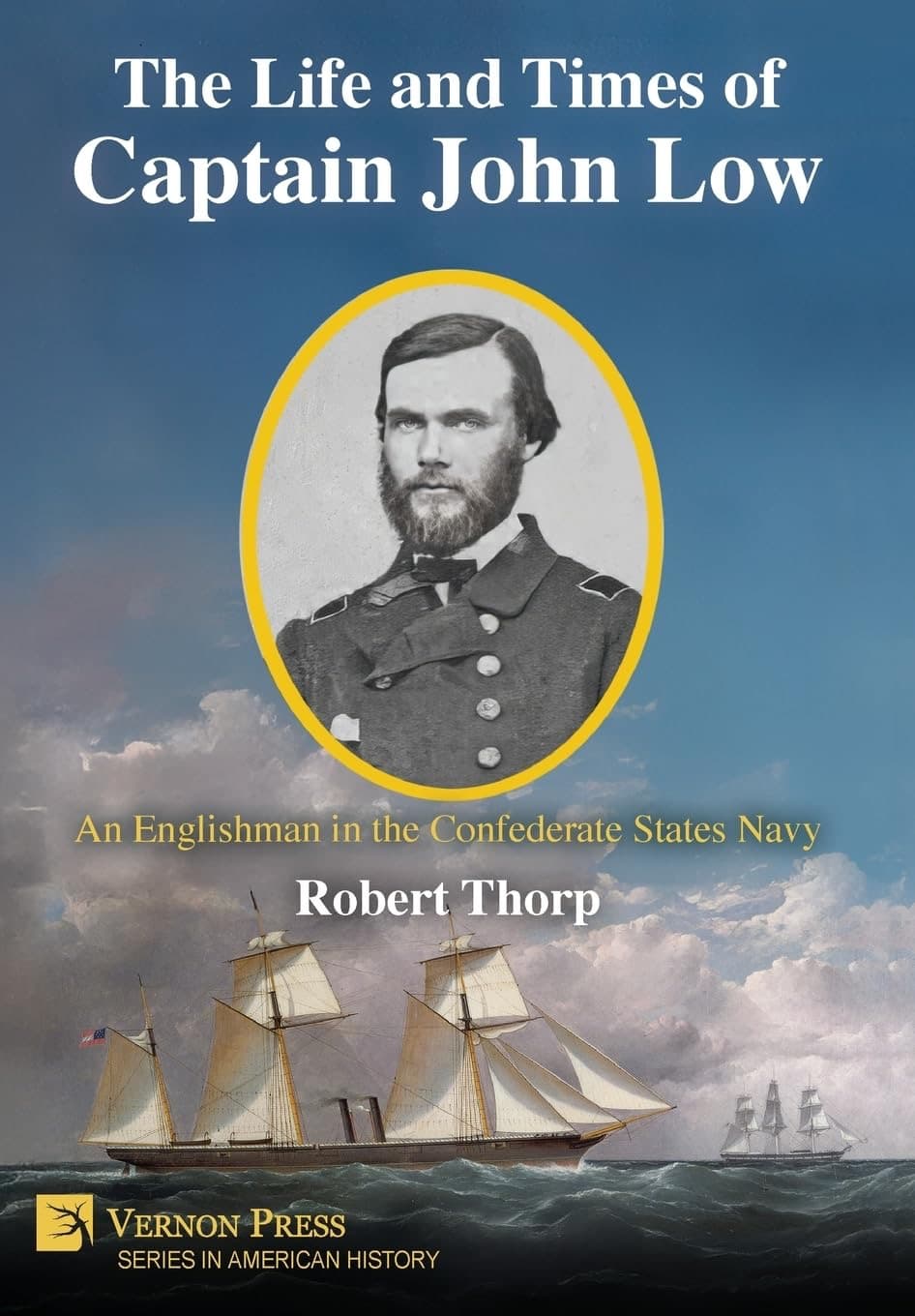 The Life and Times of Captain John Low: An Englishman in the Confederate States Navy. By Robert Thorp. Wilmington, DE: Vernon Press, 2026. Softcover, 488 pp. $95.00.
Reviewed by David F. Winkler, Ph.D.
Born just outside of Manchester, England on January 24, 1836 during the Industrial Revolution, John Low lost his parents at a rather young age. Low was raised by other family until he signed on with the merchant marine where he gained seamanship skills that would serve him admirably well during the American Civil War. Eventually, Low found himself in Savannah, Georgia where a distant first cousin “Uncle” Andrew had established himself as an entrepreneur. John Low also had success as a merchant and embraced his new surroundings to the point of signing on to join the Georgia Hussars when his adopted state seceded from the Union. However, his seamanship skills and his familiarity with Liverpool would divert him away from the war on land. Low would be offered a commission in the newly formed Confederate States Navy. He would remain a commissioned officer in the CSN for the duration of the war. His legacy would long outlive his passing in 1906.
A century after Low’s service with the Confederacy, William Stanley Hoole published Four Years in the Confederate Navy – The Career of Captain John Low on the C.S.S. Fingal, Florida, Alabama, Tuscaloosa and Ajax (University of Georgia Press, 1964). Six decades later, Robert Thorp has published a new biographical study of this Forrest Gump-like character who somehow seemed to be in just the right spot when opportunities arose to serve in the navy of a new country into which he had wedded.
Thorp’s interest in the subject hails from ancestorial root: his great-great-great grandfather owned the shipyard that secretly built the Confederate commerce raider CSS Florida. In deciding to revisit the life of Low, Thorp took advantage of digital resources unavailable to Hoole to correct factual errors found in the original biography. Indeed, Thorp dedicates an appendix to identifying the errors he corrected from the Hoole narrative. However, if one were to ask if correcting the smattering of Hoole miscues warranted another biographical treatment, it would be difficult to justify, especially in this era when statues of Confederate officers are being cast aside throughout the South.
To offer justification for publication, it appears the book has been mistitled. The Times and Life of Captain John Low: An Englishman in the Confederate States Navy is a better descriptor of what Thorp has accomplished – using the life of Low as a prism to view the creation and deployment of a naval arm that would wreak havoc upon northern shipping. Much context is provided – from the standpoint of an American with a fair knowledge of the war between the States, too much. Pages on Harper’s Ferry, the fight for Kansas, the election of 1860, and the events leading to the bombardment of Fort Sumter could be cut. On the other hand, if the reader is a fellow countryman of Thorp with an interest about the British connection with the American Civil War, the context is critical.
As an unreconstructed Northerner I must confess Thorp’s chapter titled “1864” – the year that Low was sidelined after the CSS Tuscaloosa was impounded in South Africa – was my favorite after reading the author’s description of the destruction of the Alabama. Of course, by 1864, the Union armies under Grant and Sherman are making headway in crushing the rebellion and further Southern efforts to acquire commerce raiders are nipped in the bud. However, the damage to the American merchant fleet had been done, and arguably it never recovered. By inserting Low as this character that sews together all aspects of efforts to procure, arm, and crew a navy, Thorp has produced a very readable history of the CSN that broadens our understanding of the war at sea. For British readers, the chapters covering Low’s life in England before and after the American Civil War are an added bonus with Thorp’s insights regarding life during the industrial age. Well Done.
David F. Winkler, Ph.D., is an author, adjunct professor with the U.S. Naval War College, retired USN commander, former staff historian with the Naval Historical Foundation, editor of the naval history e-letter Tuesday Tidings, and the Charles Lindbergh Chair of Aerospace History at the Smithsonian Air and Space Museum. He also is the Historian General of the Naval Order of the United States, the oldest American hereditary exclusively naval society.


