Book Review: Lee’s Army During the Overland Campaign: A Numerical Study

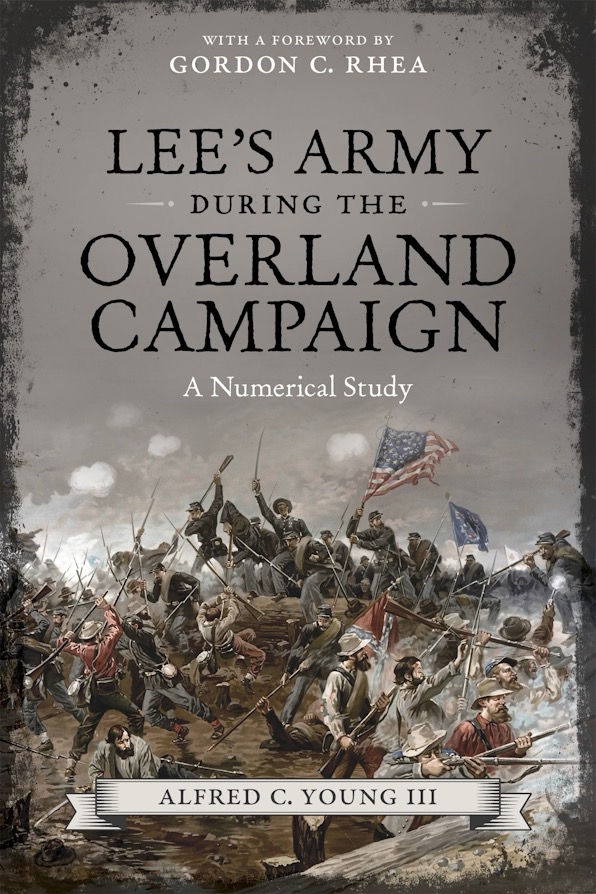
Lee’s Army During the Overland Campaign: A Numerical Study. By Alfred C. Young. Baton Rouge: Louisiana State University Press, 2013. Paperback, 428 pp. $39.95.
Reviewed by Bert Dunkerly
Although it has been out (in hardback) for thirteen years, this is a great reference book that I pull off the shelf from time to time when studying the Overland Campaign. Alfred C. Young’s work examines traditional assumptions of the strength and losses of the Army of Northern Virginia in the 1864 Spring Campaign. This reinterpretation is critically important for our understanding of that army’s capabilities and its transformation that spring and summer.
Records of Confederate troop strength and battle casualties are incomplete, and many have not survived, forcing historians to speculate in many cases. In his study, Young re-examine records and looks at previously underutilized sources, primarily newspapers. He finds that not all units added to the army as reinforcements have been accounted for. Newspapers and diaries also shed light on recruit additions, as well as document unit losses in battles.
As a result, the Army of Northern Virginia had higher strength than often assumed and higher losses in the campaign’s battles. That spring as the campaign got underway in the fourth year of the war, the stakes were high. Lincoln was up for re-election, in what was essentially a mandate on the war. Northern resources were also increasingly more effectively being used against the Confederacy.
Reinforcements for Robert E. Lee’s army came from many sources. The army received new recruits to existing units, as well as regiments and batteries from the Carolinas, forces stationed near Petersburg, the Department of Western Virginia, and elsewhere. Sick and wounded returning from hospitals also augmented the army.
The text goes through the entire army, brigade by brigade, reviewing each division and corps. It serves as a handy reference if one is researching a particular regiment, brigade, or division. The author’s research is meticulous.
Young provides a keen analysis of the sources, finding that conscripts often went to units that needed men, while volunteers went to established units from their home areas. The result was that morale began wavering in certain units. Loss of officers hurt functionality. Newly arriving units add numbers but lack combat and campaigning experience. The army was maintaining its strength, but becoming weaker as it still maintains close to original numbers
Very helpful tables in the back of the book compare the army’s strength before and during the campaign, making the information easy to digest and providing a quick and easy to use reference.
The book (now in a 2026 paperback republication) goes to show that with hard work and creativity we sometimes can overcome what are seen as barriers to accurate understandings. If you want a deeper dive into the Overland Campaign and want to see newer research on the topic, refer to this book before visiting the battlefields.


I found Young’s research to be very helpful in my own research of the 62nd Virginia Mounted Infantry and the short time they were attached to the ANV during late May and early June of 1864. They were under Breckenridge during the victory over Sigel at New Market, and as Sigel retreated, Lee ordered Wharton’s Brigade to help reinforce his forces facing the AoP. They were engaged on the right of the Confederate line at Cold Harbor. Soon after, Lee sent Early to Lynchburg to contest the offensive of Gen. Hunter who had taken over from Sigel. The 62nd went with them and spent the rest of the war in the Valley.
Thank you for reviewing this book. Not only does it help in detailed analyses of individual units like the 62nd but also gives a good picture of the ANV during the Overland Campaign.
It seems like the Army of Northern Virginia that entered the trenches around Petersburg wasn’t the same army that clashed with Grant at the Wilderness two months earlier. Battlefield casualties were bad enough but they don’t even include the thousands who succumbed to disease and injury, or simply couldn’t take it anymore and deserted. This is a valuable contribution to the literature for sure.