Book Review: White Power: Policing American Slavery

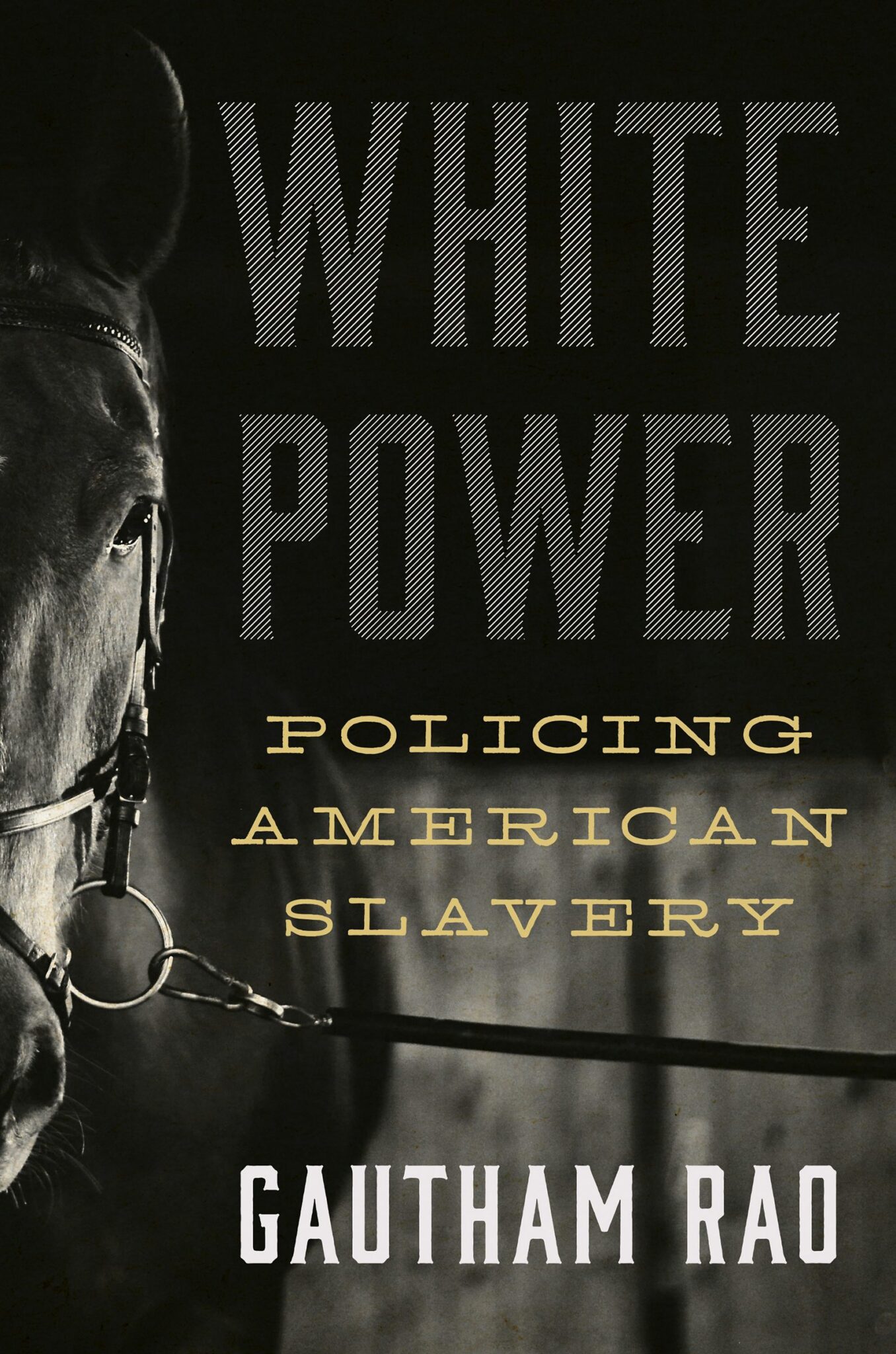
White Power: Policing American Slavery. By Gautham Rao. Chapel Hill, NC: University of North Carolina Press, 2026. Hardcover, 320 pp., $30.00.
Reviewed by Tim Talbott
Stripped to its bare essence slavery is a coercive labor system built on the cornerstone of violence or the threat of violence by a person in power against a subordinated person. In order to get a human being to work for the sole benefit of another human being, and then maintain that practice, it requires effort on the part of the enslaver. This became abundantly clear early on to those who participated in what became the American form of slavery.
White Power: Policing American Slavery by historian Guatham Rao is a new examination of the history of enforcing race-based enslavement. It explores the various laws and methods used by enslavers to maintain their power from the colonial era through emancipation and then follows its post-liberation evolution into Reconstruction, Jim Crow, and our current times.
From the earliest days of forced labor on the American continent—whether that be indentured servitude or life-long bondage—resistance was present. Resistance came in many different forms. Some methods were more subtle, like breaking work tools, feigning illness or injury, or singing coded songs that mocked one’s enslaver. Other forms of resistance were often individual in nature, like running away or poisoning an enslaver. Yet others drew upon the power of numbers and fostered a sense of solidarity that manifested in rebellions. Slaveholders especially feared the possibility of enslaved-led uprisings.
However, any and all of these forms of resistance, no matter how covert or restrained, were viewed by the enslavers as threats to the maintenance of a labor system and social order that, once established, flourished and benefited them economically, politically, socially, and culturally.
Rao contends that enslavers practiced slavery under a constant cloud of what he terms a “permanent emergency.” As he explains “[Enslavers] became obsessed with stories of rebellions. . . . These battles were evidence that when slaves became rebels, they became ‘internal enemies’ who were hell-bent on racial apocalypse. In the enslavers’ paranoid style, the very next ‘slave insurrection’ was always just around the corner.” But, as Rao also importantly points out, “the law offered enslavers hope.” (8-9) Laws, and the strong “police power” that some of the laws created, were used to maintain public order, exercise racial social control, and establish a system of policing that necessarily included slavery.
Rao is clear in stating that “the concept of policing—government delegating authority to officers to enforce laws and protect the public—long predated American slavery.” However, with this book he attempts to show that “American enslavers adapted the ideas and institutions of policing and public order to support and expand slavery, and in the process, changed the course of history.” (12)
To do so, Rao organizes White Power into ten chapters, each covering periods of time chronologically from the English settlement of Virginia, to the antebellum era and the expansion of federal power to uphold slavery with the Fugitive Slave Act, and on into the Civil War and the unique challenges that conflict presented to monitoring the institution as it previously had been. Attempts—many of which were successful—to maintain white supremacy following emancipation and into the Reconstruction and the Jim Crow eras involved both legal and extra-legal actions that tried to subvert the 13th, 14th, and 15th Amendments to the Constitution and used terroristic practices such as lynching as a means to maintain white power. The epilogue, “The Right to Violence,” offers a brief, but intriguing look at how the policing of race has continued to change over the last 60 or so years.
Rao’s evidence for White Power comes from a wide array of legislative and court records from local, state, and national government entities, period slave narratives, and personal letter collections, as well as scholarly secondary sources. Sprinkled throughout the book are eleven images and four maps that help supplement the textual information the author presents.
Adding to a growing historiography about monitoring and regulating enslavement, White Power: Policing American Slavery makes a valuable contribution to the field and expands upon earlier works like Sally Hadden’s Slave Patrols: Law and Violence in Virginia and the Carolinas (Harvard University Press, 2001) and Runaway Slaves: Rebels on the Plantation by John Hope Franklin and Loren Schweninger (Oxford University Press, 1999). Rao’s is a timely study that offers readers much to consider.


A system of labor in which the owners are in constant fear of their labor force rising up to kill them turns out not be the most effective. The amount of resources wasted on keeping slaves enslaved shows again why chattel slavery was not sustainable in the long run. Yet, in the short term it made a few people incredibly wealthy while retarding the economic growth of the whole. Stupid.
I’m often puzzled – and just as much bemused – by the amount of books on “American slavery.” 80 percent of the unfortunate Africans sold into trans-Atlantic slavery by Muslims never came to North America – they went to the Caribbean, Central America and South America, where they died by the millions due to horrible mistreatment, the kind that never occurred in North America, and to this day their descendants suffer far more from racism than do those in North America…yet I’ve never seen a single book published on their plight. I’ve never once heard “white supremacy” denounced and vilified in those regions. I’ve never once heard a demand for reparations from the wealthy in those countries. I’ve never once heard the term “the black vote” in elections in those countries. It’s really odd, because I’ve lived, worked and/or traveled extensively in Latin America, especially for long stretches in Brasil, Argentina and Chile, as well as Jamaica. Huh. Could it be due to the fact that the United States of America is so wealthy, and the other countries are not? By the way, it must be remembered that it really wasn’t “American Slavery.” The English, Dutch, French and Spanish created slavery in North America, and maintained it for hundreds of years. Americans inherited it and ended it in less than 90 years, as well as having banned the importation of slaves within 20 years. Well done, America.
I’m glad I can help you learn something new then:
https://www.nbcnews.com/news/latino/brazil-reparations-blacks-slavery-legacy-racism-rcna136334
You’ve listed quite a few things you haven’t read or heard about. That tells us something about the limits of your knowledge, but it doesn’t establish that everyone else invented a grievance.
C.L.R. James published “The Black Jacobins” in 1938. Eric Williams wrote “Capitalism and Slavery” in 1944 and then became prime minister of Trinidad. And let’s not leave out books by Gilberto Freyre, Orlando Patterson on Jamaica, and Joao Jose Reis on Brazilian slave revolts.
Btw, “Never once heard a demand for reparations” is a wild thing to say after living in Jamaica, which set up a national reparations commission in 2009. CARICOM has had a formal ten-point reparations plan since 2013. Brazil has had an organized Black movement since the 1970s, racial quotas in federal universities since 2012, and a national Black Consciousness holiday.
If none of that reached you during those long stretches abroad, perhaps the lack of literature and social movements weren’t the problem.
There are literally hundreds if not thousands of books on slavery as it was practiced in the Caribbean, Central America, and South America. The Carribean is especially well covered with extensive studies on Jamaica, what is now Haiti, and Cuba. Do a search on Amazon and see for yourself, they aren’t hiding. Then read some. The rest of the argument falls apart when it’s realized the opening statement is not true.