1,323 Graves in the Tobacco Soil: Danville’s Civil War Prisons
ECW welcomes back guest author Jarred Marlowe.
Most people who know anything about Danville, Virginia and the Civil War know two things: Jefferson Davis was there, and it was the last capital of the Confederacy.
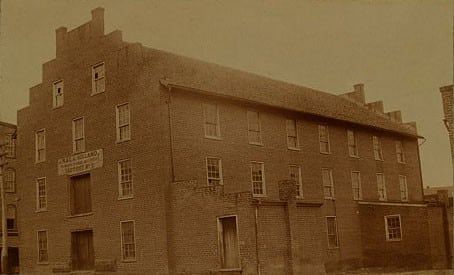
What almost nobody talks about is what happened in that city during the eighteen months before Davis arrived. Danville was already a vital supply hub and railroad center, and six military prisons were running there, too, in converted tobacco warehouses along the same streets where Davis would later take his morning walks. More than 7,500 Federal soldiers passed through those buildings. More than 1,300 of them never left Danville.
Danville’s prison system has long been overshadowed by Andersonville, which produced a far higher death toll than any other Confederate camp. Danville’s story is different: a system that collapsed the way the Confederacy itself did, from the inside out, under the weight of a war that ran longer and cost more than anyone had planned for. More than 1,300 men still died there, a story that has never fully been told.
Three firsthand accounts, two of them largely unknown, help fill that gap.
The prison system in Danville was established in 1863, when Gen. Robert E. Lee wrote to Sec. of War James Seddon recommending the city as a way to relieve overcrowding in Richmond. By November, around 4,000 Federal prisoners had been transferred there. Six facilities eventually operated, all three-story brick buildings or wooden tobacco warehouses along the same blocks of town, most of them large frame structures with guards stationed on the lower floor and prisoners crowded above. Broken windows let in cold that a single stove could never overcome in a room eighty feet long. Men slept on bare floors, and many had neither coats nor shoes.
One Federal officer, captured at Monocacy in July 1864, later published his account in a short-run pamphlet. The daily ration was corn bread and sometimes meat — lungs, scraps, and rancid bacon — along with the occasional soup with stray cabbage leaves floating in it. The bread itself was corn and cob ground together, cut into pieces about two-thirds the size of a brick, with one piece issued to each man per day. Salt became a commodity worth trading for, and a cake of cornmeal tossed over the fence from outside was a genuine windfall.
Captain Joseph Ferguson of the 7th U.S. Colored Troops, a white officer commanding a Black regiment, was captured at Fort Gilmer, Virginia, in September 1864 and brought to Danville. By the winter of 1864–65, his quarters in Prison No. 2 meant constant cold, constant hunger, and sickness spreading through men already worn down by months of confinement. The war news outside was improving for the Union, but inside, every Confederate defeat only seemed to push the moment of exchange further away.
Black soldiers fared worse still. Confederates drove them outside to dig fortifications, where they were beaten and starved beyond even the brutal standard applied to white prisoners. Isaac Gaskins, a Black POW at the Danville prison, recalled that there was scarcely anything fit to eat. What little food he received left him consumed by hunger and crippled by scurvy. Any Confederate could claim one simply by asserting ownership, with almost no process to challenge it. By the time the prisons emptied, almost none of the Black men taken at the Crater were still alive.
A mile southwest, on the right bank of the Dan River, sat the Confederate hospital—three wards of undressed pine lumber, a cook-house, a steward’s office, and a dead-house. It was more comfortable than the warehouses in town and, as Lt. W.H. Newlin of the 73rd Illinois Infantry would discover, a far better place from which to escape.
Newlin arrived in November 1863 after being captured at Chickamauga. When smallpox swept through the prison population, he was sent to the hospital and appointed ward-master of Ward No. 1. He watched men die and their bodies carted off to the burial ground. When he learned the hospital was closing and its nurses would be sent back to the warehouses, he made up his mind to escape.
On the evening of February 19, 1864, Newlin and five other men slipped past the surgeon’s tent in the dark and made their way down to the Dan River. They found a canoe chained to the bank and locked in three inches of ice, broke the chain with a rail, and crossed the swollen water one at a time, Newlin standing in the bow breaking ice while a companion worked the oar. They headed north and did not stop.
For the next week the six men traveled mostly at night, navigating by the North Star with no map and no compass. The people who saved them were Black Virginians, who fed them, hid them, and pointed them onward. Near the Henry County line, a party of Black men brought food, then later a twelve-pound ham, meal, and corn bread. Newlin wrote that they owed him nothing at all. It was, in his words, a service to the cause in which we had struggled and suffered much.
Those who stayed behind in the warehouses found their own methods. Each day a small group was allowed outside under guard to haul water from the Dan River, passing a burned section of town where an old brick kiln stood near the water’s edge. The guards paid it little mind, but the prisoners did, and two men slipped inside the kiln one day and never rejoined the water detail.
To cover for the missing pair, the prisoners cut a hidden trapdoor through the floor above them, connecting their level with the one overhead. Every morning after roll call, several men climbed through and joined the count upstairs. When the guards passed back through, the missing men had reappeared, and the numbers matched. This went on for weeks. Eighteen men eventually slipped away through the old bakery oven this way, their comrades shuffling back and forth through the hole to keep the headcount straight. When the Confederates finally worked out what had happened, the eighteen were long gone — a mystery that led some of the guards, Ferguson noted, to suspect the supernatural.
Disease spread through the buildings without interruption. The Monocacy officer was admitted to the hospital in December with diphtheria so severe that he believed it would have killed him at home. Dr. George Washington Dame, an Episcopal rector, visited almost daily and once brought him a copy of Paradise Lost. A woman in the neighborhood whose name he never learned sent food to the ward every day. In that place, those small things mattered.
That same officer later compared the Danville death toll against the Shenandoah Valley campaign and estimated that more men had died in those six tobacco warehouses than were killed in the battles of Third Winchester, Fisher’s Hill, and Cedar Creek combined, counting every disease death from that campaign on top of its battle losses. He put the numbers down without comment and let them speak for themselves. While his numbers were probably not entirely accurate, the idea that the two situations could be compared is a staggering thought.
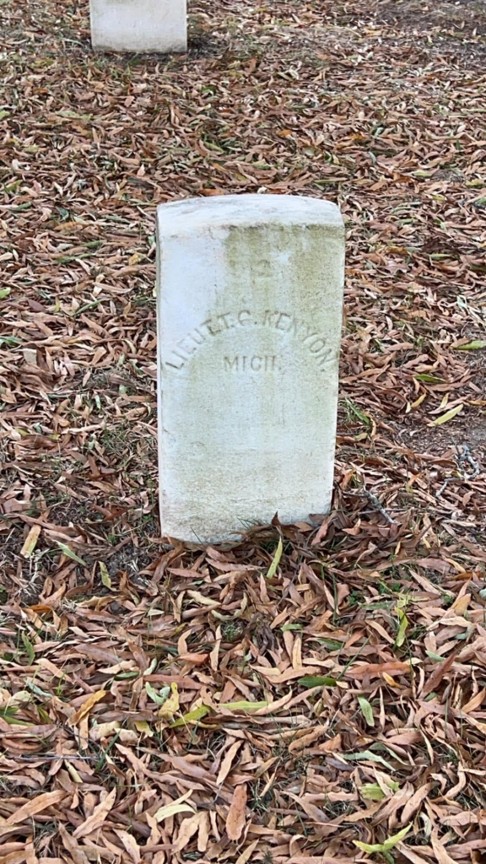
When the VI Corps marched into Danville on April 27, 1865, soldiers went straight to the prisons. Private John S. Hall of the 9th New York Heavy Artillery spent days in the nearby cemetery painting names on wooden grave markers: more than 1,300 of them, 148 bearing no name at all. He hoped, he wrote, that it would bring the families some comfort.
The people who made survival and escape possible were the very people the Confederacy had enslaved: the men who brought food through the Henry County forest, the laborers who pointed prisoners toward safe roads, the cook-house workers who helped where they could and kept quiet about it afterward. None of them appear in official records. None left written accounts. But without them, most of the men who got out of Danville alive would never have made it past the Dan River.
The Monocacy officer’s pamphlet runs forty-two pages and stops mid-sentence, in a freight car moving north out of the city. He had been inside long enough. He had seen enough. When the door closed behind him, he was done writing about it.
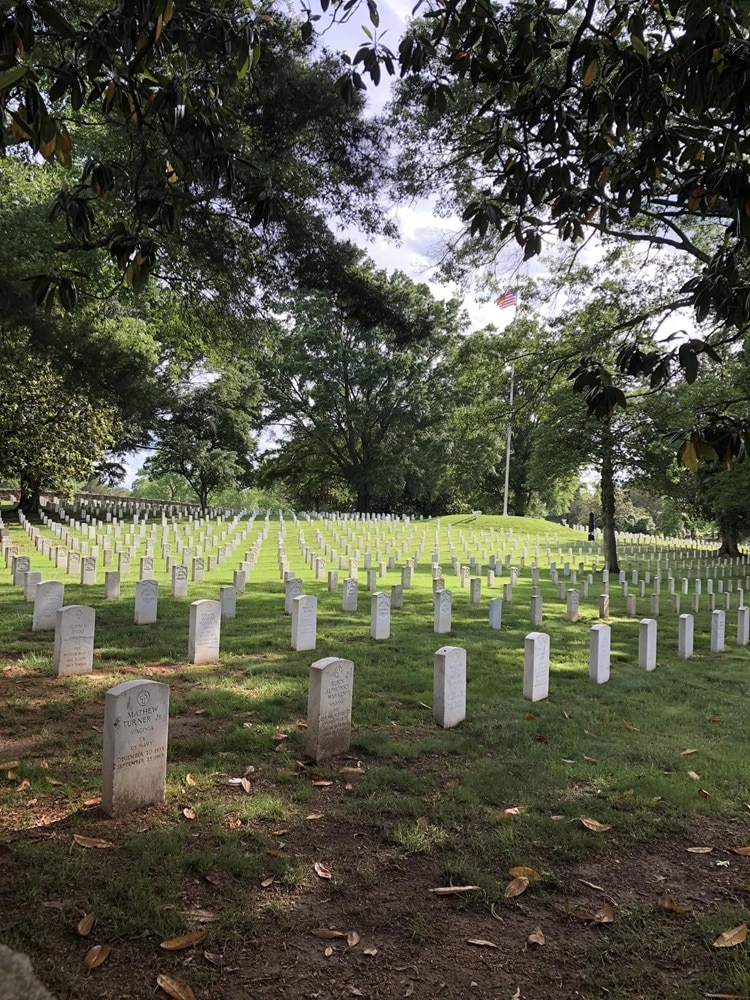
The men he left behind in the Lee Street cemetery are still there, their white headstones in silent rows above the Dan River. Most visitors to Danville know it as the place where Jefferson Davis spent one of his last weeks as Confederate president. Far fewer know it as the place where at least 1,323 Union soldiers are buried on that hillside, in a story that was already years in the making before Davis ever arrived.
Jarred Marlowe is a historian, author, and community leader based in Collinsville, Virginia. He is the social media coordinator for the Blue and Gray Education Society, past president for the Col. George Waller SAR chapter, and serves on the Martinsville VA250 Committee. He is currently working on a book highlighting the role of Danville and Martinsville in the last days of the American Civil War.
Sources
- James I. Robertson, Jr., “Houses of Horror: Danville’s Civil War Prisons,” Virginia Magazine of History and Biography 69, no. 3 (July 1961): 329–345. Robertson’s article remains the foundational treatment of the Danville prison system. The mortality figures cited throughout this article draw on Robertson’s research and on the burial records of the Danville National Cemetery.
- Experiences in a Rebel Prison; or, Experiences in Danville, Va. N.p., n.d. Accessed via Project Gutenberg/Internet Archive edition.
- Joseph Ferguson, diary manuscript, cited in James I. Robertson, Jr., “Danville Under Military Occupation, 1865,” Virginia Magazine of History and Biography 75, no. 3 (July 1967): 332–347. Ferguson’s full account has not been separately published. His observations on the treatment of Black prisoners are corroborated by the anonymous officer’s pamphlet and by the Official Records.
- H. Newlin, An Account of the Escape of Six Federal Soldiers from Prison at Danville, Va. (Cincinnati: Western Methodist Book Concern, 1887). Newlin’s account is available through Project Gutenberg and provides the most detailed firsthand description of the Confederate hospital facility and of the escape route through Southside Virginia.
- Alfred S. Roe, The Ninth New York Heavy Artillery (Worcester, MA, 1899), 247–248. Hall’s grave-marking work is also referenced in Robertson, “Houses of Horror,” 344–345, and in the regimental history of the 9th New York Heavy Artillery.
- Brundage, W. Fitzhugh. A Fate Worse than Hell: American Prisoners of the Civil War. New York: W. W. Norton & Company, 2026.


Jarred,
An important story, well presented. We look forward to hearing more on this topic when you present to the Roanoke CWRT.
The “Monocacy officer”, from other uses of the same account, seems to be Alfred Roe of the 9th NYHA. Just to help put a name to the account! Thanks for adding to the Danville story.
I used it in a previous ECW article here: https://emergingcivilwar.com/2022/04/13/from-monocacy-to-danville-captured-soldiers-of-the-87th-pennsylvania-infantry/
Awesome, thanks for linking it!
I am researching USCT prisoners from the Battle of the Crater at Petersburg for a published article and have found numerous men who were imprisoned and died at Danville and then were buried in the National Cemetery. Thanks for your fine article.
Further reading along these lines can be had with – “The Yankee Plague: Escaped Union Prisoners and the Collapse of the Confederacy” by Lorien Foote.