A Look at How AI Can Assist with Transcription
 Without question, the use of Artificial Intelligence has its pros and cons, its benefits and drawbacks, and its promising and dangerous possibilities. My last few years of teaching high school English (I retired in June 2025) were made far more difficult by the many ways students could now “cheat” when it came to writing their essays and completing their other assignments. We, as teachers, were going back to pen and paper in many cases to ensure students were actually doing their own thinking, writing, and revising. Initially, I must say, I was only focused on the negatives.
Since then, I have actually discovered many ways it can help me in my writing and work. One of those ways arose when I needed to create a list of high schools in my county, along with their principals and their email addresses, so I could reach out to them about the essay contest our South Bay Civil War Round Table was hosting. When I asked AI (aka. Google Gemini) for help, it put together that list in a matter of seconds. A few of the listings were outdated, but it certainly made my job easier than if I’d had to start from scratch.
As a researcher, I am constantly turning to Google to answer many of my questions – not that I always rely on its answers, which can often be at least partially inaccurate, but as a starting point to find sources that may be helpful. My search history is a smorgasbord of seemingly random questions, clearly showing the gamut of the types of research I do, much of it related to family history, books I’m reading, and travel in various parts of the world.
An interesting email exchange several months ago, though, really opened my eyes to some of the possibilities of AI when it comes to transcription work. I wrote about the issues brought up by transcription in a previous ECW post, titled “The Issue of Transcription and Editing: Maintaining “Voice” and Authenticity while boosting Comprehension and Readability.” Those were issues I had to think a lot about as I transcribed fifty Civil War letters written by two of my ancestors for my book A State Divided: The Civil War Letters of James Calaway Hale and Benjamin Petree of Andrew County, Missouri, published in 2024.
The first issue, though, before worrying about maintaining voice and authenticity through the editing process, was actually transcribing the letters, which were often hard to read, sometimes quite faded or even torn, and included many names and slang terms I didn’t recognize. At the time, after putting them in chronological order, I painstakingly began deciphering the fragile pages, often with a magnifying glass in hand, striving to make out these precious words written over a period of three years to family members back home – letters that had come to me through an amazing Ancestry.com connection almost 160 years later.
So, where does AI come into all this? I now fully recognize how it could have helped me with this process. That realization hit me in a gobsmacking sort of way as the result of an email exchange back in March. A woman contacted me with the following message:
Hello Ms. McQuade,
My name is ****. I received your contact information from a colleague of mine, ****, from the African American Civil War Era Round Table organization. I emailed the members asking if they’re knowledgeable in interpreting 18th century cursive writing, and he suggested I contact you since you transcribed your ancestors’ letters for your book. I’ve been trying to read my 4th great-grandfather’s military record document from the Civil War and the writing is extremely hard to understand. Can you assist or know of an organization that I could contact? Your help is greatly appreciated.
I replied that I was willing to “give it a try,” but clarified that I am “certainly no expert” at historical transcription. I asked her to send me the record she was having a hard time reading, and she did. After looking at it, even with my magnifying glass, I knew I wasn’t going to be much help since I could only make out a few of the words in the left hand column (which was where she was having difficulty). Then, I had the idea to take a picture of the record in question and plug it into the “AI Mode” on Google. I had used that method before to digitize text I wanted to use from some old news articles I was hoping not to have to retype, and it had done so quickly and easily. Might it work for this?
This is the record she sent me.
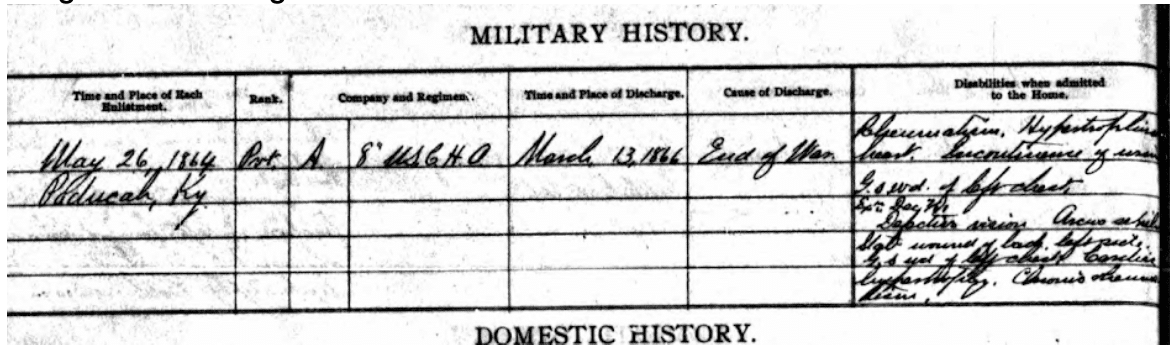
Since the portion in question was the final column, I fed this image into AI, noting that the record had some medical terms I could not read and asking for help.
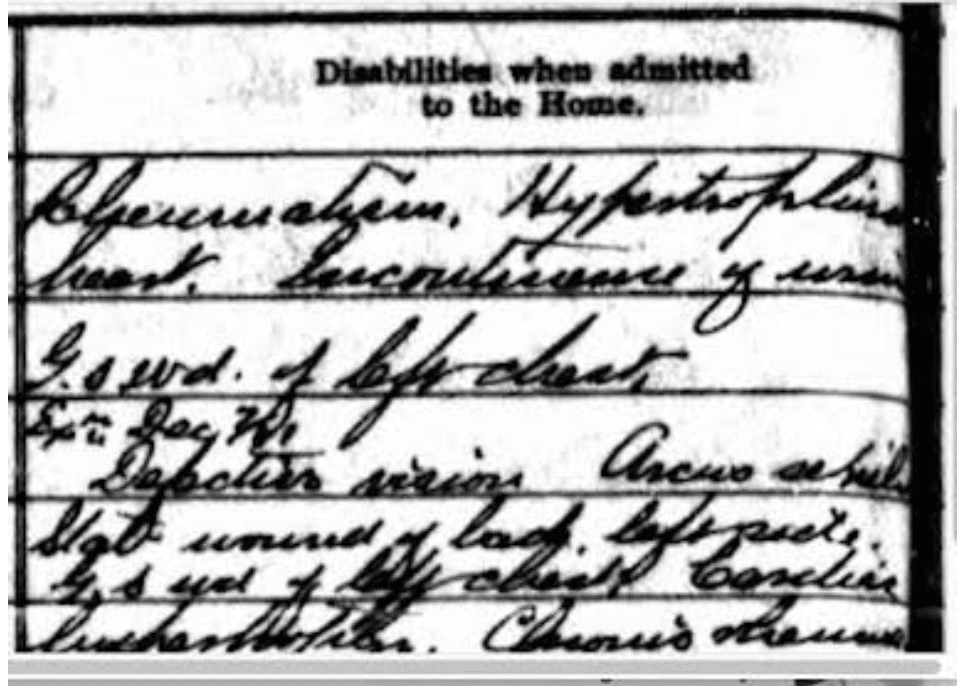
I here include its response in full, as it came to me in seconds – not only with a transcription (which, seemed to be accurate as I looked back at the previously indecipherable writing), but also with explanations of all the terms involved:
Google Gemini Response: This handwritten document lists several medical conditions and injuries. The script is a historical cursive, likely from a military or institutional ledger, which uses common medical abbreviations from that era.
Transcription
Based on the visual features of the handwriting, here is a line-by-line transcription:
Rheumatism. Hypertrophied
heart. Incontinence of urine
G.S.wd. of left chest (Note: “G.S.wd.” is a common abbreviation for “Gunshot wound”)
Exr. Day 71 (This line is partially obscured and appears to be a date or administrative note)
Defective vision Arcus senilis
Slight wound of back, left side
G.S.wd of left chest Cardiac
hypertrophy. Chronic rheum.
Key Terms and Context
Hypertrophied heart / Cardiac hypertrophy: These terms refer to an enlarged heart, often
caused by high blood pressure or overexertion.
G.S.wd. (Gunshot wound): This abbreviation is frequently found in Civil War-era or late
19th-century medical records.
Arcus senilis: A common condition in older adults where a white, grey, or blue opaque ring
appears in the corneal margin (the edge of the cornea).
Rheumatism / Chronic rheum.: A general term used historically to describe various types
of joint or muscle pain and inflammation.
Please note: This transcription is for informational purposes only. You should double-
check the original physical record or consult with a professional genealogist or historian if
these details are critical for official records.
Reading this extremely quick response – which gave me even more than I had hoped for – I sat there, stunned. Wow. How much would that have helped me two years earlier as I transcribed all those letters? I sent the response to the woman who had contacted me, along with a comment stating, “I think it’s pretty amazing (and also scary) what AI can do.” She replied:
WOW!!!!! This is impressive and yes very scary.
Thank you so much!!! Now I need to dig deeper as to when he was shot? What battle was he fighting, where was he taken for treatment, did he return to the battlefield, etc….
I’m sure you know, the more that’s discovered, the more questions I have.
Thanks again.
I have since used AI to help me transcribe other family letters my father gave me, written by one of my paternal great-grandmothers, and it tends to be about 85-95% accurate, depending on how messy the person’s handwriting is. I always go back and cross-check it with the actual letter, making any changes I deem necessary, but it has certainly cut down on the time transcription takes in my research. More recently, I even used it to help translate some old Hungarian records I had for one of my maternal great-grandfathers.
Now, if I was paying someone to do that work, it might mean a lost job for someone (which is certainly a negative consequence we are seeing from increasing use of AI). However, since I am the one doing that work for myself, it simply means I have more time for my writing and other projects, which I have to say is a positive win for me.
If you’ve never used AI in this way, I encourage you to give it a try – but be aware of that 5-15% error rate. And no, that is not scientifically verifiable data as far as error rates go, but that has been my experience when it comes to transcription. I’d love to hear how it works for you!


thank you for the very informative and useful tips.
Good stuff here Tonya. For what it’s worth, here are some of my personal, general musings about the use of AI. Regardless of how anyone feels or believes about AI, it is here to stay. It’s not a fad, it’s not a trend, it is now reality. That genie isn’t going back into the bottle. If we as a nation and society don’t ‘get onboard’ with it, others will, and the results for us as a nation could be quite catastrophic. AI represents enormous opportunity, and hand-in-hand with that is enormous risk. The home computer industry opened up conveniences for its users in the early ’80s or so that were in many ways inconceivable as that industry was developing in various entrepreneurs garages and basements and kitchen tables and school labs. Of course, criminals and others wth nefarious aspirations have been able to cause considerable misery and damage via that technology. Such realities always seem to come with the territory.
As far as the actual hands-on experiences involving AI go, here are some questions I have about it. To begin with, where does the emotional component fit in? The term “artificial intelligence” certainly implies creating original thought, and reasoning all of the attendant factors that goes into that. But where is that emotional component that determines and/or tells us about right from wrong? Empathy, sympathy, compassion, sadness, happiness, and so much more, go into virtually everything we as humans think about. How is that being ‘tackled’ within the AI circles? For those teaching classes on the subject, is that brought up in their discussions? I remember that adage about the Internet that goes “If it’s on the Internet then it must be true!” I’m also familiar with “Garbage in, garbage out”! Will AI be anointed as an unfallible source and resource for ‘truth’? In its present nascent form there are plenty of instances of AI being wrong in some of the information it presents. How will AI be ‘corrected’ in such circumstances?
Another consideration is what role will the government play as AI becomes more entrenched? What kind of regulations can we expect? How much will it be embraced for government ‘purposes’? This is going to be interesting going forward.
Again, good stuff here!
You ask some great questions – but you’re correct in that we can’t just “write it off.” I have plenty of concerns about its uses, and there are many very concerning issues that need to be addressed, and soon. As I do research for the books I am working on, I find myself turning to Google and AI quite frequently – but always knowing that I can’t rely on its answers without double checking other sources. I have had to “correct” it many times, sometimes when it comes to my own work! It can certainly be helpful, though – and in this area of transcription, it has saved me a lot of time and figured things out that were beyond me.
Wow. This post is eye opening. Tonya, is it easy to access and use this Google AI feature you referenced? Is it a free service?
Yes – it’s the free “AI Mode” you find on Google. So easy to use! I’ve had many long “conversations” now with AI, sometimes even getting feedback on my own writing. It can be a helpful editing tool and offer some useful suggestions.
Excellent. Thank you.