Book Review: Researching Your Civil War Ancestor: A Guide to Understanding Civil War Pension Files and Legislation

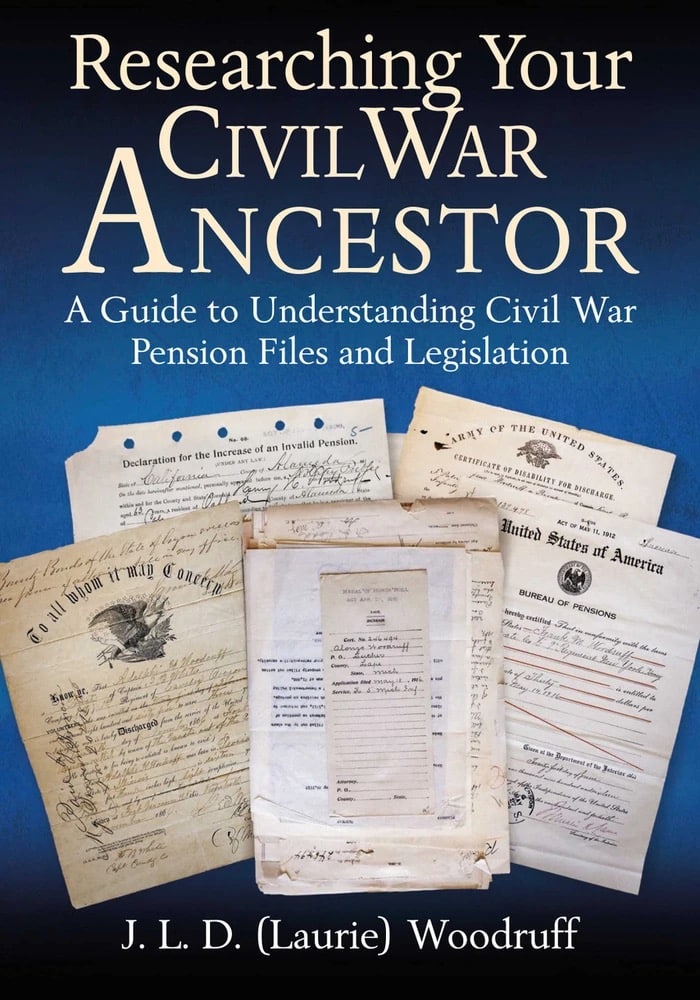
Researching Your Civil War Ancestor: A Guide to Understanding Civil War Pension Files and Legislation. By J.L.D. (Laurie) Woodruff. El Dorado Hills, CA, Savas Beatie, 2026. Paperback, 228 pp., $26.95.
Reviewed by Kevin C. Donovan
Books seeking to assist the efforts of Civil War researchers are not new, as evidenced by Bertram Hawthorne Groene’s Tracing Your Civil War Ancestor (Ballantine Books, New York, 1973) and Alan C. and Barbara A. Aimone’s A User’s Guide to the Official Records of the American Civil War (White Mane Publishing Company, Inc., 1993). J.L.D. (Laurie) Woodruff’s innovation is his focus on one particular resource that he shows can yield a plethora of valuable information on one’s Civil War ancestor as well as many aspects of the war—Civil War pension files.
Woodruff’s Researching Your Civil War Ancestor: A Guide to Understanding Civil War Pension Files and Legislation is the product of his research into more than 125 of his family members who served during the Civil War. In sharing his personal experiences Woodruff illustrates how pension files are a rich source of primary source material on multiple Civil War related subjects, especially the experiences of individual veterans, and how (and why) to access such files.
The book is presented in four chapters, backed by three supporting appendices. Woodruff starts with a brief overview of the Civil War pension system. This explains how federal pension coverage expanded over several decades from only covering those who suffered death or disability during the war to encompass a far larger class, ultimately including anyone who served the Union cause (plus their dependents), regardless of whether the veteran had suffered any fatal or disabling wound. This benefit expansion resulted in a much more comprehensive set of historical records because many more individuals could seek a pension but were required to provide facts and descriptions of war time events in order to support their claims.
In his second—and by far largest— chapter, “What Will You Find in the Pension Files?”, Woodruff provides numerous examples of applicants, both veterans and dependents, who offered detailed and often vivid descriptions of Civil War engagements that resulted in death or injury warranting a pension. As the author notes, many of these descriptions will not be found in other histories of the war. They also are highly personal accounts, as befits the reason for providing such in the first place. Pension applicants also might provide information about family history, including dates and places of birth, names of their children, their occupation before and after the war, and other genealogical information that could prove invaluable for those seeking information about ancestral history.
In his final two chapters, the author explains in practical terms how to locate different types of physical pension files, as well as how to access the text of various legislation authorizing pensions. The latter resource is relevant because it will aid the researcher in understanding what information would necessarily be created as a result of the eligibility requirements imposed by the many laws passed over decades as authority for different types of pensions, as well as revealing those who would be eligible under the evolving standards.
An appendix explains the many different types of “pension record index cards.” These cards were created to capture summaries of pension information found in the original documents, a system the author explains was designed to protect the base documents from deterioration due to frequent handling by those seeking access to the records. A further, quite lengthy appendix sets forth summaries, text excerpts and ways to access the multitude of pension legislation (331 separate acts of Congress) and related regulations that emanated from the government over the years and which governed the contours of required applicant submissions that resulted in the historical records that now are such a valuable resource to researchers.
Although the author’s stated primary purpose is to inform the reader how to access and understand pension records in connection with research into one’s Civil War ancestors, the extensive information provided in this book—intentionally or not—goes well beyond that goal. Specifically, the reader learns how the government addressed a variety of subjects that naturally arose from the decision to award Civil War-related pensions.
For example, how did the government treat already pension-eligible veterans who later joined the insurgent cause? In addition, since prior to emancipation enslaved individuals had no means of legally solemnizing their marriages, how would de facto widows of slain U.S. Colored Troops prove entitlement to a dependent pension? How would the government treat ex-Confederate soldiers who later joined the U.S. Army and served with honor? Would such persons be entitled to pensions? During the period that pensions were based solely on disability caused by wartime wounds, a condition that might not surface until years later, what types of evidence would be deemed sufficient to prove pension eligibility? How did the government detect fraudulent claims? Moreover, when pension eligibility was expanded to extend benefits to veterans based solely on age, how would eligibility be established during an era in which officially issued birth certificates generally did not exist? All of these questions, and more, can find answers in the legislation reproduced in painstaking fashion by the author (or in some cases by discussion by the author). The answers also provide valuable insight into the history of the U.S. military pension system, itself a fascinating object of study.
Finally, this reader was intrigued by a small detail that appeared in several of the wartime documents displayed by the author. That detail was that the name that the U.S. government and pension applicants used to identify the war then being waged. What we now know as the “Civil War” was contemporaneously referred to by the participants (at least in the U.S.) as the “War of 1861.” Again, a small point, but this provides an example of what the author set out to establish: the pension files of the Civil War are a gold mine of interesting and valuable historical information. Kudos to Mr. Woodruff for sharing the results of his own personal efforts.


I guess we had “The late war with the British”, and the War of 1812, so the war of 1861 made sense.
Kevin. Thank you for this detailed review and summary of the book. Questions or observations from readers are welcome. I can be contacted at jldwoodruff@outlook.com.
Laurie Woodruff
It was my pleasure. Your book is a valuable resource and a good read.
Just over 40 years ago, March 22, 1986, my wife and I walked into the gift shop of Fort Point, a Civil War era fort built at the entrance to San Francisco Bay. I spotted Bertram Hawthorne Groene’s “Tracing Your Civil War Ancestor” on the shelf and purchased it. To say that it changed my life would be an understatement. I had grown up with an interest in Civil War history, but his book gave me specific tools to learn more. What I learned in Groene’s book set me on a course not only into genealogy but the entire area of Civil War research, so I am very thankful for his book.
“Researching Your Civil War Ancestor: A Guide to Understanding Civil War Pension Files and Legislation” looks to be much like that- a practical guide to get the most out of Civil War pension files. Pension files have been a very helpful for my own family history and Civil War history research, but they are not always easy to work with or understand. Therefore, I look forward to getting a copy of my own. Thank you for the review and bringing this book to our attention and also to the author for writing it!