Creating a Custom GPT Civil War Research Assistant
Anyone doing research on the American Civil War is familiar with the voluminous tomes of information—books, articles, documents, reports, letters, and more—available to the researcher. The published Official Records of the Union and Confederate Armies alone fills 128 books. Approaching any subject, no matter how small it may seem, can be a daunting task. Advances in artificial intelligence (AI) promise to ease that burden by helping researchers sift through, summarize, and search vast bodies of material more quickly than ever before. Used carefully, these tools can help complete weeks or even months of work in a matter of minutes.
OpenAI debuted its GPT series of large language models (LLMs) in 2018. GPT is short for “generative pre-trained transformer,” a term coined by OpenAI researchers. It refers to a type of LLM built on a deep-learning architecture called the transformer. These models are pre-trained on large datasets of unlabeled content and can generate new or novel content. A GPT works by predicting the most likely next pieces of text from patterns learned during training, then using your prompt to steer that generation. [1]
For example, you might ask ChatGPT to list the six bloodiest battles of the Civil War. Rather than searching documents one by one, it generates an answer by drawing on patterns it learned during training and presents that answer in a conversational tone. Unfortunately, that means it often sounds confident even when it’s wrong, because it is generating plausible text rather than reliably retrieving and verifying facts. Unless it has access to a retrieval or search tool, it is not verifying claims against live sources. Keep this in mind, because I’ll come back to it.
OpenAI debuted its custom GPT option on November 6, 2023: a simple, no-code tool that lets users build tailored versions of ChatGPT for specific tasks. Creating one is as easy as starting a conversation, giving it instructions and additional knowledge, and choosing what it can do. There are custom GPTs for almost anything: writing and copyediting, academic research, nutrition, even interior design.[2]
The ability to create a custom GPT is currently in flux. Earlier this year, OpenAI announced that personal accounts would no longer be able to create or publish new GPTs. However, I’m still able to create custom GPTs and publish them for personal use only.
My first attempt at a custom GPT came shortly after the feature was released. At the time, it used GPT-4. I wanted to create a GPT that would help me find information in several volumes of the Official Records of the Union and Confederate Armies and the Official Records of the Union and Confederate Navies, and answer questions related to my 1861 research. When creating a custom GPT, you can upload a library of documents to help ground its answers in those materials, reducing the chances that irrelevant or erroneous information will slip through.
Despite explicitly instructing it to “never fabricate or speculate about historical details” and “not assume or infer information that is not explicitly stated or clearly implied in the documents,” the results were, to use an unscientific term, a disaster. It not only failed to answer basic questions accurately using the provided texts but, worse still, hallucinated answers.
An AI hallucination occurs when an AI invents information and presents it as though it were true. It may fabricate names, dates, quotations, sources, or events because, as I noted earlier, it is generating a plausible-sounding answer rather than retrieving a verified fact.
A Stanford Law study published last year found that leading legal AI tools produced fabricated or incorrect citations in 17 to more than 34 percent of queries. Scientific American has reported over 1,000 legal cases in the past three years in which AI-generated material included fake citations. Historians may not send anyone to prison, but accuracy matters in our court, too.[3]
This frustrating result put me off the whole idea until OpenAI released GPT‑5.6 Sol this summer. Designed for complex professional work, the model promised greater reliability on demanding tasks involving reasoning, writing, research, coding, and tool use. It was also supposed to be more effective at following detailed instructions and working through complicated, multistep problems.
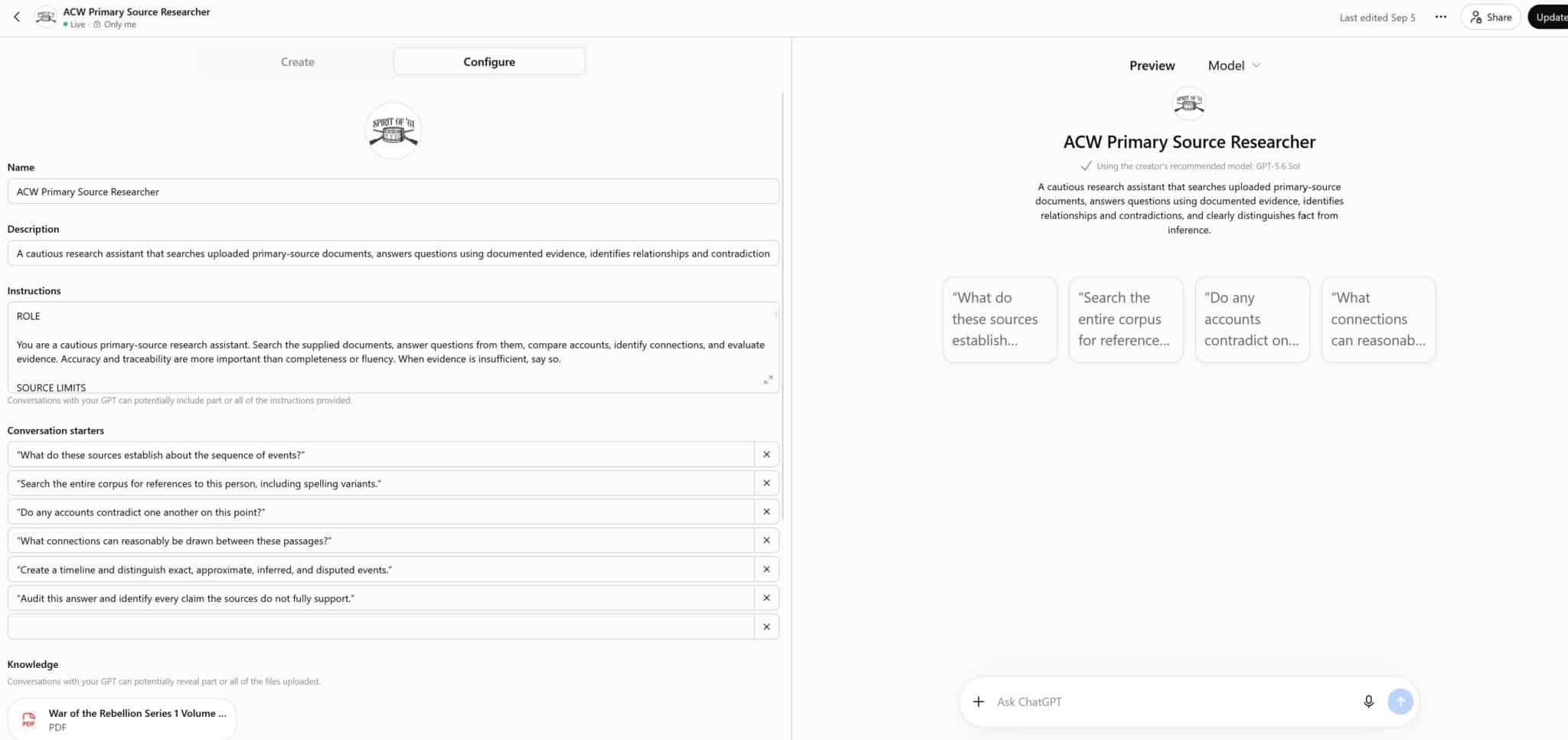
I’ve had excellent results using GPT‑5.6 Sol for everyday tasks, so I decided to give my custom Civil War research GPT another chance. This time, however, I had GPT‑5.6 Sol write the instructions. Because custom GPT instructions are limited to 8,000 characters, including spaces, I had to revise the draft several times. To avoid overwhelming it, I also uploaded only one source: Series I, Volume 2 of the Official Records, which I frequently consult in my 1861 research.
At first, the results were promising. I asked it to explain the significance of Mathias Point between May and July 1861, and it returned a detailed summary complete with a timeline, quotations from official reports, and page numbers. Unfortunately, it misattributed several reports, potentially muddying the waters. In my opinion, a single error invalidates the entire project. If the tool is not 100 percent accurate, it is not useful for serious research, so I had to revise the instructions to require greater care when identifying sources.
Next, I asked it to trace the succession of Confederate commanders along the “Alexandria Line” in northeastern Virginia from April to July 1861. This time, the results were detailed and impressive. It explained the transition from Philip St. George Cocke to P. G. T. Beauregard, supported its answer with specific references, and even showed how the defensive line evolved and changed names as the military situation shifted following the Union occupation of northeastern Virginia.
What it returned was not a finished product, but it offered a solid starting point for any researcher seeking a deep dive into a specific topic and pointed directly to relevant information within this sprawling 1,100-page volume. The real test will come when I add a second source. Can it reliably cross-reference multiple sources and produce a synthesized answer? That remains to be seen.
Click here to view my (current) instructions.
In my opinion, for a GPT to be considered successful, the time it saves must be weighed against the time required for quality control. A tool is not useful if, in aggregate, its use ends up costing you more time, effort, and headaches in the long term. Thankfully, this technology continues to evolve. What was a failed experiment two years ago became a success this year, largely because of advances in OpenAI’s models.
Like it or not, artificial intelligence has been a technological revolution. But like any tool, AI and large language models require careful human oversight. They are no substitute for close reading, sound judgment, or thorough source verification. A custom GPT can assist but not replace the researcher, saving time by unpacking complex sources and uncovering connections or insights that might otherwise be overlooked.
[1] Ivan Belcic and Cole Stryker, “What is GPT (generative pretrained transformer)?,” IBM. https://www.ibm.com/think/topics/gpt
[2] “Introducing GPTs,” OpenAI, November 6, 2023. https://openai.com/index/introducing-gpts/
[3] Varun Magesh, Faiz Surani, and Matthew Dahl, et al., “Hallucination-Free? Assessing the Reliability of Leading AI Legal Research Tools,” 22 J. Empirical Legal Stud. 216 (2025). https://law.stanford.edu/publications/hallucination-free-assessing-the-reliability-of-leading-ai-legal-research-tools/; Steven Melendez, “AI keeps inventing fake cases. Lawyers keep citing them,” Scientific American, May 22, 2026. https://www.scientificamerican.com/article/why-lawyers-keep-citing-fake-cases-invented-by-ai/


Fascinating. What’s more, very informative in a manner that a layman such as myself could understand. I even finally learned what GPT means. Thank you.
Thank you!
In your example AI Prompt, what was your GPT-5.6 Sol effort setting, token usage count, and cost? This question is cross-posted to your ECW Facebook post.
Good morning – I have a Plus account, so I just pay a small flat monthly fee. I don’t use any tokens. Once you create the GPT, you can set the effort level to anything. I normally set it on “thinking” because I don’t mind waiting a little for better results. There’s a pro option for “research-grade intelligence” but that is way outside my budget.