What’s in a Nickname?: The Many Monikers of the Confederate Ironclad Ram Manassas
One of the surprising things I encountered while researching Ironclad Ambush: Confederates Strike Lincoln’s Mississippi River Blockade at the Head of Passes, October 12, 1861 centered around nicknames for the Confederate ironclad Manassas.
When it comes to the US Civil War, nicknames abound. Hundreds of generals each had their own nicknames, some flattering and some not quite. Hosts of regiments, batteries, and even companies also had their own nicknames of endearment. Like today, ships of the Civil War often had nicknames as well; USS Monitor being called a “cheesebox on a raft” comes to mind. But one ship in particular, the Confederate ironclad Manassas, had at least a half dozen distinct nicknames.
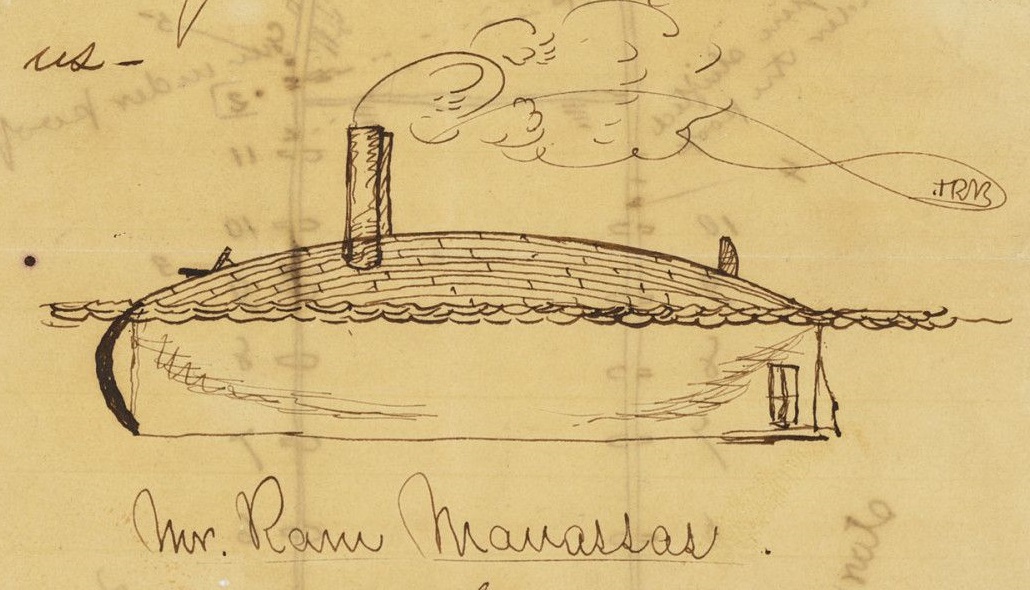
CSS Manassas was the first ironclad warship utilized in the Civil War. The Confederate ship was originally envisioned as a privateer to attack and breech the blockade. Confederate naval leadership at New Orleans seized the ship in late 1861 and tested it at the battle of the Head of Passes in October 1861. The ship was ultimately destroyed on April 24, 1862, in the battle of Forts Jackson and St. Philip in a failed effort to maintain Rebel control of the Crescent City.
Manassas’s many nicknames came to the ship from three avenues: a physical description of the vessel itself, nicknames pertaining to its mission, and a nickname related to its name. Unpacking each nickname, where it came from, and what it means will help Civil War enthusiasts better understand how Civil War participants dealt with the stress of naval combat operations.
The ironclad Manassas was a different design than most other ironclads of the era. It was relatively small (crew of less than 40) and was modified into the warship it became from the antebellum tug Enoch Train. The ship had a convex hull where the vessel laid very low in the water. It housed a single gunport to fire a sole piece of artillery. Its real weapon was the iron ram affixed onto the vessel’s bow. There were no masts or sails, and an inch of iron was overlaid atop the shell of the upper hull. It was a ship that certainly looked much different than most others of its time.
Several nicknames targeting description of CSS Manassas became regularly used in 1861 and 1862. The most popular of these physical description nicknames was “turtle,” linking the vessel’s concave shell with that of a turtle’s shell. George N. Hollins, the Confederate naval officer who seized the ship, himself noted in his (admittedly confusingly written) memoir that “the Manassas was the name of the iron-clad, or nicknamed the ‘Turtle.’”[1] A New Orleans man visiting the city’s shipyards in 1861 agreed that the ironclad was “commonly called ‘the turtle.’”[2]
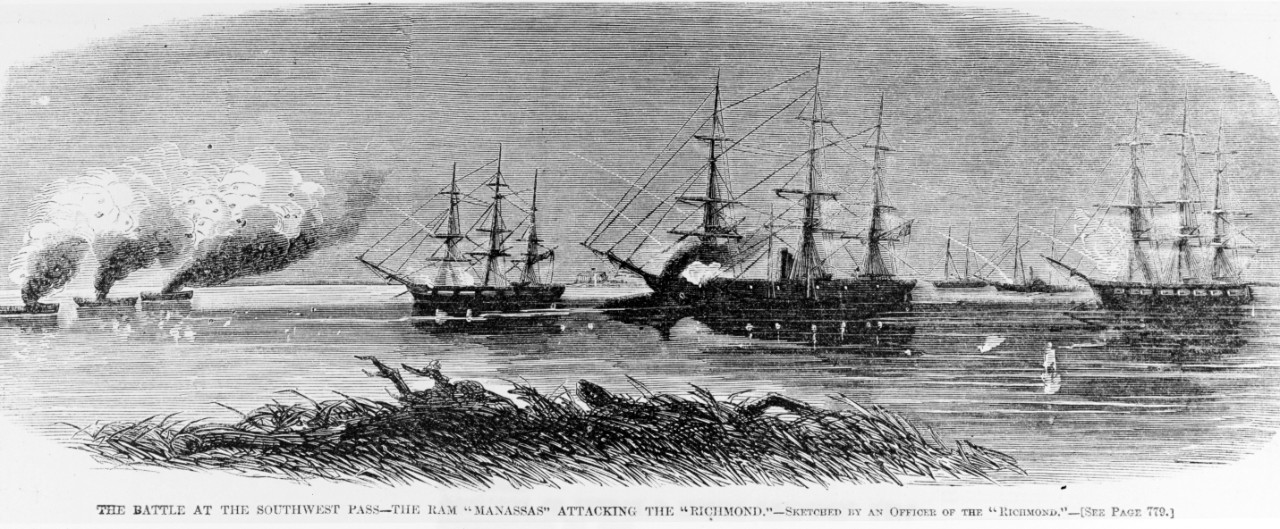
The ship also had nicknames based on other animals. In keeping with the sea creature theme, Cmdr. Henry French, a Federal naval officer who saw Manassas in battle in October 1861, described the Confederate ironclad as “a high whale in the water.”[3] One New Orleans newspaper labelled the ironclad “Gyascutis,” the genus name for a type of beetle.[4]
Manassas had another nickname that developed largely because Confederates were not sure what it was. Thus, they called it a “nondescript.” Confederate Cmdr. Raphael Semmes referred to the vessel as “a little nondescript ram” after seeing the ship converting in 1861.[5] Jeanie Mort Walker, wife of another Confederate naval officer at the Crescent City, did much the same, referring to the ship as “a nondescript iron-clad.”[6] As far away as Virginia, soldiers acknowledged that the ironclad was “better known as the nondescript.”[7]
Just as Civil War battles often had two names, many people began calling Manassas by its alternative battle name. Since the ship was named to honor the battle of First Manassas in July 1861, a battle Federals instead called Bull Run, the ship was occasionally called Bull Run. Boston Journal correspondent Albert G. Hills did so, as did Confederate naval engineer John H. Dent.[8]
Another string of nicknames emerged related to the Manassas’s primary weapon, its ram. One Federal naval surgeon, Charles Foltz, said that men on USS Niagara called Manassas “The Boomerang.”[9] One man wrote to US Navy Secretary Gideon Welles calling Manassas “a battering ram.”[10] Another surgeon, Joseph Shively, likewise called the ship “the ironclad battering ram.”[11] Even North Carolina civilian Sarah Wadley agreed, calling the vessel “a sort of battering ram.”[12] Perhaps the most famous example of calling Manassas a battering ram came from the poem “Capture of New Orleans” written by USS Brooklyn sailor William Densmore.[13]
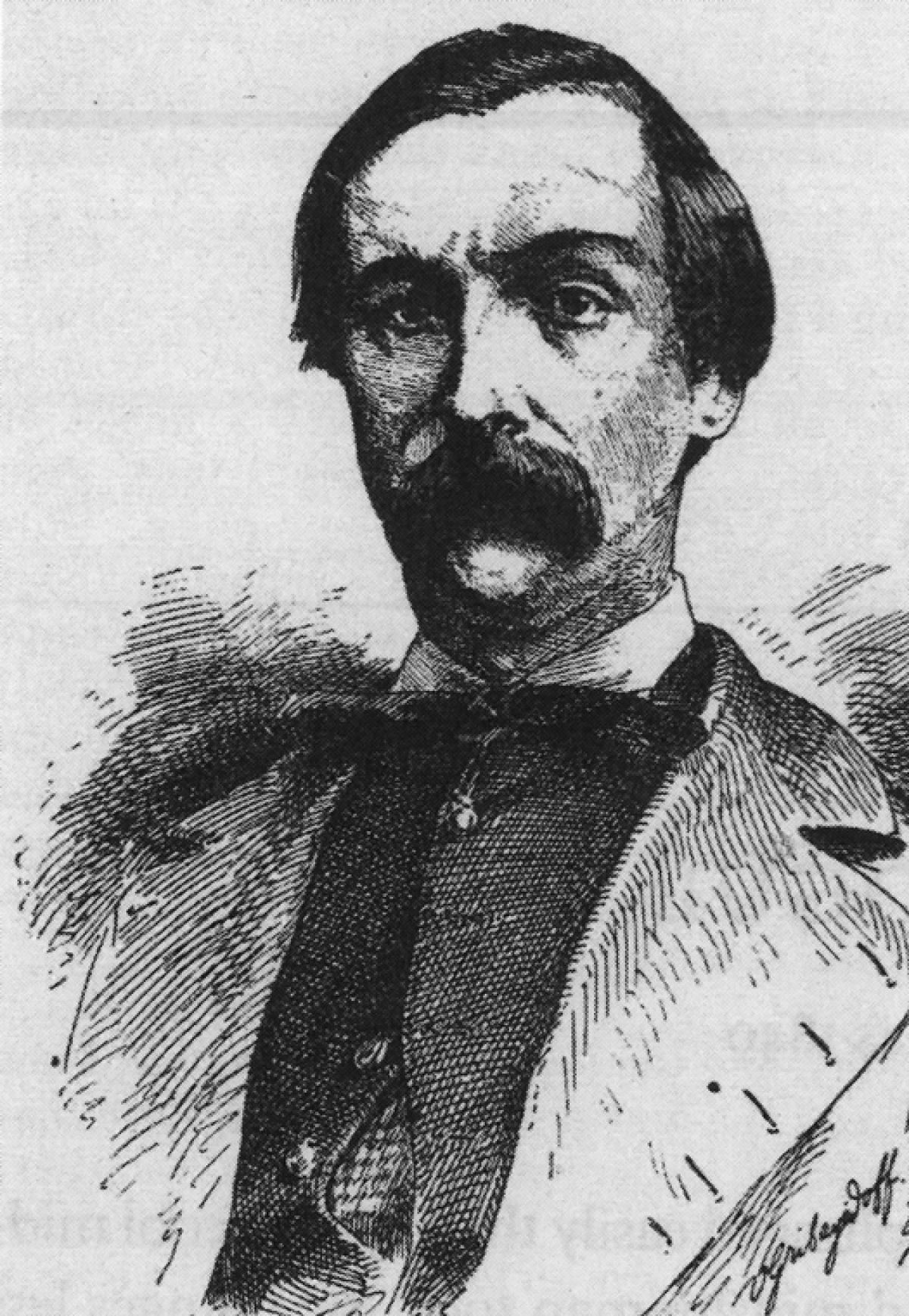
For Federal line officers, the most popular moniker for CSS Manassas was simply “the ram.” The ship was called “the ram” by no less than Rear Admiral David Farragut, as well as Capt. John Pope, Capt. Thomas Selfridge, Acting Master Edward Devens, and Acting Master Frederic Hill.[14] Junior Confederate naval officers, such as Midshipman Charles W. Read and Midshipman James M. Morgan, likewise simply referred to Manassas as “the ram.”[15]
The ironclad’s final nickname came from its skipper, Lt. Alexander Warley. Writing in June 1865, Warley provided a wartime closing to the vessel, noting “I may mention the end of the Manassas, the greatest humbug that ever was used as a bugbear.”[16] Regardless of what the ship was called, CSS Manassas went by many names as it helped transition Civil War navies from sailing wooden vessels to ironclad steam powered ships.
Endnotes:
[1] George N. Hollins, “Autobiography of Commodore George Nicholas Hollins, C.S.A.” Maryland Historical Magazine (1939), Vol. 34, No. 3, 239.
[2] “The Manassas,” Daily Picayune, New Orleans, LA, September 19, 1861.
[3] French to McKean, October 22, 1861, Official Records of the Union and Confederate Navies in the War of the Rebellion, Series 1, Vol. 16, 712.
[4] “The Naval Combat,” Daily True Delta, New Orleans, LA, October 13, 1861.
[5] Raphael Semmes, Memoirs of Service Afloat: During the War Between the States (Baltimore, MD: Kelly, Piet, and Co., 1869), 112.
[6] Jeanie Mort Walker, ed., Life of Capt. Joseph Fry: The Cuban Martyr (Hartford, CT: J.B. Burr Publishing Company, 1875), 144.
[7] John R. Woodbridge to Charles H. Thurston, October 21, 1861, Charles H. Thurston Correspondence, Accession 10706, Special Collections Department, University of Virginia Library.
[8] Gary L. Dyson, ed., A Civil War Correspondent in New Orleans: The Journals and Reports of Albert Gaius Hills of the Boston Journal (Jefferson, NC: McFarland & Company, 2013), 96; John H. Dent Jr. to Papa, CSS McRae, October 10, 1861, John Horry Dent Jr. Letters, The University of Alabama Libraries Special Collections.
[9] Charles S. Foltz, Surgeon of the Seas: The Life of Surgeon General Jonathan M. Foltz (Indianapolis, IN, Bobbs-Merrill Company, 1931), 203.
[10] Union to Gideon Welles, July 27, 1861, Area 4, Mississippi River, Area File of the Naval Records Collection, 1775-1910, M625, RG 45, US National Archives.
[11] October 31, 1861, Journal of Surgeon Joseph Warren Shively, Spared & Shared, https://sparedshared22.wordpress.com/2021/10/11/the-civil-war-journal-of-dr-joseph-warren-shively/, Accessed June 3, 2022.
[12] Sat Oct 19 1861, Diary of Sarah L. Wadley, Sarah Lois Wadley Papers, 1859-1886, Collection 01258, Southern Historical Collection, University of North Carolina-Chapel Hill.
[13] Daniel G. Hoffman, “Historic Truth and Ballad Truth: Two Versions of the Capture of New Orleans,” The Journal of American Folklore, July-September 1952, Vol. 65, No. 257, 299.
[14] Farragut to Welles, March 13, 1862, ORN, Series 1, Vol. 18, 31; Pope to McKean, October 13, 1861, ORN, Series 1, Vol. 16, 703; Selfridge to Farragut, March 7, 1862, ORN, Series 1, Vol. 18, 32; Devens to Fox, Oct 28, 1861, Robert Means Thompson and Richard Wainwright, eds., Confidential Correspondence of Gustavus Vasa Fox: Assistant Secretary of the Navy 1861-1865, Vol. 1 (New York: De Vinne Press, 1918), 394; Frederic Stanhope Hill, Twenty Years at Sea: Leaves from My Old Log-Books (Boston, MA: Houghton, Mifflin, & Company, 1893), 155.
[15] Charles W. Read, “Reminisces of the Confederate States Navy” Southern Historical Society Papers (1876), Vol. 1, 334; James M. Morgan, “The Pioneer Ironclad,” United States Naval Institute Proceedings, Vol 43, No. 10. (October 1917), 2277.
[16] Extract from papers of Lieutenant Warley, C.S. Navy, commanding C.S. ram Manassas, July 1865, ORN, Series 1, Vol. 18, 342. A monument to Manassas near Lake Pontchartrain in Louisiana does not list any nicknames.


More great information about the first iron-clad, the people of the time, and the English language. I’m reading your latest book now.
How much more iron by inch could they have covered her with without compromising her ability to steam around and ram in the lower Mississippi?
For the longest time, the only description of “the ram at the Head of Passes” in the North was that provided by eyewitness crew members of the US Navy ships engaged October 1861. In OR(Navy) series 1vol.16 page 712 Commander French of USS Preble called it “an indescribable object” initially, but went on to state “it looked like a huge whale in the water.” On page 713, CDR French concedes: “it must have been the ram, of which we had been told so much.” Captain Pope of USS Richmond simply called the Rebel vessel “the ram” [page 711.] And Flag-Officer McKean on page 703 summarized the various descriptions and labelled the Rebel vessel as “the steam ram.”