Book Review: The Business of Bigotry: John Van Evrie’s Nineteenth-Century Racist Media Empire

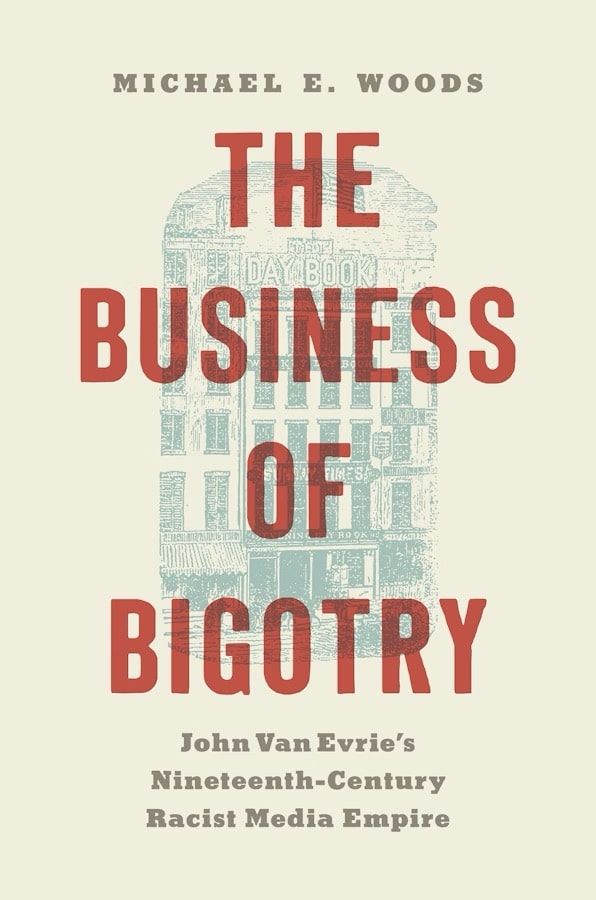
The Business of Bigotry: John Van Evrie’s Nineteenth-Century Racist Media Empire. By Michael E. Woods. Chapel Hill: University of North Carolina Press, 2026. Paperback, 333 pp. $34.95.
Reviewed by Max Longley
Twenty-first century debates about alleged hidden or subtle racism have nothing to do with John Van Evrie (1814–1896). The physician-turned-editor-and-publisher dedicated himself, after leaving the healing profession, to the dissemination of explicitly racist ideas, earning considerable influence in both North and South during the Civil War era. Indeed, Van Evrie has been described as “perhaps the first professional racist in American history.” (2)[1]
Van Evrie made the term “white supremacy” popular. He rejected monogenism—the idea that all human beings have a common origin. Monogenism at the time had both egalitarian and racist variants. Anti-racists said that a common origin made all humans equal, but racist monogenists said that human beings started out the same, but that Whites ended up as a superior type vis-à-vis Blacks. Polygenism – Van Evrie’s concept—was not open to such differing interpretations. To polygenists like Van Evrie, Whites and Blacks were separately created—Blacks as an inferior race suited to serve the Whites. Thus, when defending the institution of slavery, Van Evrie put “slavery” in quotes because he did not think that the term sufficiently reflected the allegedly inherent inferiority of Blacks.
Van Evrie not only sincerely held his white-supremacist ideas, but he also sincerely believed in making those ideas central to American life. As a businessman, editor and publisher, Van Evrie constantly changed his strategies for marketing white supremacy in light of the changing conditions of the Civil War era. Author Professor Michael E. Woods explores the history of Van Evrie’s white-supremacy businesses. Woods studied census records (often to find out the backgrounds of people who promoted Van Evrie’s newspaper or signed pro-Van Evrie petitions), numerous private papers including business records, and of course Van Evrie’s own publications and publicity materials to provide a picture of this man and his efforts.
Van Evrie’s ancestors fought for the British in the American Revolution and subsequently moved to Canada. Rejecting this heritage, Van Evrie settled in New York state and tried to make a living as a physician. By Van Evrie’s later account, the young doctor’s views on race were fixed when he went to Mexico during the U.S. invasion and saw what he forever after proclaimed to be the evil results of racial intermingling. Curiously, Van Evrie’s “cure” for that “problem” was the South’s slave system, which notoriously was associated with racial mixture (much of it forcible).
Failing as a physician, Van Evrie published a book whose themes he stuck with ever after. He popularized polygenist ideas and their political implications. Van Evrie blamed Britain for fomenting abolitionist and racially egalitarian ideas in order to weaken America and American Whites.
Van Evrie became an editorialist for an ideologically compatible New York City newspaper, the Day Book, and two years later—in 1857—he was a co-owner. Before the takeover, the Day Book had received patronage (in the form of printing contracts) from officials in the Pierce administration, but that dried up under President Buchanan. Yet Van Evrie more than made up for this loss with his own improved marketing. Most of the newspaper’s customers were White Southerners involved with slavery, but the Day Book also promoted itself to New York City merchants who served as middlemen selling Southern products in Europe. Through the Day Book, Van Evrie proclaimed that Southern and Northern Whites were all on the same side, with the whole county’s prosperity based on Southern slavery (or “slavery”). As anti-slavery forces grew in the North, the Day Book also grew, by focusing on the “dangers” of antislavery politics.
After war broke out, Van Evrie became a copperhead, a Northerner seeking a negotiated, proslavery reunion. Sporadic censorship by the Post Office, local military commanders, and mobs, posed a challenge but not an existential one. Van Evrie tried to make up for Confederate subscribers cut off by the war by appealing to the Northern White working classes – his lower-income supporters tended to be rural and native-born. Van Evrie’s publishing company printed racist tracts by himself and by similarly minded authors.
Peace brought back Southern White subscribers, while Reconstruction provided new opportunities to emphasize the “perils” of racial egalitarianism. Van Evrie relied on wealthy locals in various communities to promote subscriptions to the Day Book. He blasted Republicans and insufficiently-racist Democrats, while flirting with Southern terrorists. His publishing company continued to sell white-supremacist literature, including promoting the old Confederacy as right about slavery (albeit wrong about the Union).
In 1872, allegedly prompted by a financial sweetener, Van Evrie briefly boosted longtime racial liberal Horace Greeley for President in 1872 against President Ulysses Grant. Though he later switched from Greeley to a “straight out” Democratic white-supremacist candidate, many of Van Evrie’s core supporters saw him as a sellout to the racist cause. Van Evrie’s political influence withered away after this, though he lived until near the end of the century.
Anyone interested in the civilian side of the Civil War should learn about the life of that supervillain racist propagandist, John Van Evrie. Woods’ book is a thorough history of Van Evrie’s life and unique business career. There are plenty of studies of the effects, during this era, of the various stands of White racism, but as far as Van Evrie and his influence, Woods’ book is for now authoritative.
[1] The quoted charge is from George M. Fredrickson, The Black Image in The White Mind – The Debate On Afro-American Character and Destiny, 1817-1914 (Hanover, NH, University Press of New England, 1987), 92.


Very interesting. I never heard of this guy. Mostly we hear of those who fought against racism–and not nearly enough about those who promoted racism in the past, because history has forgotten such losers. We need to know about them.
Kind of ironic that the biggest racist and pro-slavery demagogue lived in New York.
Ah, UNC-Chapel Hill – forsaking serious publishing in order to socially re-engineer America – and American History – out of existence. Happily, these National Socialists will fail, just like those before them.
How’s your book(s) coming along Pard?
Just interested in knowing whether anyone else had ever heard of this fellow. He appears to be utterly forgettable. Did he actually have any sort of substantial following at the time, or was he always on the fringe?