Memory in Brass: The Fourteenth Wisconsin Captures—and Keeps—a Cannon
ECW welcomes back guest author James Marten.
The Fourteenth Wisconsin captured a Confederate cannon during their first few hours of combat at Shiloh. Far more than most artifacts of war that accompanied survivors into peacetime, the twelve-pounder remained central to their memory of the Civil War for the rest of their lives, a memento of regimental fortitude rather than individual valor.
The men of the Fourteenth were rather unlikely heroes during the fighting on April 7, 1862, the second day of the battle. The regiment had mustered into federal service in late January 1862 and spent that bitterly cold winter training at Camp Wood in Fond du Lac, named for their commander, Col. David E. Wood. The Fourteenth was sent south in late March, as Gen. Ulysses S. Grant assembled an army to begin the campaign along the Mississippi River. They spent a few days in St. Louis before continuing on to Savannah, Tennessee.
Not yet assigned to a brigade, the regiment spent April 6 listening to the heavy cannonading and musket fire from several miles downriver. “News came that the enemy were driving us,” assistant surgeon Duncan Cameron wrote a few days after the battle. Around 4:00 p.m. Col. Wood eagerly agreed to join an ad hoc brigade being formed to reinforce the hard-pressed Union force. “It was as dark as Egypt” when they stepped off a steamboat at Pittsburg Landing late in the evening. The men stumbled up a slippery bluff and to a path leading to the battlefield. “It was a dreary walk up that road,” wrote Cameron, “muddy, narrow, dark, and the air filled with the neighing of horses, the braying of mules, and the sickening odor of human blood, and the groans of wounded and dying men.”[1]
After a decidedly uneasy night, the Fourteenth joined a line of battle along the Eastern Corinth Road in the left-center of the Union line. Just after 8 a.m. “the rebels came pouring down upon us in fearful numbers, with wild yells.” The Fourteenth rose and “at the rebels they went in real earnest,” eventually making a bayonet charge that drove the rebels for a mile and captured a battery. Although it was lost and retaken two more times, the regiment finally held the ground and the guns on it. “Nearly every man did his whole duty, and acted as patriots and heroes should act.”[2]
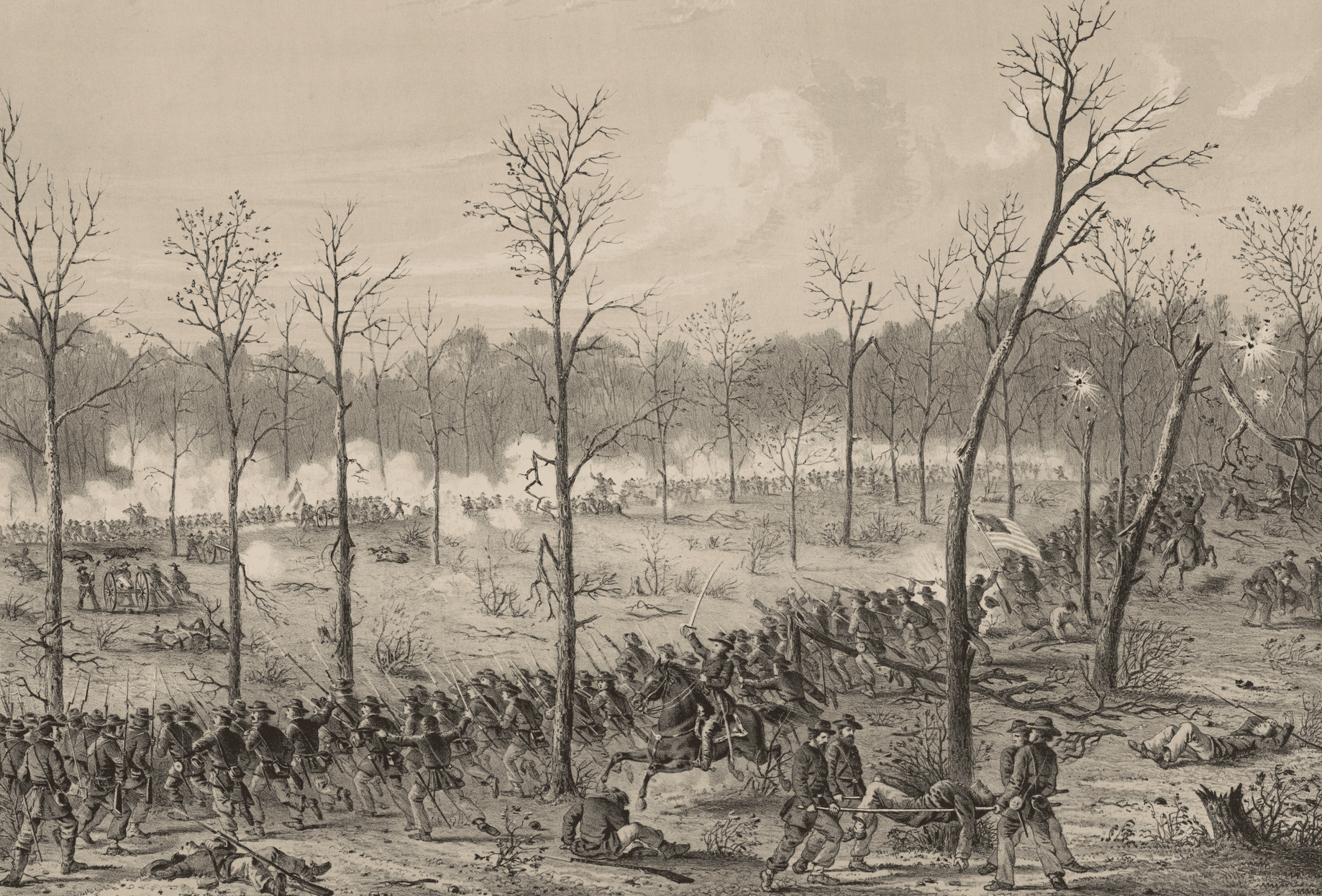
The regiment lost seventy-four wounded and sixteen killed, including Capt. George Waldo, a brave and popular company commander who was shot through the heart. Colonel Wood survived the battle but died of disease two months later. The regiment went on to have a distinguished career. They were assigned to provost duty immediately after the battle, took part in the Corinth campaign, were the first Union troops to occupy Natchez, and were heavily engaged at Vicksburg, losing over one hundred men in a frontal assault. After most of the men re-enlisted in 1864, part of the regiment served under Sherman during the Atlanta Campaign and the March to the Sea, while the bulk took part in the Red River Campaign and the capture of Mobile, Alabama. Altogether 122 officers and men were killed in battle, while 197 died of disease and nearly three hundred were discharged for disability.[3]
In the meantime, the Fourteenth had sent its captured cannon to their state capital at Madison. By mid-June 1862 the prize had already taken a place of honor in the park surrounding the capitol building, where huge crowds were “constantly huddling around it.” It remained a popular attraction at the capitol for decades.[4]
While many units proudly displayed their tattered battle flags as totems of patriotism and sacrifice, the Fourteenth Wisconsin naturally commemorated the artillery piece that symbolized their unlikely role in a signal Union victory.
When veterans of the Fourteenth held their annual reunion in Fond du Lac in 1886, they held the usual business meeting, listened to formal papers about battles and marches, and held a “campfire,” where comrades ate hardtack and beans and told stories of battles, marches, and camps. But the highlight of the reunion came when attendees crowded around “their” Shiloh cannon—which had been shipped the hundred-plus miles from Madison for the occasion—to have their picture taken with the symbol of their greatest accomplishment as a regiment.
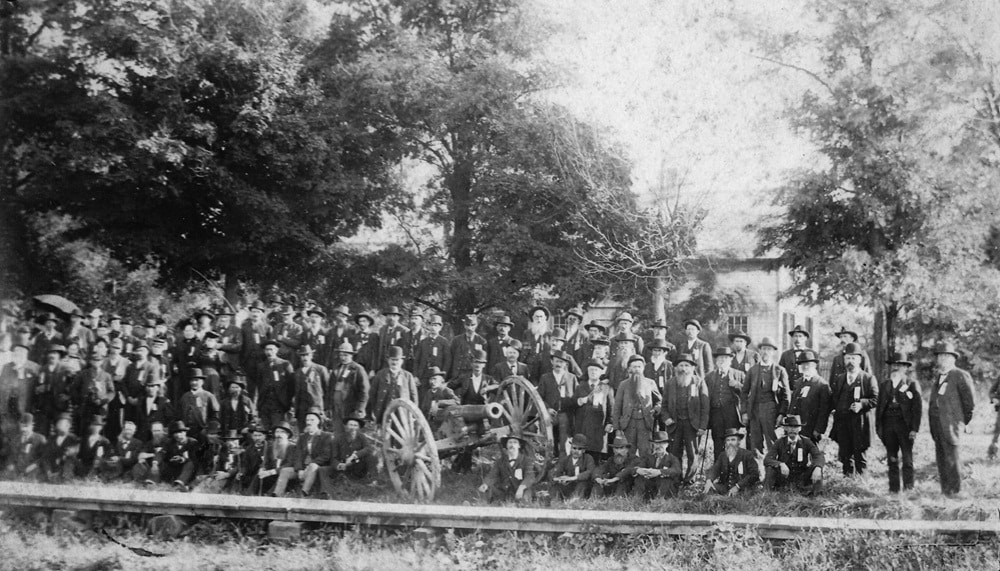
The cannon remained a source of pride and remembrance. In 1891 an almost mythic story of the cannon’s provenance was published. It held that Gen. Grant had actually witnessed the event. After a Kentucky regiment had valiantly failed to capture the Confederate battery, the commander of the ad hoc brigade to which the Wisconsinites belonged turned to Grant, pointed to the Fourteenth with his sword, and said “General, that regiment can take that battery.” They did, and when Grant traveled to his old home in Galena, Illinois, many years later, a number of veterans from La Crosse, home to many men of the Fourteenth, traveled downriver to meet him. The episode naturally came up, and Grant supposedly said that he remembered that moment of the battle clearly—although he held that it was his idea for the Fourteenth to make the attack. “I felt when I made the suggestion that the regiment could capture the battery that they were just the men to do it. It was a most gallant charge.”[5]
The moment was memorialized permanently in 1907 when the Wisconsin monument honoring the Fourteenth, Sixteenth, and Eighteenth Wisconsin, featuring several bas relief sculptures, including the moment when the cannon was seized, was erected in 1906 not far from the spot of the capture.[6]
There were two major challenges to Wisconsin’s claim to the cannon. The first came in 1896, when an Ohio general declared in a Chicago newspaper that troops from the Buckeye state had actually captured the cannon. The Wisconsin State Journal quickly dismissed the assertion. “Up to the time of the appearance of this letter,” declared a Wisconsin newspaper, “the Fourteenth men had always supposed they were the ones who captured the piece, and so did everybody else.” The challenge sparked a vigorous but brief public debate, which included a long article in the Wisconsin State Journal that traced the gun’s provenance from the battle to its presentation by the regiment to Gov. Louis Harvey, who visited the troops just after the battle (and tragically drowned a few days later when he fell off a steamer), to the arrival in Madison of the cannon. “There is good evidence that the gun belongs to Wisconsin and will stay here.” So it did.[7]
The cannon remained in its place near the south gate of Capitol Park until sometime around 1912, when it was moved to the Camp Randall Memorial Arch at the entrance to the old training ground, which had for years been used by the University of Wisconsin for football games.
The last challenge to the Fourteenth Wisconsin’s possession of the cannon came in 1953, after its captors were all dead, when the Shiloh National Military Park requested that the cannon be returned to the battlefield. Although the park had two hundred artillery pieces, the cannon in Madison was the only one known to have actually been on the battlefield in 1862. The Wisconsin Historical Society seemed interested in donating the cannon, and the issue became important enough to warrant a public hearing in the state capitol. Some witnesses expressed concern that the cannon might be stolen or damaged if it remained near the football stadium (apparently three other pieces had aleady been taken), and the commander of the local Sons of Union Veterans complained about the poor condition of the cannon, which “looks down there like a sparrows roost to me.” Yet another witness declared that he “would rather have 380 Wisconsin school children see that cannon at Camp Randall than have 380,000 people from all over the country see it in Tennessee.” When the state legislature seemed to agree with the opposition of the descendants of the men who had captured it, the National Park Service quickly declared that they would not accept the cannon if “the majority or even a sizeable number of the local citizens object.” The cannon stayed in Wisconsin.[8]
It was eventually moved to the Wisconsin Veterans Museum in the 1990s, where it remains the state’s most unique piece of material history traceable to a specific battle and regiment.
James Marten is professor emeritus of history at Marquette University and a former president of the Society of Civil War Historians. His most recent book is The Sixth Wisconsin and the Long Civil War: The Biography of a Regiment (Chapel Hill: University of North Carolina Press, 2025).
Endnotes:
[1] NOTE: Cameron’s account of the regiment’s fight appeared in the Daily Milwaukee News on April 19, 1862.
[2] Ibid.
[3] Capt. F. H. Magdeburg, comp., Wisconsin at Shiloh: Report of the Commission (Madison: Wisconsin Shiloh Monument Commission, 1909), 23-28; “14th Infantry Regiment,” Wisconsin Genealogy Trails, https://genealogytrails.com/wis/military/cw/14thWIInfReg.html (transcription of the official Roster of Wisconsin Volunteers).
[4] Wisconsin State Journal, June 17, 1862.
[5] Vernon County Censor (Viroqua, Wisconsin), March 4, 1891.
[6] Darlington (Wisconsin) Democrat, January 17, 1907.
[7] Wisconsin State Journal, January 27, 1896.
[8] Wisconsin State Journal, April 29, 1953.


