A New Perspective on War: The Union Army Balloon Corps and the Introduction of Aerial Reconnaissance in the American Civil War
ECW welcomes back guest author Drew DeLong.
Today’s Air Force commanders can peer deep into hostile territory through an array of sophisticated reconnaissance platforms. Satellites orbiting above the Earth deliver near real-time imagery, unmanned aerial systems silently track enemy movements, and high-altitude aircraft collect intelligence with remarkable precision. These technologies have fundamentally transformed the speed and scope of battlefield awareness, making aerial reconnaissance an indispensable element of modern warfare. Yet the concept of observing an enemy from above did not begin in the jet age or the space age. Its American military origins can be traced to the Civil War, where silk balloons provided aeronauts on both sides an unprecedented view of battlefields from above the lines.
The military application of balloons for aerial reconnaissance was not a novel innovation born of the American Civil War. Nearly seven decades earlier, the French established the Corps d’Aérostiers, the world’s first military balloon unit. The corps made its debut during the battle of Fleurus in 1794, the balloon L’Entreprenant conducting what is widely regarded as the first military aerial reconnaissance in history.
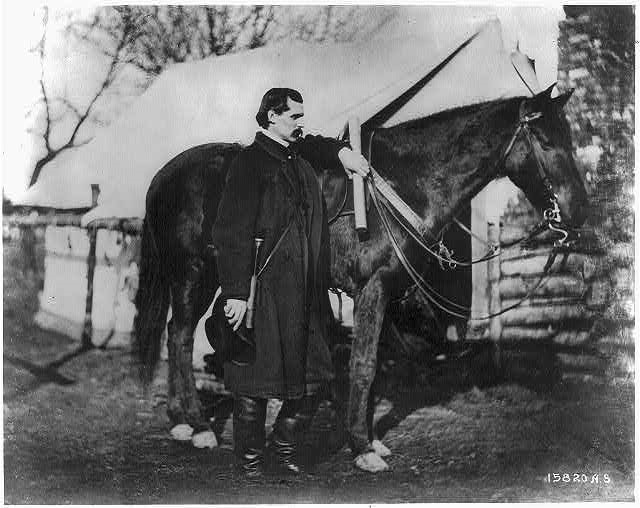
A civilian operation, the UABC was predominantly manned by non-military aeronauts and placed under the Bureau of Topographical Engineers. Of a fleet of seven balloons, the two largest, both 32,000 cubic feet and carrying five people, were Union, the original balloon, and Intrepid. Constitution and United States were 25,000 cubic feet and carried three people. Washington, 20,000 cubic feet, carried two people. The two smallest balloons were Eagle and Excelsior, each 15,000 cubic feet and operated by a single person.[1]
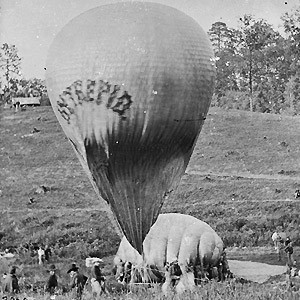
John LaMountain, another ballooning pioneer, conducted aerial reconnaissance while at Fort Monroe. On August 1, 1861, LaMountain conducted what is widely regarded as the first aerial reconnaissance mission in United States history, ascending in a tethered balloon to observe Confederate positions at Young’s Mill. Nine days later, he became the first individual to gather military intelligence from a free, untethered balloon flight. Drifting over Confederate lines near Hampton, Virginia, LaMountain observed the disposition of Brig. Gen. John B. Magruder’s forces. LaMountain’s observations demonstrated the unprecedented strategic value of aerial reconnaissance. From two ascensions, he identified troop concentrations, assessed the disposition of enemy camps, monitored naval activity, and confirmed the absence of Confederate defenses across a broad geographic area.
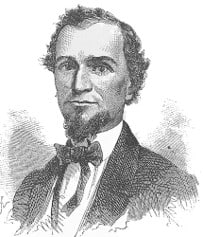
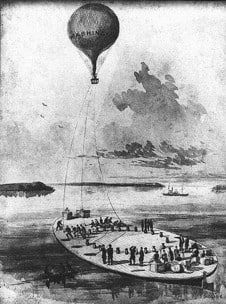
Three months later, Lowe conducted one of the earliest and most consequential applications of balloons in military operations. On Sunday, November 10, 1861, having converted the abandoned coal barge George Washington Parke Custis into a mobile platform, Lowe ascended in Washington while tethered to the vessel. As the barge drifted down Mattawoman Creek, Lowe, accompanied by Gen. Daniel Sickles, conducted aerial reconnaissance of Confederate encampments along the shore. “I have the pleasure of reporting the complete success of the first balloon expedition by water ever attempted,”[2] reported Lowe. The operation represented a remarkable convergence of naval mobility and aerial reconnaissance, demonstrating that a vessel could serve as a mobile base for aircraft. In this respect, George Washington Parke Custis occupies a significant place in the history of naval aviation as an early antecedent to the aircraft carrier.
Confederate Lt. Col. Edward Porter Alexander, an experienced signalman, recognized the value of using aerial platforms to signal enemy troop movements and positions. Interestingly, Alexander also addressed the psychological effects that balloon reconnaissance could impose upon soldiers. He suggested that the mere sight of a balloon hovering over a position could produce a profound sense of demoralization among troops, observing that “the very knowledge by the enemy of one’s use of balloons is demoralizing.”[3]
At the same time, the knowledge that their movements and dispositions were visible to an unseen observer introduced an additional psychological burden. In this respect, the balloon represented more than a means of gathering intelligence; its presence itself could affect the morale, confidence, and physical well-being of the soldiers beneath it. In a May 1862 report to Gen. Braxton Bragg, Gen. P.G.T. Beauregard expressed relief upon learning of a supposed “sham balloon,” remarking, “I hope it is so, for I fear that more than their artillery…”[4]
While McClellan’s Peninsula Campaign was unfolding in the East, Union forces were engaged in the battle of Island No. 10 along the Mississippi River. During the Union assault on the island, the Navy balloon operator reported that “our shot and shell went beyond the enemy,” prompting Union forces to adjust their range. Corrections made, the artillery fire became sufficiently effective to “compel the enemy to evacuate.”[5] The engagement thus demonstrated the balloon’s emerging value as an aerial fire-control platform: by observing the trajectory and impact of artillery from above, balloonists could identify errors in range, communicate adjustments to gunners, and facilitate more accurate fire against concealed or distant targets. Island No. 10 provided an early example of the integration of aerial observation with artillery fire direction, a capability that would become increasingly important in the evolution of modern indirect-fire warfare.
Further enhancing aerial reconnaissance, Lowe proposed employing balloons as platforms for nighttime visual signaling. He envisioned balloons that “can be used for letting up various colored signal lights at night, which can be made to burn for a long time…”[6] Lowe’s rudimentary proposal anticipated the use of signal and illumination flares to communicate information and illuminate areas of operations. Lowe recognized that extending aerial observation into hours of darkness enabled reconnaissance, signaling, and even combat operations under limited visibility. In this respect, his proposal represents an early conceptual precursor to the airborne illumination and signaling technologies.
Despite the considerable advances achieved by the Union Army Balloon Corps, military ballooning never secured universal acceptance within the Union military. In 1863, the UABC was transferred to the Army Corps of Engineers and placed under Capt. Cyrus Comstock. Dissatisfied that Lowe was paid more than himself, on April 12, 1863, Comstock informed Lowe that “…it might be necessary…to reduce your pay…”[7] and cut the aeronaut’s pay almost 50%. The reduction further strained the relationship between Lowe and the military bureaucracy. Frustrated by his pay cut and the increasing difficulty of operating his balloons within the Army’s administrative structure, Lowe resigned from military service. His departure deprived the corps of its principal organizer and most experienced aeronaut. By August 1, 1863, the UABC had ceased operational use, bringing an end to the Union’s employment of balloons for military reconnaissance during the Civil War.
Long before aircraft or satellites revolutionized military intelligence, these pioneering balloonists demonstrated that the greatest tactical advantage often belonged to the army that could see the farthest. Despite this, the UABC’s balloons remained constrained by weather, terrain, technical limitations, and the skepticism of many within the military. Yet, for the first time in American military history, commanders gathered intelligence from a vantage point far removed from the front lines, observed enemy movements from above, and used aerial observations to enhance artillery fire and battlefield coordination. Although the UABC failed to survive the war, the significance of its brief existence extended well beyond the Civil War. The experiments conducted by Lowe and his fellow aeronauts established the military value of looking down upon the battlefield rather than solely across it, foreshadowing the increasingly central role that aerial reconnaissance, observation, and airpower would assume in modern warfare.
Drew DeLong is a Captain in the United States Air Force and holds a Master of Arts in the Military History of the American Civil War. A native of Wisconsin, he currently resides in Montana. When not doing research or writing on the Civil War, he enjoys traveling, playing soccer, and spending time with his wife, Anna.
Endnotes:
[1] Chan, Hannah. Civil War Ballooning: The First US War Fought on Land, at Sea, and in the Air. Federal Aviation Administration, https://www. far. gov/sites/faa.gov/files/about/history/pioneers/Civil_War_Ballooning_Article. pdf (2024), 2.
[2] The War of the Rebellion: A Compilation of the Official Records of the Union and Confederate Armies, Series IV, Vol. II. 1900, (U.S. Government Printing Office, 1880-1901), 266.
[3] Edward Porter Alexander, Fighting for the Confederacy: The Personal Recollections of General Edward Porter Alexander (Chapel Hill, NC: The University of North Carolina Press, 1989), 115.
[4] Official Records, Series I, Vol. X, Part I. 1884, 769.
[5] Official Records, Series IV, Vol. II. 1900, 269.
[6] Official Records, Series IV, Vol. II. 1900, 262.
[7] Official Records, Series IV, Vol. II. 1900, 303.


Great article, Drew! Were any of these balloons ever shot down? I’ve always thought they must have presented tempting and vulnerable targets – or did they operate too far out of range? Also, you mentioned “aeronauts on both sides,” but I don’t think I’ve ever heard of a Confederate hot air balloon. Who was Lowe’s Southern counterpart?
Dr. Langdon Cheves Jr. built a balloon out of ladies silk garments. Edward Porter Alexander went up in it during the Peninsula campaign.
https://airandspace.si.edu/stories/editorial/most-fashionable-balloon-civil-war
Thank you so much! Appreciate the kind words/review. My apologies for the delayed reply to your questions. There is no record of any of the balloons being shot down. Throughout my research, I did not even come across anything (written or verbal accounts) from observers, aeronauts, Generals, etc. who were operating the balloons mentioning anything about being shot at either. Most of these balloons would operate at altitudes that was past the effective range of the muskets/rifles of the time, and were not targeted. The South (to my knowledge) did not have a primary aeronaut like Lowe, instead, they had several enthusiasts and military members operate their balloons, such as Edward Porter Alexander.
-Drew
Thanks for a great article. I always wondered why balloons weren’t mentioned much in the later years of the war. Do you have information about Confederates using balloons, such as how long their balloon corps was in service and which theater(s) they operated in?
Hello Debbie! Glad you liked the article, and thank you for the kind words. The UABC was effectively disbanded in 1863 and balloons weren’t used in 1864-1865 as they were for the first couple years. On the Confederate side, the CSA was able to build 3 balloons throughout 1861-1863 (one made from cotton, two made from silk), however, they (CSA) lacked the ability to produce hydrogen in the field, along with material shortages due to the Union blockage and years of war, would force them to cease their balloon operations in 1863 as well. I may have to do a follow up article to this one focusing on the Confederacy’s use of balloons during the war!
-Drew
Debbie, forgot to answer the other part of your question. For which theatre they were mainly used in, that would be the Eastern theatre. There is a recorded instance of the Union using a balloon during the Battle of Island No. 10 on the Mississippi River (Missouri and Tennessee), however, the main period of balloon use was 1861-1863, and primarily out east.
On the Confederate side Langdon Cheves Jr. constructed a balloon called the “Gazelle” out of silk that had been intended for ladies garments. Edward Porter Alexander was one of the more notable Confederates to ascend in it during the Peninsula/Richmond campaign of 1862. The balloon was likewise put on a vessel in the James River and the boat was subsequently captured by a Union vessel, thus ending the Confederate’s use of the balloon in 1862.
Very interesting, I was unaware of that. There were so many innovations in the war that saw only limited use. BTW, I saw your previous comment – but it’s been held for moderation (it automatically does that when someone includes a link). Not sure when it’ll be approved, sorry.
Thank you for letting me know that, M. A.! Much appreciated. I wasn’t sure if that was the case or I forgot to submit it. Hopefully, I’m not violating any policies or rules, with the link. I’ll avoid links in the future if they are problem. I guess I site them without the link, but figured you and maybe others would want to read up on it.
E. P. Alexander writes about it in one or both of his postbellum memoirs, which where I read about it first, I think.
The Confederates came up with or utilized a lot of new technologies out of necessity, for sure. Ironclads, submarines, torpedoes, mines, grenades, and even a couple of balloons.
Lyle, spot on! I’m working on a larger sized article that focuses on ballooning in the Civil War, and have a section that focuses on the Gazelle and her capture. I was also recently in Dayton, OH and had the chance to once again visit the National Museum of the United States Air Force. In it, they have a surviving silk fabric piece of the Gazelle on display along with a small area that highlights balloons in the Civil War. If you haven’t already, I recommend checking it out!
-Drew
The balloon surveillance likely would have been very helpful during siege warfare, like Petersburg, perhaps even Spottsylvania,Cold Harbor and North Anna during the Overland Campaign
Michael,
I absolutely agree. One can only wonder about the impact that balloons would have had on the Overland Campaign and Petersburg. If Grant had had that advantage, I wonder if the siege would have been shortened, and the Overland Campaign conducted differently. Maybe the fruitless assaults at Cold Harbor would have not occurred.
-Drew