Book Review: Crisis at Antietam: The Cornfield and West Woods, September 17, 1862

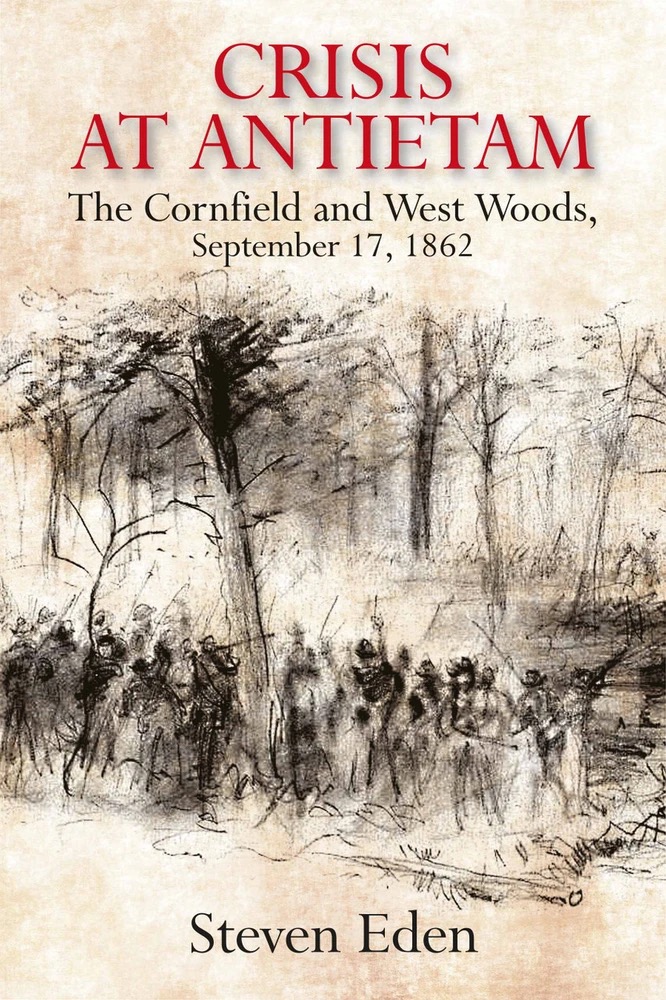
Crisis at Antietam: The Cornfield and West Woods, September 17, 1862. By Steven Eden. El Dorado Hills, CA: Savas Beatie, 2026. Hardcover, 354 pp. $34.95.
Reviewed by Danny Brennan
Some of the bloodiest ground in American history lies just northeast of Sharpsburg, Maryland. From the evening of September 16, 1862, into the following morning, soldiers fought through thick smoke, dodging bullets and artillery shells as momentum repeatedly shifted. Many know this area as the “Cornfield,” but the northern sector of the Antietam battlefield encompasses several other important sites, including the North, West, and East Woods and the high ground surrounding the Dunker Church. In his book, Crisis at Antietam, Steven Eden examines these contested landscapes and the experiences of the soldiers who fought across them.
Eden, who focuses on the opening phases of the Battle of Antietam, begins with eight chapters of strategic context, follows with five chapters describing the movements and fighting of September 16, and then turns to his core tactical study of September 17. A brief concluding “Assessment” summarizes leadership lessons from the fighting, though it misses an opportunity to connect the northern front more fully with the rest of the battle.
The book pursues two interconnected goals. First, it assesses combat leadership from the top down, seeking to understand “how decisions made before and during the battle affected combat performance.” (x) Second, it aims to “show what the men in the regiments saw, what they believed was happening, and why they acted the way they did.” (xi) For most of the narrative, Eden moves seamlessly between these perspectives, combining command decisions with soldiers’ experiences. He pays close attention to sensory details and demonstrates a keen understanding of the terrain so crucial to Antietam. Brief biographies of nearly every Union and Confederate army, corps, division, and brigade commander add a humanizing touch reminiscent of Harry Pfanz’s Gettysburg studies. Telling a story from both the top and bottom of command is challenging, but Eden largely succeeds.
While conscious of varied perspectives, Eden also reaches strong conclusions that some readers may question. Following the tradition of Stephen Sears, he portrays George McClellan in decidedly negative terms. The commander was “perpetually indecisive, overcautious” (2) who had a habit for “second-guessing himself” (9) while failing to “ignore the minor frictions that bedeviled every military operation.” (44) The book would have benefited from engaging recent revisionist arguments about McClellan’s generalship, particularly the thorough works of Steven Stotelmyer. Such scholarship might have complicated Eden’s portrayal of a Federal commander working primarily “from the comfort of his armchair in the Pry house.” (90)
Other commanders operating within what Eden calls “McClellan’s dysfunctional command structure” receive criticism as well. (193) Joseph Hooker attracts particular ire. Eden concedes that Hooker was “more than competent” as First Corps commander but he concludes that the general was “indisputably a failure” as a de facto wing commander because of micromanagement and poor coordination. (327) The latter claim is anything but indisputable. One example of Hooker’s leadership came when he consulted with George Meade and John Gibbon of the First Corps and Alpheus Williams of the Twelfth just south of the North Woods. He instructed Gibbon and Meade to hold until reinforcements arrived and directed Williams to extend his line to outflank the Confederates. This hammer-and-anvil approach ultimately drove Confederate forces from the ground east of the Hagerstown Pike.
Eden is similarly critical of other Union corps commanders. Alpheus Williams, who assumed command of the Twelfth Corps after Joseph Mansfield fell, is described as “distracted” (258) and “unable to exert effective control over the corps as a whole.” (327) Here, Eden mistakes fluid battlefield movements for a lack of focus. Williams made tactical missteps, but he also maintained a strong awareness of his troops’ locations and needs after assuming command, a view shared by superiors and subordinates. If any commander was guilty of micromanagement, it was Edwin Sumner, whom Eden identifies, with perhaps some presentist language, as “the true villain on the Union side.” (327) Confederate commanders, by contrast, escape much of the censure, with their tactical mistakes usually credited with producing “serendipitous” results. (321)
The book’s conclusions rest primarily on published primary sources. While Eden found valuable material “trawling through the small but excellent library at Antietam National Battlefield Park and the Army War College,” the book might have been stronger with greater use of archival sources. (xi) The unpublished correspondence of Ezra Carman and John Mead Gould, both veterans of the Cornfield/West Wood front, would have been particularly useful. The absence of references to several important recent works, including D. Scott Hartwig’s two-volume study of the Maryland Campaign, is also noticeable.
Steven Eden has produced a thoroughly argued study. Though some conclusions would benefit from broader sources and engagement with recent scholarship, Crisis at Antietam remains a valuable contribution. Eden reminds us that understanding Antietam requires considering not only commanders’ decisions, but how those decisions unfolded on a battlefield and shaped the experiences of the men who fought there.
Danny Brennan is a PhD Candidate at West Virginia University who works as a seasonal ranger at Gettysburg National Military Park. He is interested in exploring the culture and experience of Union soldiers in war and memory.


I enjoyed Eden’s book. It introduced a better understanding of the sequencing of the fighting. Eden’s book inspired me to read nearly 300 pages(so far) of “I Dread The Thought of The Place.” Eden’s book served as a helpful foundation to the complexity of the Hartwig master works.