Book Review: The Federal Signal Service at Antietam: Stations, Officers and Battlefield Intelligence on America’s Bloodiest Day

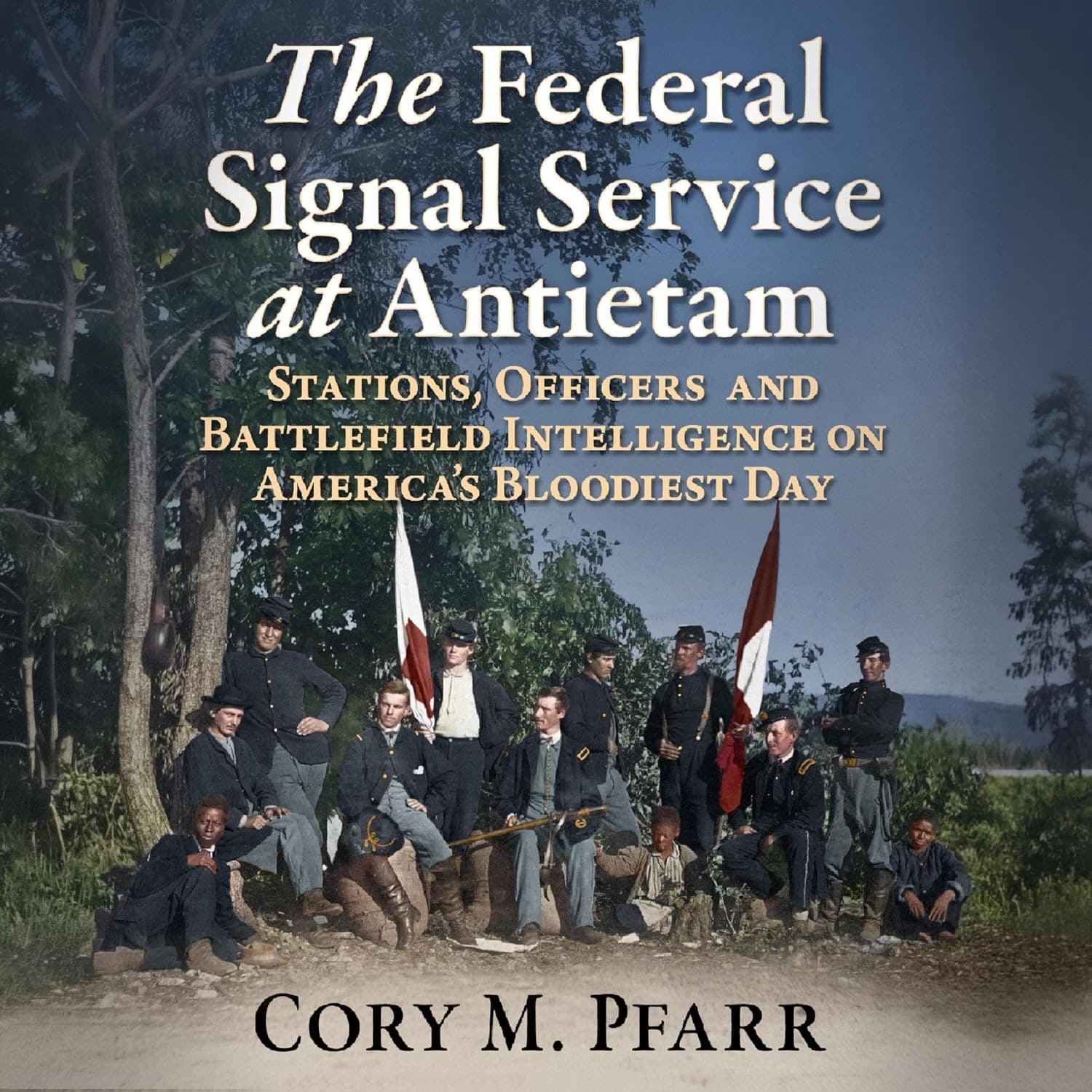
The Federal Signal Service at Antietam: Stations, Officers and Battlefield Intelligence on America’s Bloodiest Day. By Cory M. Pfarr. Jefferson, NC: McFarland & Company, Inc., Publishers. Softcover, 274 pp. $39.95.
Reviewed by Danny Brennan
“Look out well on your left; the enemy are moving a strong force in that direction.” Late in the 3:00 p.m. hour, U.S. signalmen atop the 1,060-foot rise known as Red Hill transmitted this message to colleagues at a station above the famous Lower Bridge over Antietam Creek. The day’s fighting had gone on for nearly ten hours when A. P. Hill’s Confederate division had arrived from the south, threatening to outflank the Federal left and undo its gains. The message warning of this advance was promptly delivered and acknowledged, but it came too late to affect the IX Corps, which was already advancing in its “Final Attack.” (139)
Hill’s arrival and its role in halting the Federal army’s final major assault on September 17 are familiar, as is the warning that first alerted Federal commanders to the threat on their left. Less understood, however, is how this and other messages traveled across the battlefield. In The Federal Signal Service at Antietam, Cory Pfarr addresses this gap by offering an intimate look at the signal officers whose work during the Maryland Campaign made them “an essential arm of wartime communication.” (213)
Built on Maj. Albert Myer’s communication innovations and forceful leadership, the U.S. Signal Service (later Corps) enabled the Federal army to transmit valuable information quickly. In his first chapter, Pfarr contextualizes its creation, early operations, and equipment, noting that torches and canteens of flammable liquid supplemented familiar flags and telescopes. He then traces the service through the marches and early fighting of the Maryland Campaign before turning to Antietam.
The book’s core consists of eight chapters examining communication stations positioned on the heights around Sharpsburg, an approach Pfarr describes as “an operational study framed through the stations…interwoven with biographical portraits.” (11) Rather than a traditional battle narrative, the study unfolds through a series of interlocking microhistories. Brief operational accounts of each station’s role during the battle open the chapters, while numerous well-drawn maps help readers visualize the action.
The bulk of each chapter consists of biographies of the eighteen signal officers assigned to the various stations. Most were young volunteers who joined the Signal Service in 1861. Some transitioned when the Signal Corps was established formally in 1863, while others left because of disputes over rank, a desire to return to the infantry, or disabling illness or injury. All but one survived the war. The portraits vary considerably in length: Fountain Wilson of the Roulette Farm Station receives sixteen pages, while Charles Herzog of Red Hill receives only three. Rather than aiming for uniformity, Pfarr gives each officer as thorough a portrait as the evidence allows, tracing their careers beyond the Maryland Campaign and even beyond military service. One might only wish for similarly detailed information about the enlisted personnel who assisted them.
This study also enters the longstanding debate over Gen. George McClellan’s leadership. Drawing on previous scholarship, Pfarr identifies what he calls the “McClellan, the spectator” motif, which portrays the commander as unimaginative and immobile at the Philip Pry House. (3) Challenging this interpretation is the book’s “first aim.” (12) McClellan did not always stay at the Pry House, Pfarr argues, but when he did, it was part of a “deliberate plan” (9) to keep him near his signal system, providing “near-real-time awareness of developments on the field.” (213)
Pfarr builds this case by tracing McClellan’s support and use of the Signal Service from the beginning of his command through its deployment on the march and at South Mountain. Chapter 3, which focuses on the Hooker-Meade-Sumner station on the battlefield’s northern end, particularly depicts McClellan as an active commander who responded to transmitted information by consulting nearby officers and issuing direct replies. Explicit mention of the commander largely disappears from later sections, likely because of the “fragmentary survival of message texts,” which makes reconstructing the flow of communication difficult. (213) This reflects the available evidence rather than a flaw in Pfarr’s work, but it limits his discussion of McClellan’s role in two of the day’s most controversial areas: the Federal center and left.
That fragmentary evidence is also what makes Pfarr’s achievement notable. He combines official correspondence and service records with pensions, newspapers, census data, and numerous other sources to construct an operational, biographical, and argumentative study. He also demonstrates a strong command of the secondary literature, situating his work comfortably within ongoing historiographical debates about the Army of the Potomac’s leadership.
The Federal Signal Service at Antietam will be essential reading for students of the Maryland Campaign and the history of the Signal Service/Corps. Meticulously researched, usefully illustrated, and well written, the book keeps its signalmen at the center of the story. Pfarr concludes that these often-overlooked officers possessed “intellectual training, moral seriousness, and professional dedication.” (213) His own dedication ensures that their contributions finally receive the attention they deserve.
Danny Brennan is a PhD Candidate at West Virginia University who works as a seasonal ranger at Gettysburg National Military Park. He is interested in exploring the culture and experience of Union soldiers in war and memory.


