Echoes of Reconstruction: Best Books on Reconstruction of 2026
Emerging Civil War is pleased to welcome back Patrick Young, author of The Reconstruction Era blog.
 For years now, I have published a list of the best books on Reconstruction in October, National Book Month. My wife is a librarian, my mother-in-law was a librarian, and my step-daughter just started her career as a librarian in Manhattan. I enjoy telling you which volumes published over the previous twelve months are the real prizes that I have read.
Last year when I published the 2025 article on the best books I told you that while “I usually look forward to posting the list, …this year I have a strange foreboding as I write this. Newspaper literary supplements have been axed, or maybe the entire newspaper has gone out of business. For those following Civil War histories, several of the magazines dealing with the subject, like the Civil War Times, have ceased publishing altogether.” Last year the Associated Press stopped publishing all book reviews. And while Artificial Intelligence is now slopping out hundreds of books on the Civil War and Reconstruction in the last year, it is also replacing book reviews written by real human beings (like me) with “reviews” by Claude. The AI book reviews on sites like Amazon now make up an estimated half of all the reviews posted there since the beginning of this year. This means that for real reviewers the traffic to our reviews are down dramatically.
Still, if AI kills off human reviews of books and replaces it with slop, then the number of readers of the books formerly subject to reviews will drop off because many people find out their next read through human commentary. Would I purchase a book based on a non-human review? Emerging Civil War, fortunately, still provides this service both to our readers and to the authors of these histories.
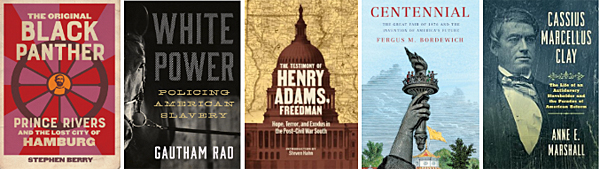
This year I have five books to recommend to those looking to understand the Reconstruction Era, its people, and the impact of Reconstruction on our society today. The link for each book takes you to a full review that I wrote.
The Original Black Panther: Prince Rivers and the Lost City of Hamburg by Stephen Berry published by University of Georgia Press (2026) is one of my favorite books because it takes the reader inside the mind and motivation of a man who was born into slavery but who achieved so much more through his own bravery and a calculating mind that weighed possibilities that would have overwhelmed most people. The Original Black Panther is good for Civil War and Reconstruction scholars and college students, but it can also be used with advanced high school students. Younger people will appreciate the complexity of Prince Rivers’s personality.
Rivers was born in Beaufort, South Carolina, part of a chain of communities on islands off the coast of the Carolinas. The African Americans there developed the unique Gullah-Geechee culture which still endures today. Rivers was a house servant who also drove a carriage for the man who enslaved him. When the United States army and navy took over the islands, his “owner” told him to drive him to a place of safety. Rivers did that and then unhooked the carriage and stole the horse he would ride back to freedom. Several months later Rivers enlisted in the first Black regiment on the East Coast.. He said, when asked if Blacks would fight, “I know we would. Only let us know for sure—for sure, mind you—that the white people mean right; let us know for sure that we’re fighting for ourselves, and I know we will fight.”
After the war ended, Rivers helped write the new constitution for South Carolina, he was elected to the state legislature, he became a lawyer, he incorporated a new town and he drew the lines of a newly created county. After a decade of increasing the power of Black people, the town he was mayor of, Hamburg, was the scene of one of the worst massacres unleashed by the white supremacist Red Shirt militias of South Carolina and Georgia. The Red Shirts left behind Black dead and they also killed Rivers’s dream.
White Power: Policing American Slavery by Gautham Rao published by University of North Carolina Press (2026) is not an exclusively Reconstruction book. Rao treats the development of the policing of Blacks over three centuries.
When slavery was introduced to British North America in 1619, the English colonists had very few laws regulating chattel slavery. In some cases, early on, the law treated slaves like they were indentured servants, but an indentured servant could be held by his or her “master” for seven years while a slave was owned by a white man for life. Gautham Rao goes into great detail in the perfection of laws governing slavery.
While slavery was common in all regions of British North America, after the American Revolution Northern states gradually abolished slavery. The South continued to develop its legal code to ensure that slaves were completely controlled by their “masters” and by white society at large. Author Gautham Rao quotes a Louisiana attorney in 1850 who said that “each” white person “is made a police officer,” and every African American “a criminal.” All white people could question and arrest a Black person off of his or her owner’s land. While 40% of Southerners were enslaved, a broad uprising of Blacks never took place because the other 60%, the whites, were heavily armed and united in their ideology of Black subordination. Even if a poor Southerner did not own a slave, he was more than likely involved in controlling Blacks through his participation in the slave patrol, heavily armed units of men on horseback, to run down escaped slaves and to subject Blacks to arrest and torture who showed any signs of rebellion.
According to Rao, the “Enslavers’ solution was to transform their whiteness into police power and to make themselves the police. When a white person appeared in public, their white skin was like an officer’s badge. It made them deputies to the state with a duty to be vigilant over enslaved people, to question and investigate those who struck them as potential threats. Whiteness also came with the power of arrest—to seize or incarcerate. Most importantly, it gave white people the right to violence. They could seize or assault an enslaved person who didn’t comply with their order. They could form armed posses and attack suspicious people of color. Sometimes this right to violence gave them the right to kill.” The universal deputization of all white men meant that individual Blacks had no chance at freedom.
Because of the ideological commitment of Southern men to using terror to control enslaved African Americans, by the 1850s Southern statesmen pressed Congress into passing the 1850 Fugitive Slave Act which overrode the local laws allowing Blacks to live freely in a number of Northern states. This trampling on states rights by Southern white leaders helped cause the Civil War.
Finally, Roa frames the violent resistance to Black freedom during Reconstruction as a successful resuscitation of the old slave codes of the Antebellum period. Many of the same structures were used by the mid-1870s as had been used very successfully before the war. Armed men on horseback rode through Black communities to control the labor and culture of their former slaves. They were no longer “slave patrols,” they were now called the White League and the Red Shirts.
When slavery ended, Southern whites asked themselves this question according to Rao; “Could slave policing laws exist without slavery?” The answer by the end of Reconstruction was Yes.
The Testimony of Henry Adams, Freedman: Hope, Terror, and Exodus in the Post-Civil War South Introduction by Steven Hahn published by Library of America (2026) is the testimony of former slave Henry Adams to a Senate committee. He was freed in 1865, two years after the Emancipation Proclamation was issued. Freedom didn’t mean security. Adams saw violent retaliation for emancipation right after the Civil War. He reported that “In the year 1866,” in the parish of Caddo, State of Louisiana, “‘I seen hanging to a limb of an oak tree, about six miles south from Shreveport, the body of a colored man. He was dead when I seen him. About six miles north from Keachie I saw a wagon belonging to a colored man burning, with all his things; even his mules were burned to death. While on my way to Sunny Grove I seen the head of a colored man lying on the side of the road.’”
In the fall of 1866, Adams enlisted in the United States Colored Troops (USCT). There he learned to read and to write. He met Black men from all over the South and they decided to form a committee to record human rights abuses in the former Confederacy. Adams’ work was so important that his report on white supremacists’ subversion of democracy in Louisiana was sent by President Ulysses S. Grant to Congress!
Adams and his fellow committee members risked their lives to interview witnesses to the violence in the South. They felt that it was their duty because the white power structure often turned a blind eye to the trampling of Black people’s rights. This book is hard to read, but it gives a Black laborer’s view of the re-establishment of white supremacy.
Centennial: The Great Fair of 1876 and the Invention of America’s Future by Fergus M. Bordewich published by Knopf (2026) is an excellent popular work of narrative history of the time of the anniversary of the Declaration of Independence, not on July 4, 2026, but on July 4, 1876. Many Americans celebrated the founding of their country at the great world’s fair in Philadelphia that year, but the scripted celebration was overwhelmed by the tragedy unfolding around the country.
On the Centenary, George Armstrong Custer’s men lay unburied at Little Big Horn after an attempt to wipe out the Sioux. Political corruption was threatening the Republican control of the Federal government while racial supremacy was undermining Black voting throughout the South. The Ku Klux Klan violence which Ulysses S. Grant had successfully suppressed during his first term came back as a fury with the Centennial celebration with one of the worst massacres at Hamburg in South Carolina starting on the Fourth of July in 1876.
Fergus Bordewich has done remarkable research into the material and ideological culture of the time. These details are not lost in Bordewich’s telling of the larger story of race, gender, and labor relations of 1876. There are many stories of politicians, organizers, artists, feminists, and fairgoers that make the one hundredth anniversary of the signing of the Declaration of Independence a time to look back on today, 150 years later.
Cassius Marcellus Clay: The Life of an Antislavery Slaveholder and the Paradox of American Reform by Anne E. Marshall published by University of North Carolina Press (Sept. 2025) is about one of the most famous politicians of the Civil War and Reconstruction Era and one of the least understood. An anti-slavery advocate, even though he owned slaves, Cassius Clay had derogatory stories made up by white Southern leaders to marginalize him, but Clay also invented stories about himself to increase his visibility and make himself converts outside of his native South.
Clay had a big role to play before the war and during Reconstruction, although what the details were were purposely obscured by Clay himself. When Clay died, he was honored as an early Southern abolitionist. Of course this was not true. One of the largest Black organizations in Kentucky honored him by saying “a man who in his time stood almost single and alone for a defenseless race during the eventful period that tried men’s souls…It was Cassius M. Clay, a giant in intellect and a lion in courage who contended for the emancipation and civilization of our people…” He was hailed for being “maimed and scarred for the God-given rights of all mankind.” Of course he was not.
Anne Marshall has picked a good subject to write about. Even for laypeople devoted to the Civil War Era, there are surprises in every chapter. She integrates primary sources into the narrative of the text quite well, and we can hear Clay’s contemporaries be as confused as we are about his motivations.
Enjoy your reading in the coming year. Hopefully I will too!


I am very interested in the Prince Rivers bio. In “Army Life in a Black Regiment”, a memoir by Thomas W. Higginson, Higginson gives a positive portrayal of Rivers, then a sergeant in the First South Carolina Volunteers(“The First South”), later renamed the 33rd USCT. After the war, Rivers went into politics, and Higginson became a literary man, best known as Emily Dickinson’s bemused editor.
it is good.
It must never be overlooked, or suppressed, that even though Northern states gradually abolished slavery after the Revolution, slavery still existed in the North until after the end of the Civil War. New Jersey, for example, though it abolished slavery, also “grandfathered” it – if you were a slave at the time of abolition, your master could choose to free you or retain you for the duration of your life. Any children you produced after abolition would be born free, but not you. The amount of slaves held in New Jersey during the war was around 1,000, give or take a few, and of course, five other states that remained in the Union, or joined it during the war, were slave states.
What’s more, while “The South continued to develop its legal code to ensure that slaves were completely controlled by their “masters” and by white society at large,” despite gradually abolishing slavery over the years, the North continued to develop its legal code to ensure blacks were completely controlled in the North. In fact, these laws were known before the war as “The Black Codes,” and were hugely repressive, even, in some instances, completely banning free blacks from living in certain states. This is where “Jim Crow” came from; these “Black Codes” were simply instituted in the South after the war and given a new name.
It’s curious how all this history somehow manages to not make it into “history” books these days…
Yup, those white southerners would have never created the Black Codes unless northerners showed them how. That’s exactly what happened! Bunch of exconfederates were sitting around, butts a little sore from the legendary beatdown they received in the hands of the northerners. Cluelessly they stared vacantly into space, until a northerner came along, sighed, took pity on them an slowly explained how to create an proto apartheid system. After repeating himself a few times, the ex confederates, their spirits revived, created the black codes, and after some more explanation, by the same northerner, which I assume involving drawing some diagrams in the dirt, formed the KKK. The northerner even insisted on they wearing stupid looking hoods, desperately trying not to giggle as the former rebels struggled to get the holes to line up with their eyes. The northerner shook his head: these guys are incapable of independent action or thought, which is why they can never bear responsibility for any action they take. Its always somebody else’s fault.
The northerner then rode back to Washington, where he then passed the 14th and 15th Amendments, and accompanying legislation! Twist!
Its curious how all this history somehow manages to not make it into scare quotes history books. A lot of it never happening has something to do with that. But its probably a big “conspiracy.”
Thank you Patrick for the book suggestions. Much appreciated and posted to X now!