Book Review: John M. Schofield: Soldier-Statesman of the Civil War and Gilded Age

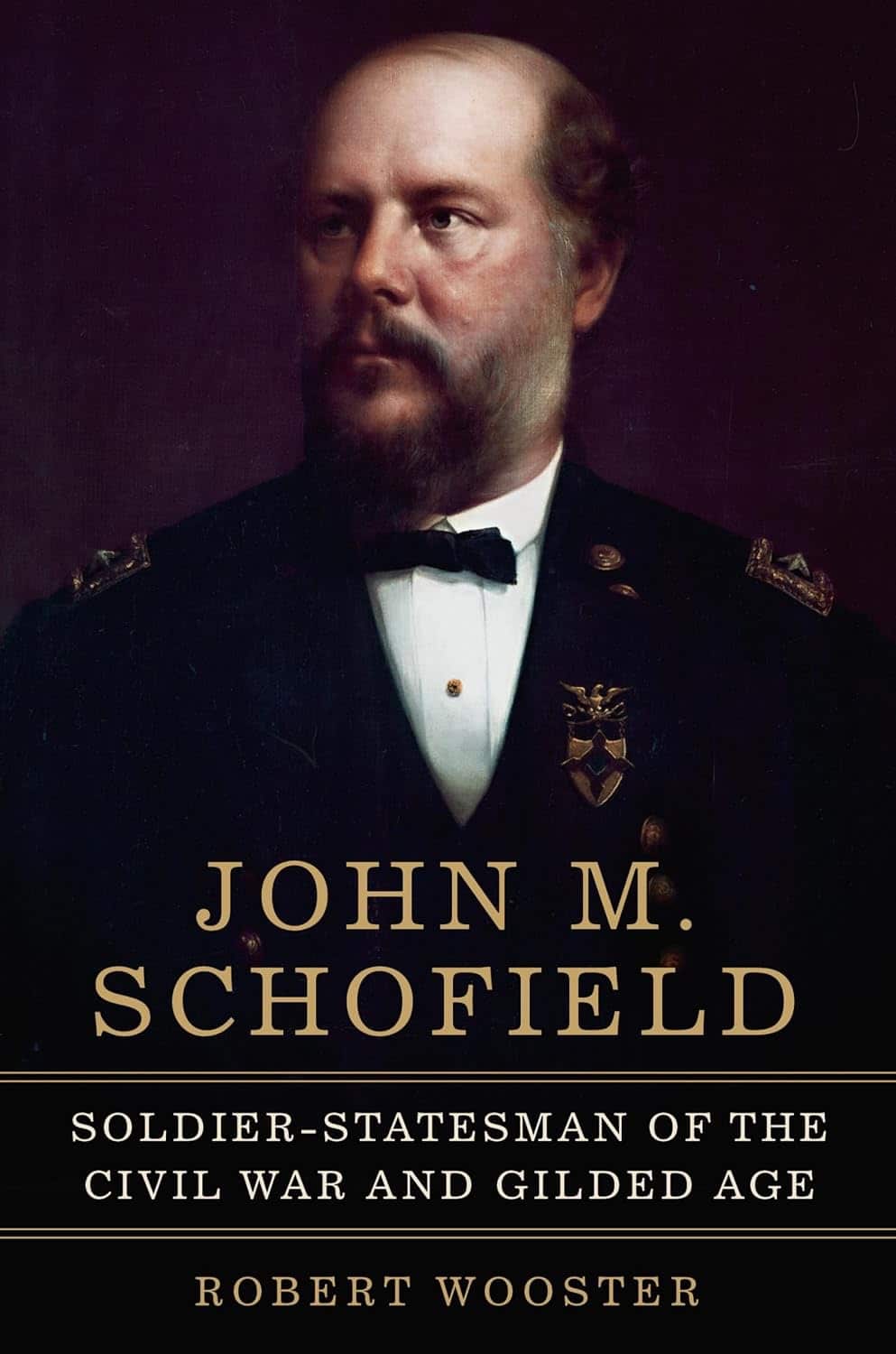
John M. Schofield: Soldier-Statesman of the Civil War and Gilded Age. By Robert Wooster. Norman, OK: University of Oklahoma Press, 2026. Hardcover, 394 pp. $55.00.
Reviewed by Joseph Ricci
John McAlister Schofield served his country for forty-six years and rose to the very top of the U.S. Army’s command structure. In his career, he saw the American Civil War, Reconstruction, labor unrest, American imperialism, and the rise of a superpower, one which he helped build. Robert Wooster’s recently published biography of Schofield examines his professional life from his early days as a cadet at the U.S. Military Academy to his retirement as General of the Army. Wooster’s work joins James Lee McDonough’s Schofield: Union General in the Civil War and Reconstruction, published in 1972, and Donald Connelly’s John M. Schofield and the Politics of Generalship, published in 2006. While all three books strike a similar chord regarding Schofield’s wartime performance, Wooster’s major contribution to a thorough examination of Schofield comes in his focus on the later years of the general’s career.
Though the Civil War years comprise only one hundred pages, Wooster offers his perspective on Schofield’s role as a U.S. Army officer in campaigns in Missouri, Georgia, Tennessee, and North Carolina. By 1864, Schofield assumed command of the Department of the Ohio and the Army of the Ohio, comprised of the XXIII Corps. In this role, Schofield played a key role in the Atlanta Campaign and the Tennessee Campaign of 1864. Here, Wooster enters the historiographical fracas surrounding the history and historical memory of that latter campaign. Wrought with army tribalism, interpretations of the Tennessee Campaign have largely been divided along the lines of the Army of the Ohio and Schofield, and the Army of the Cumberland and Maj. Gen. George Thomas.
By and large, Wooster manages to ably sidestep much of that morass and presents, instead, a thoughtful summary of Schofield’s most in-depth experience as an army commander. At times, however, Wooster’s narrative strays toward some of the old, well-trodden myths about Spring Hill and Franklin. That aside, Wooster offers readers a rare opportunity to view the events of the campaign from Schofield’s perspective rather than engaging in the usual divide along the XXIII Corps and IV Corps axis.
Of particular interest is Wooster’s handling of the Schofield-Thomas controversy in the days leading up to the battle of Nashville. Much like Connelly, Wooster paints the picture of a sturdy, steady politician and “experienced hand” at “backbiting among generals.” That “backbiting,” however, has largely been overblown, he argues. Instead, Wooster posits that Schofield, while he may have engaged in nefarious dealings in Missouri, knew it would have been a “foolish ploy” to attempt to wrestle command from Thomas. Wooster concludes that much of what has driven the controversy stems not from what Schofield did, but from what Thomas “believed” (emphasis in original) he did to undermine him. (96)
After bringing the war to a close with Schofield in North Carolina, Wooster devotes the next two hundred pages to the rest of the general’s impeccable, though occasionally controversial career. It presents a fascinating picture of a man who oversaw Reconstruction-era policies, rapid post-war military demobilization, political and military clashes with Mexico and indigenous tribes in the American West, and global expansion of American influence in the Pacific and Caribbean. At the same time, Schofield’s life was shaped by the loss of his first wife, scandal during his tenure at West Point, and the political turmoil of the U.S. government’s war with tribal nations in the territories. By the time he retired in 1894, Schofield’s career spanned four decades and shaped the future of the United States Army as it entered the 20th century.
In summary, John M. Schofield: Soldier-Statesman of the Civil War and Gilded Age provides readers with a fascinating picture of a Civil War officer navigating the post-war world and the dawn of the American Century. Wooster’s analysis offers readers the opportunity to reflect on the seeds which Schofield planted in the early years of reform in the army and the fruit they bore in the Spanish-American War, World War I, and World War II. Unlike McDonough, it is not a military biography focused upon tactics or command decisions; instead, similar to Connelly, Wooster’s work informs readers how Schofield and the Army shaped the nation and international affairs. For those interested in Schofield’s wartime exploits, Wooster ably summarizes his performance in a highly readable, direct way. Wooster’s biography is a splendid addition to the limited studies of Schofield and, perhaps more importantly, studies of the Army in the second half of the 19th century.


