Book Review: Ulysses’s Odyssey: Ulysses S. Grant’s World Tour at the Dawn of American Empire

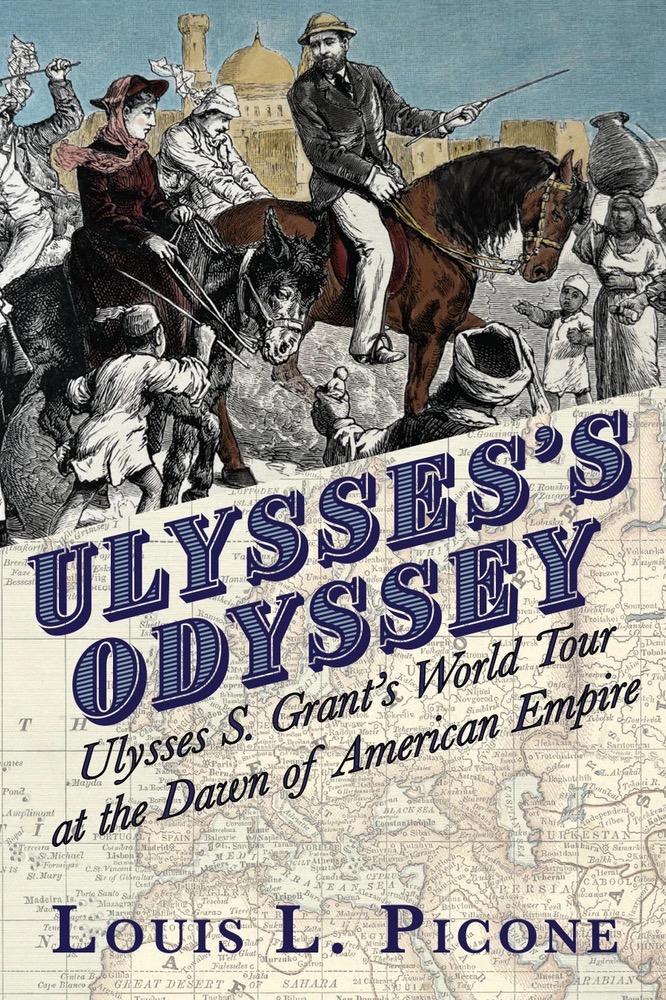
Ulysses’s Odyssey: Ulysses S. Grant’s World Tour at the Dawn of American Empire. By Louis L. Picone. El Dorado Hills: Savas Beatie Press, 2026. Hardcover, 349 pp. $34.95.
Reviewed by Joan Waugh
In 1877 the 55-year-old Ulysses S. Grant was liberated at last from the grave duties and responsibilities of his eight years in the White House. Now a private citizen, the ex-president and his wife Julia pondered various options for their immediate future. Together, they made the momentous decision to travel around the world on a lengthy tour that would last two years and take them to Europe, Asia, Africa, China and India on the warship Indiana. Accompanying them on the trip was their son, Jesse, later joined by his brother, Fred, and fortunately for posterity, the well-known and widely read New York Journal reporter John Russell Young, who later published the best-selling two-volume Around the World with General Grant.
Many modern Grant biographers have paid little attention to his world tour, considering it frivolous, even embarrassing compared to his hugely impactful military and political career. But that assessment has been challenged in recent publications such as Edwina Campbell’s Citizen of a Wider Commonwealth (2016) and now Louis L. Picone’s Ulysses’s Odyssey. Picone delivers an entertaining and detailed narrative (with maps, illustrations and photographs) deftly combining the political, social, cultural, and personal currents of Grant’s journey. During this lengthy and sometimes arduous expedition, the former president was not only a “citizen tourist” but, as Picone argues, also a “foreign diplomat, international peacemaker, and ambassador for the United States on the cusp of becoming a global economic, industrial military and political powerhouse.” (xv)
Grant got a preview of his celebrity status when he arrived in Liverpool. In a city known for its cotton mills whose product aided the Confederate cause during the American Civil War, the Grants received a rapturous reception from both the elites and the working class. The U.S. State Department had alerted all the foreign consuls in the countries included on Grant’s itinerar,y paving the way for maximum publicity. Huge crowds greeted his arrival in London despite an initial snub from Queen Victoria, but he was soon feted by the high and mighty, a trend that would continue throughout Grant’s long journey that would come to symbolize the growing power and influence of the United States. One pleasurable bonus for Ulysses and Julia was a visit to their beloved daughter Nellie Sartoris’ home near Southhampton, which included seeing their first grandchild, Algernon.
In England, Ireland, and Scotland, Grant managed to find time in various cities and towns to visit museums, walk the streets by himself (sometimes causing commotions when citizens recognized him from newspaper illustrations) and indulge his genuine curiosity and delight at new experiences, traits that would continue unabated from Egypt to Greece, Italy, Germany and Austria. He met with the leaders of all these countries, including Chancellor Bismarck of Germany, who invited Grant to accompany him on a military review that celebrated the country’s military prowess. Grant was greatly impressed by Japan, his last stop on the world tour. He particularly admired its technological progress, particularly the country’s excellent railroad system.
The last part of the book covers the return of the couple as they considered their future. Ulysses and Julia sailed home arriving in San Francisco on September 20, 1879. Cheering crowds in California and throughout the country flocked to witness the Grant’s progress as they made their way back to the East Coast. Picone devotes several chapters to the couple’s continued travels to Florida, Cuba, and Mexico, with enthusiastic receptions everywhere. Indeed, Grant’s renewed popularity sparked a movement in the Republican Party to nominate him for a third term, ultimately fizzling out when Ohioan James Garfield won the 1880 nomination on the 36th ballot.
Picone’s Ulysses’s Odyssey reminds modern readers of Grant’s stature in the postwar era and provides a fresh and lively addition to the literature on the popular Union hero and to the growing global reach of the United States in the nineteenth century.
Professor Emerita Joan Waugh of the UCLA History Department researches and writes about nineteenth-century America, specializing in the Civil War, Reconstruction, and Gilded Age eras. Waugh has published numerous essays and books on Civil War and Gilded Age topics, including U. S. Grant: American Hero, American Myth (2009) and The American War: A History of the Civil War Era (2022, co-authored with Gary W. Gallagher).


I admit to not knowing a lot about Grant’s trip around the world, but if memory serves, the ship that carried him was not a US Navy warship. It was the SS Indiana, a relatively new steamer at that time. That said, this book certainly sounds like an interesting read.
were there any threats to his life noted during the trip or return?
I really enjoyed the same author’s book, Grant’s Tomb, so I am likely to pick up a copy of this new book.