Patch Work: A Sample of Civil War Unit Insignia
ECW welcomes back guest author Mike Busovicki.
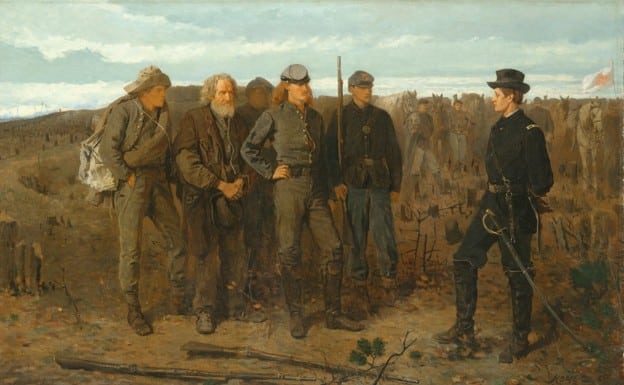
Military emblems create order. They efficiently convey information about the wearer, foster unit cohesion and esprit de corps, and help troops reorganize themselves when scattered across a chaotic battlefield. Today’s military takes standard insignia for granted, including small or subdued badges of rank, unit, or special skills and qualifications. The wild diversity of uniform designs and regimental colors at the outset of the Civil War prohibited easy identification of friend and foe and order of battle, leading to creative and varied distinctive symbols for that purpose.
In the spring of 1862, Gen. Phil Kearny rebuked officers he’d seen alongside the road during a particularly hard march, assuming they were from his command and malingering. However, the officers respectfully informed Kearny they were staff from another unit and not part of the movement. Kearny apologized, vowing mistaken identity would never occur again, and ordered officers under him to affix a piece of red cloth in the shape of a lozenge, 2 inches square, to the front of their caps for ready identification.[1]
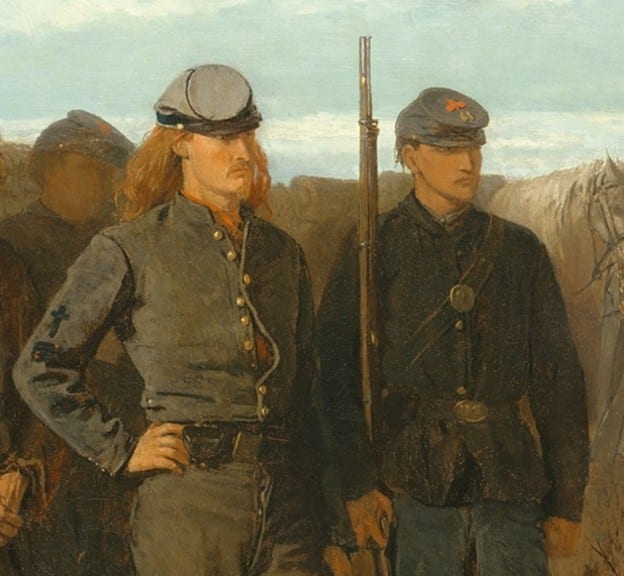
Kearny saw validation of the unit identification idea in June 1862 at the battle of Fair Oaks (Seven Pines) when Confederates captured from Gen. D.H. Hill’s division were found to have different colored strips of cloth affixed to their caps for the same reason. Known as the “Kearny Patch”, men of all ranks in Kearny’s division maintained the patch after he was killed in action at Chantilly on September 1, 1862.[2]
Recognizing both the utility and unit pride bolstered by the patch, Gen. Joseph Hooker tasked his chief of staff, Dan Butterfield, to design a badge for each corps in the Army of the Potomac. These would identify not just the corps, but the division: red insignia for the first division, the same emblem but in white for the second division, and blue for the third division. Those with a fourth or additional light division would wear the badge in green or yellow. Orange was authorized for fifth divisions, but fifth divisions were uncommon or established only temporarily. Corps insignia also helped guide ambulances to the appropriate field hospital and identify the dead.
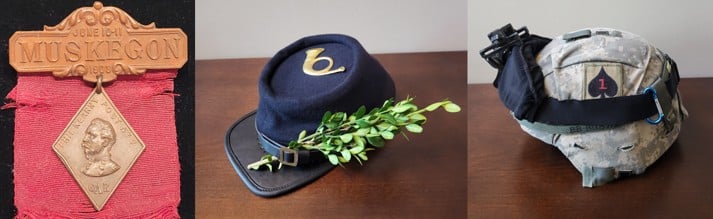
Unofficial uniform items were popular as well. Pennsylvania backwoodsmen known as the “Bucktails” reported for duty in 1861 with a deer tail attached to their caps as proof of their marksmanship.[3] The Irish Brigade wore bits of boxwood stashed in their hat bands at Fredericksburg when their regimental flag had been sent back to New York for repair, but they would still wear “green” into battle.[4] The 7th Ohio, with their rooster-crow battle cry, proudly wore metal rooster pins, indicative of their boisterous and aggressive reputation.[5]
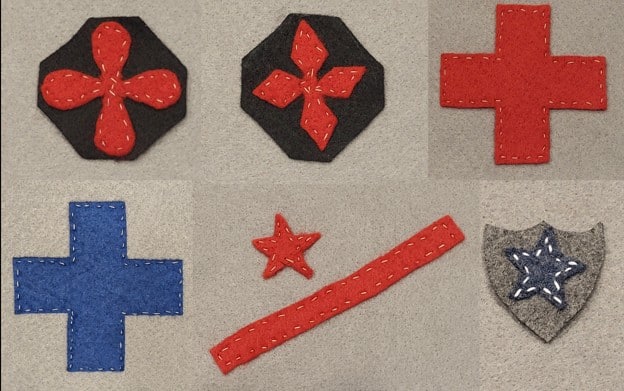
“The Sharp Shooters were privileged characters. They were distinguished by a badge consisting of a red band running diagonally across the left elbow of the coat sleeve with a red star just above the band. This badge would pass the Sharp Shooter anywhere…”[6]
Confererate patches were less common, but perhaps carried greater importance for the individual. Not just marksmen, sharpshooters had additional scouting and skirmishing roles, putting individuals or squads in between the lines in unconventional duties that required autonomy and freedom of movement. Ready identification and verification of their status was essential to reentering friendly lines without fear of being detained under suspicion of being a malingerer, or worse – a spy.
Rebels crafted cloth patches that varied by unit and evolved over time. Men from Maryland utilized variations of the Bottony Cross or quatrefoils centered on a dark octagonal background roughly 2 inches wide. The sharpshooter battalion in William McRae’s North Carolina Brigade wore a gold cross on the left sleeve, and veterans stitched the names of battles in which they fought below the cross. Other North Carolina battalions used a red cross approximately 3 inches wide, centered between the shoulder and elbow. Rebel-turned-artist A.C. Redwood included a blue cross approximately 2 inches square on a drawing of a Virginia sharpshooter assisting a wounded comrade to the rear. A red half chevron and star were the mark of Dunlap’s Battalion. Weisiger’s Brigade of Mahone’s Division wore a blue star centered on a gray shield about an inch and a half in height.[7]
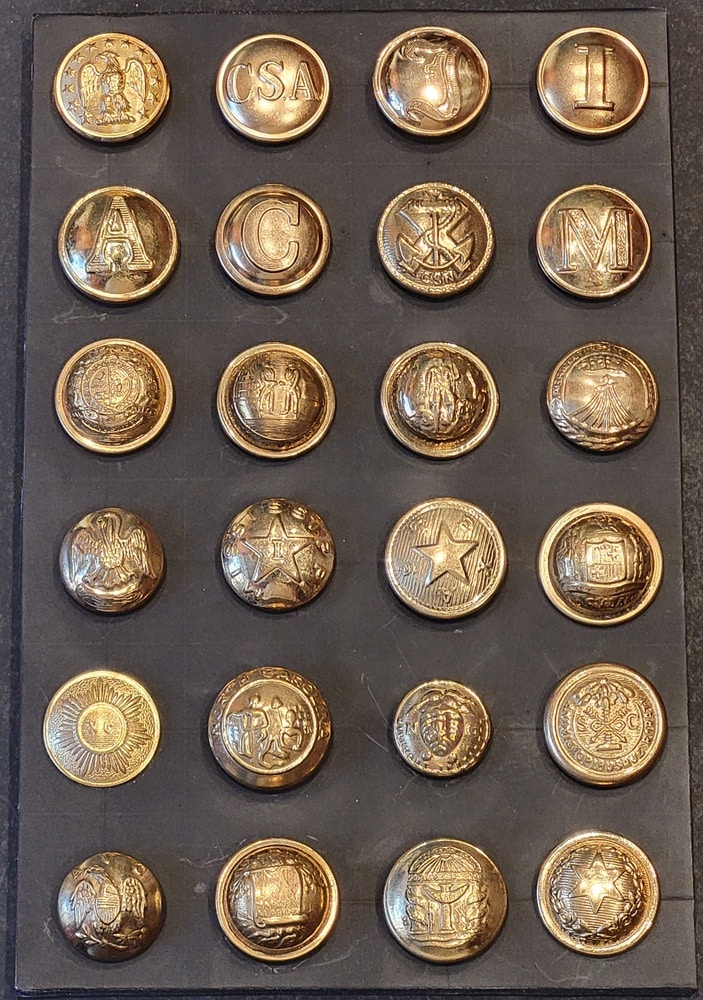
Rebels in more traditional roles wore specialized buckles, accoutrement plates, and buttons when available. Buttons, an antebellum status symbol and prized wardrobe enhancement, became the most common unit-specific emblems on both sides: tin and brass versions became common a few decades before the war and the 2-piece designs were more affordable even if a gold wash or gilt was applied.[8] The machining process stamped the front piece with an intricate design, then crimped it over the rear plate containing the shank. Federal uniforms normally featured the standard eagle and shield design, though many state militias mustered-in wearing distinctive emblems. Unit buttons were a point of pride, especially considering the uniforms’ cost often came out of the soldiers’ pockets.[9]
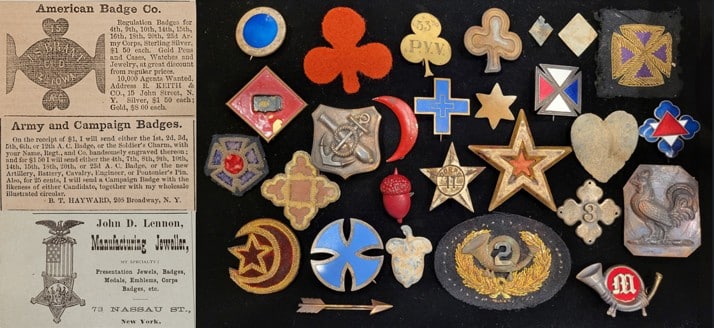
The same presses facilitated production of metal badges in the shapes Butterfield created. Some were enameled in the appropriate color; multiple colors indicated headquarters or artillery.[10] Professionally crafted badges were purchased from sutlers and jewelers, though not all soldiers could afford metal versions or gilt thread. Field expedient cloth patches in the prescribed color and shape were stitched directly onto caps or uniforms over the left breast. More durable badges could be fashioned from stiffened cloth (perhaps bordered in wire thread or tin), bone, wood, or lead.
As the use of official badges spread to the Western Theater, some were chosen by the men themselves. The XIV Corps chose the acorn, remembering how after Chattanooga they supplemented meager rations with roasted acorns, some calling themselves “The Acorn Boys.” A XV Corps trooper, challenged by a new arrival from the east as to why he wore no badge, clapped his hand on his cartridge box and replied, “Here’s my badge! Forty rounds! It’s the orders to always have forty rounds in one cartridge box, and we always do.” The XV’s emblem became a miniature cartridge box set in the middle of a lozenge.[11]
Corps badges became legally recognized decorations in Revised Statute 1227, Chapter 33, Section 1426: honorably discharged Veterans to wear “on occasions of ceremony, the distinctive army badge … in which they served.” Many were proudly worn alongside G.A.R. and other organizational badges for decades. The popular corps-badge concept continued to evolve, and new designs saw service in the Spanish-American War. Soldiers and Marines wore patches of their current assignment on the left shoulder in both world wars, though usually indicative of division affiliation rather than corps. The Army continues this tradition today, as well as patches on the right shoulder indicating former wartime service in that unit.
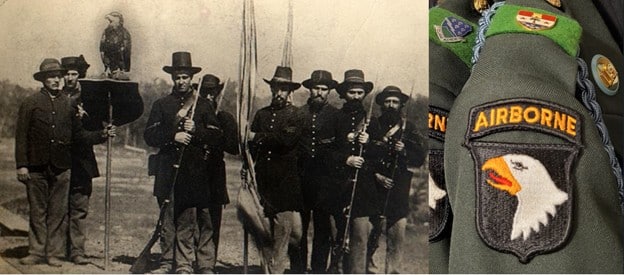
The Army still maintains some interesting connections to the Civil War through unit insignia. The post WWI 101st Infantry Reserve, headquartered in Milwaukee, adopted the popular Civil War mascot of the 8th Wisconsin – Old Abe the War Eagle, as their emblem. The patch was crafted in the shape of a Union shield, same as Abe’s perch. Though the original unit was disbanded prior to WWII, the reconstituted 101st Airborne Division retained the distinctive eagle patch with the addition of an “Airborne” tab – indicative of their ability to drive deep into enemy territory by glider, parachute, or helicopter, prepared to fight surrounded by foes when they arrive.[12]
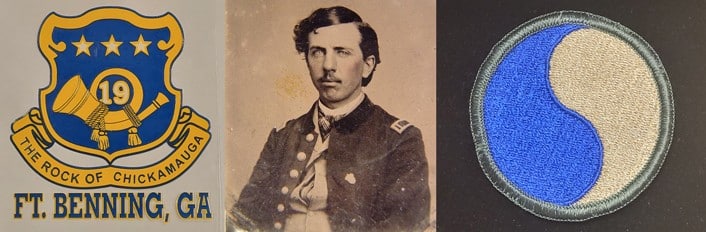
The 29th Division wears a blue and gray Monad (ying-yang symbol); the unit was originally comprised of Soldiers from New Jersey, Delaware, Washington D.C., Maryland, and Virginia – both sides of the civil war – symbolizing their defense of a reunited country. The 19th Infantry Regiment is still known “the Rock of Chickamauga.” Battle streamers traced to Confederate units were no longer authorized on regimental colors in September 2023, though ones with Federal lineage remain. And the 69th Infantry still proudly wears boxwood on their uniform in the St. Patrick’s Day parade.
Mike Busovicki is an Iraq War Infantry Veteran. He evaluates disability claims for the Department of Veterans Affairs and holds a master’s degree in public and international affairs.
Endnotes:
[1] Phillips, Stanley S. Civil War Corps Badges and Other Related Awards, Badges, Medals of the Period. S.S. Phillips and Assoc., Landham, MD, 1982, p. 2.
[2] Myhal, Michael J. Corps Badges of the Union Army. © Michael J. Myhal, 1973, p. 2.
[3] Ray, Fred L. Shock Troops of the Confederacy: The Sharpshooter Battalions of the Army of Northern Virginia. CFS Press, Asheville, NC, 2006 305-307
[4] Green Sprigs of Courage: How the mythologizing of the Union Army’s Irish Brigade helped dispel anti-Irish sentiment. Bunk History Blog, University of Richmond. https://www.bunkhistory.org/resources/green-sprigs-of-courage-backstory-archive
[5] 7th Ohio.com: Remembering the Men of the Rooster Regiment. https://7thohio.com/
[6] Letter of Sgt. W.T. McGill. Recollections and Reminiscences, Vol. III. United Daughters of the Confederacy, Columbia, SC, p. 18
[7] Ray, 284-285.
Yee, Gary. Sharpshooters 1750-1900. Sharpshooter Press, Broadmoor, CA, 2009, p. 226-231
[8] Weicksel, Sarah Jones. A Nation Unraveled: Clothing, Culture, and Violence in the American Civil War. University of North Carolina, Chapel Hill, NC, 2026, p. 20-29
[9] Cox, Shae Smith. The Fabric of Civil War Society: Uniforms, Badges, and Flags, 1859-1939. Louisiana State University Press, Baton Rouge, 2024, p. 15-24
[10] Phillips, 25, 66-68
[11] Myhal, p 43-45
[12] Page, James CPT. The Story of “Old Abe,” famous Wisconsin War Eagle on 101st Airborne Division patch. https://www.army.mil/article/91178/the_story_of_old_abe_famous_wisconsin_war_eagle_on_101st_airborne_division_patch


Excellent work as always! I appreciate the photos too, they help bring your descriptions to life.