Book Review: “Now I’m With the Invalids”: The Veteran Reserve Corps in America’s Civil War

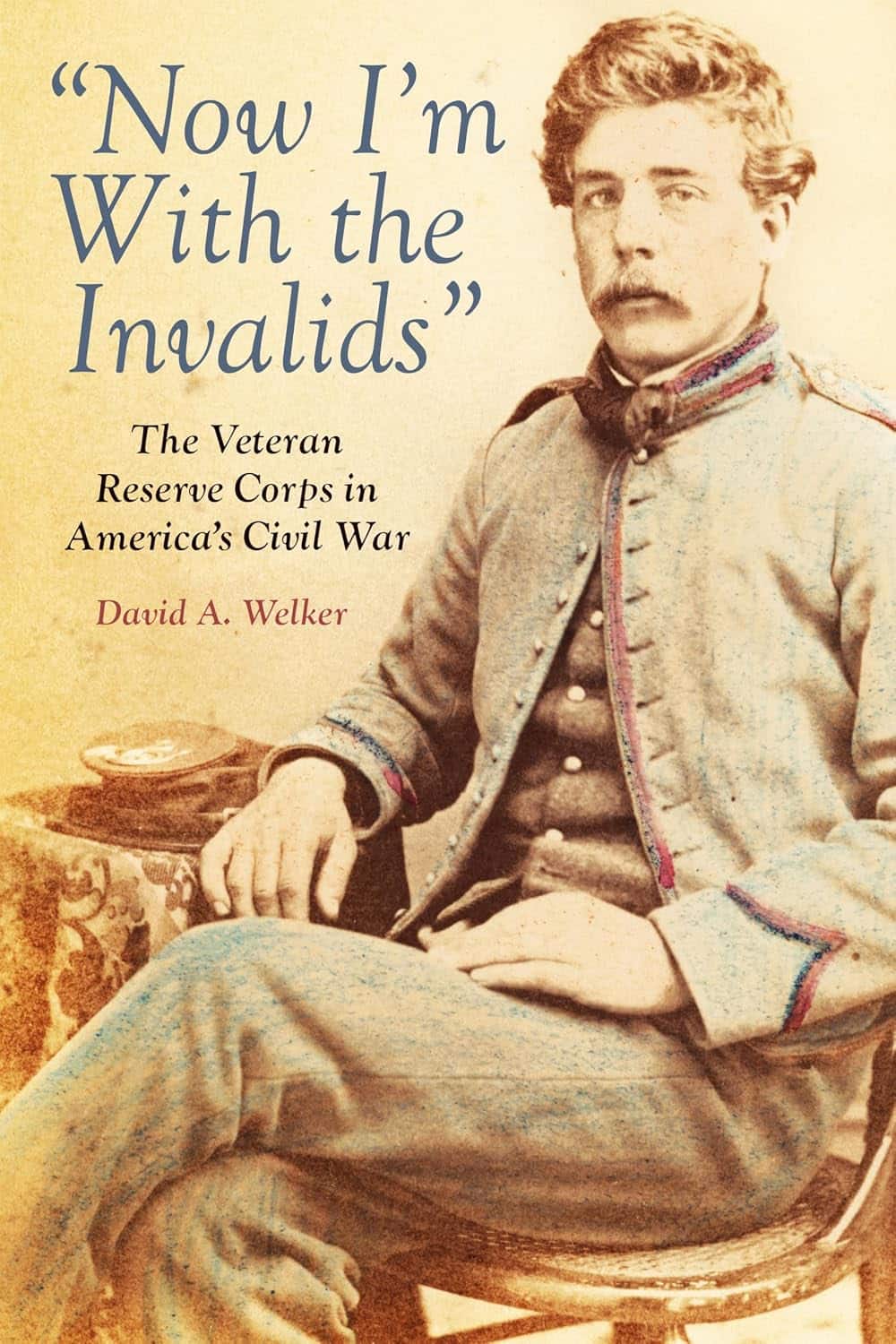
“Now I’m With the Invalids”: The Veteran Reserve Corps in America’s Civil War. By David A. Welker. Havertown, PA: Casemate Publishers, 2026. Hardcover, 352 pp., $34.95.
Reviewed by Tim Talbott
When one thinks about Civil War era innovations, inventions like the USS Monitor ironclad, the CSS Hunley submarine, the Spencer repeating rifle, or other some other weapon or mechanical device more often than not first come to mind. However, some of the conflict’s most significant innovations were merely good ideas that knowledgeable and skillful people put into motion and then successfully guided forward. Such was the organization first known as the Invalid Corps (IC). Due to prejudices and the baggage that came with that name, on March 18, 1864, it was renamed the Veteran Reserve Corps (VRC).
While well-versed students of the Civil War are familiar with the VRC name, until recently no in-depth scholarship explored its history, scope, or impact on the conflict. Historian David A. Welker capably fills this previous void with the publication of “Now I’m With the Invalids”: The Veteran Reserve Corps in America’s Civil War.
Like many innovations, the VRC was born out of a necessity. Its driving motivation was Federal manpower needs. The intensive 1862 battles at places like Shiloh, the Seven Days’ Battles, Second Manassas, Antietam, Perryville, and Fredericksburg created long lists of dead and wounded. In addition, the tens of thousands of deaths and disabilities caused by disease left the Union’s field armies needing restock. Black soldiers who enlisted in United States Colored Troops (USCT) regiments, largely in 1863 and 1864, helped solve part of that problem. However, it took time to recruit and train USCTs for the roles they would later perform.
Meanwhile, with what promised to be a heavy campaign season in 1863, the army needed more men to accomplish its goals of preserving the Union and abolishing slavery. The Federal draft began in March 1863, as well, helping meet immediate needs, but still the army needed more men.
As with most innovative ideas, a take-charge person usually serves as the ramrod. For the Veteran Reserve Corps, it was Provost Marshal Gen. James B. Fry. In this role, as Welker notes, “Fry proposed utilizing the nation’s legions of wounded and injured veterans to fill his provost marshal general force. . . .” Fry believed that those men who were unable to do field duty, but who could still perform “light duty,” such as “hospital, garrison, and provost duty” could be of immense help. Instead of discharging them, and since they were “already in Federal service and so were almost instantly available to join Fry’s command,” he reasoned that they could continue to serve. Eventually, the approximately 60,000 VRC men filled additional roles like transporting and guarding prisoners of war and monitoring railroads, among many other duties. In doing so, it “gave thousands of wounded and recovering men a way to continue serving the Union cause they had already sacrificed so much to support.” (25-26)
To tell the story of this fascinating yet previously understudied organization, Welker structured his book into eleven thoroughly researched and well-written chapters. The book also includes three appendices, one of which discusses the Confederates’ intriguing attempt with a VRC of their own. One might not think that a topical study such as this one would include maps, but due to the VRC’s diverse roles and geographic breadth of service, Welker includes a number of maps to help readers better understand where VRC companies and regiments served, including a few maps displaying some skirmishes and battles in which they participated. In the center of the book there are eight pages of period photographs that show images of prominent members of the VRC, VRC soldiers in their distinctive light blue uniforms, and VRC soldiers performing some of their responsibilities.
While all of the chapters are chocked full of details and information, chapter five makes a bit of mid-book departure from the nuts-and-bolts discussion contained within much of the study and instead focuses on individual stories of several VRC men over the chapter’s 23 pages. Chapter five serves as a gentle reminder that these men were more than additional numbers for the Federal army, above all else, they were people.
Spanning 30 pages, the endnotes section shows the depth of Welker’s impressive research in period newspapers, the VRC records in the National Archives, letters of VRC soldiers, and GAR records. Taking the first swing on a topic that has received little previous scholarly attention is always a tall task, and it is one that Welker preforms amazingly well.
It has taken over 160 years to get a full-length study of the VRC. However, with Welker’s “Now I’m With the Invalids”: The Veteran Reserve Corps in America’s Civil War, we finally have that definitive scholarly study to better understand the VRC’s many contributions toward helping win the war.


