The Twin Sisters Cannons in the Civil War
On January 28, 1861, delegates from across the Lone Star State assembled in the state capital at Austin to debate the topic of secession. Quickly, as secession seemed imminent, a Committee on Public Safety formed to address the concerns of the state’s defense. By February 14, the chairman of the committee—John C. Robertson—addressed in a letter to the Louisiana commissioner to the Texas convention, George Williamson, his hope to acquire “whatever spare arms [Louisiana] may have.”[1]
Adding an additional request, Texas delegates set their sights on the legendary cannons known as the Twin Sisters which many believed resided in Louisiana at the time of secession. By calling for the return of these relics of the Texas Revolution, Texas officials demonstrated through such measures how they attempted to resolve the shortage of arms that plagued the Confederate states along the Gulf Coast.
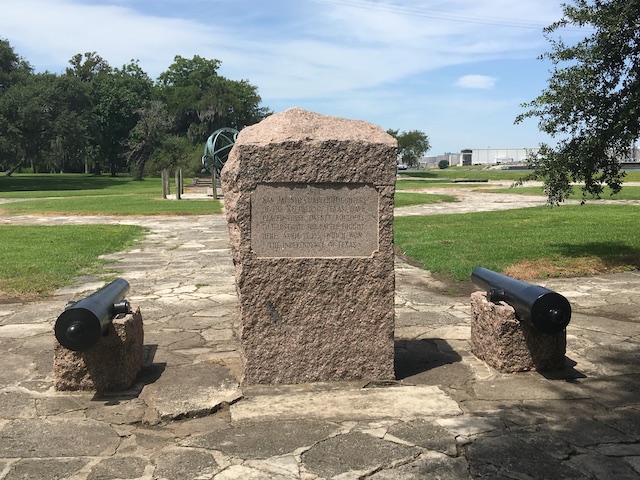
The story of the Twin Sisters begins in October of 1835, when the citizens of Texas rose in rebellion against the government of Antonio López de Santa Anna. With insufficient arms to fight against the Mexican government, the Texians turned to the citizens of the United States for aid in their fight. On November 17, 1835, the citizens of Cincinnati, Ohio proclaimed in good faith that the “citizens of Texas shall be supplied…with such an amount of hollow wares as may be deemed sufficient.”[2] Forged at the Miles Greenwood Eagle Iron Works in Cincinnati, the twin cannons arrived in Texas in early 1836. Arriving just days before the climactic battle of San Jacinto, the “Twin Sisters” etched their name into Texas legend through their actions in the battle.
Following their role in the Texas Revolution, the two field pieces remained in the service of the Texian Army. Witnessing continued service to combat indigenous attacks on the Texas settlements along the frontier, they last appeared in the historical record as being present in Austin during the Mexican incursions into Texas in 1842-43.[3] After 1843, they simply disappeared from the record.
Much debate circulates as to what happened to the famed cannons following these episodes. While commentators at the time raised several claims as to the whereabouts of the cannons, one news outlet, the Texas State Gazette in Austin, suggested in 1849 that the Twin Sisters—along with other military stores—had been shipped to Baton Rouge, Louisiana following the conclusion of the Mexican War. While this is more speculative than observative, many Texans believed that this was the fate of the famed cannons by the time of the Civil War.[4]
As sectional tension mounted in 1860, Ben McCulloch—who had commanded one of the cannons at San Jacinto—sought the prospect of obtaining the cannons from Louisiana. Writing to Governor Sam Houston, McCulloch advised Houston to secure them in anticipation of open hostilities. Houston then brought this inquiry to Secretary of War John B. Floyd, writing that as a “matter of pride,” many Texans wanted “to procure those arms for the State.”[5] Recognizing that the aging cannons were “worthless to the General Government,” Governor Houston noted that their presence served as “a relic of her revolution.”[6] Despite Houston’s pleas, the request went unresolved.

The issue regarding the cannons did not die in 1860. The following year, John C. Robertson of the Committee on Public Safety reported on the current defense situation while in Galveston in February of 1861. Recognizing Galveston’s severe lack of arms, Robertson emphasized that the largest Southern port west of New Orleans, needed any arms that its neighbors could offer. Appealing to the commissioner from Louisiana to Texas, George Williamson, he wrote that “we ask of you your individual efforts on our behalf to secure for us the two pieces of ordinance, well known in the history of Texas as the ‘Twin Sisters.’”[7] In reply, Williamson promised to do everything in his power to secure both arms and the Twin Sisters for the state of Texas.
Given the legend surrounding the twin cannons, their safe passage into Texas proved to be of paramount interest to the Texas secession delegates. The president of the convention, Oran M. Roberts, even thought it prudent to submit to the record of the convention the correspondence of Williamson to the state legislature of Louisiana on this issue. In this correspondence, H.W. Allen of the Louisiana state legislature responded to George Williamson’s request for procurement of the two cannons. Affirming Williamson that “action was immediately taken” upon his request to locate the Twin Sisters, Allen hoped that this solidified good sentiments with “our gallant sister state.”[8]
By April of 1861, the editor for the Texas State Gazette, John Marshall, wrote that the “two cannon used so effectively on the 21st of April, 1836” had arrived in Galveston and had been presented to state authorities.[9] Enthusiasm for the return of the Twin Sisters reverberated throughout Galveston as the The Civilian and Gazette Weekly reported that “the two cannon, which spoke so audibly and effectively for freedom at San Jacinto” arrived amongst “a worthy ovation.”[10] While John Marshall believed the intention was for these two cannons to be “preserved as proud testimonials of the gallantry of the men of our revolution,” it is quite possible that they served a much greater role in the coming conflict.[11]
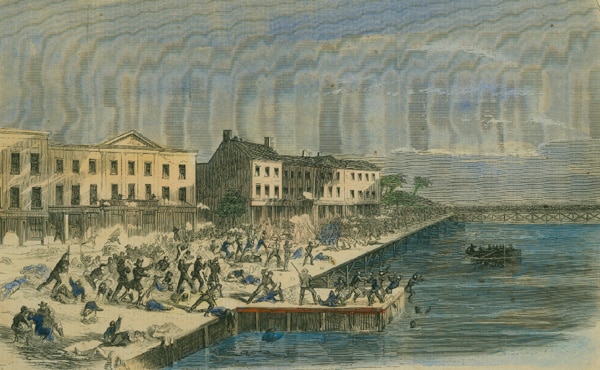
Some historians believe after their arrival, the Twin Sisters witnessed service in the vicinity of Galveston. According to historian Edward T. Cotham, the Twin Sisters remained in the vicinity of Galveston up to the battle of Galveston on January 1, 1863.[12] Several accounts appear to corroborate this claim. In a letter to Texas Confederate Governor, Edward Clark, Sidney Sherman—a veteran of San Jacinto and commander of Texas coastal defenses in 1861—reported the “Twin Sisters” as present within Galveston’s coastal defenses. Nearly five decades after the war, Judge William P. Hamblen believed that Confederate troops removed the Twin Sisters during the Federal occupation of the city in October 1862.[13]
Following their service at Galveston, the cannons continued to be of concern for Texas officers, demonstrating their continued importance to Texas defenses. On November 30, 1863—with Maj. Gen. Nathaniel Banks federal force beginning its anticlimactic Rio Grande Campaign—Maj. A.G. Dickinson reported to Maj. Sidney T. Fontaine that the cannons had since moved to the vicinity of Austin. He reported that “they are in deplorable condition, and I am fearful could not be used.”[14] Proving a serious issue throughout their service in Confederate Texas, eyewitnesses often described them in poor condition. Even upon receiving the cannons in April of 1861, Sidney Sherman noted them as “much impaired by rust.”[15]
With such arms in the service of the Texas defenses, their presence symbolized a larger problem confronting Confederate Texas. With Texas officials relying upon relics of their own revolution, it demonstrated the poor logistical system of armaments that plagued the Confederate cause along the Gulf Coast. Ultimately, the Twin Sisters served more of a symbolic role by connecting Texas’ previous quest for independence in 1836 with that of 1861.
Endnotes:
[1] Ernest William Winkler, Editor, Journal of the Secession Convention of Texas, 1861, (Austin, TX: Austin Printing Company, 1912), 308.
[2] Daily Cincinnati Republic, Cincinnati, OH, November 19th, 1835, 2.
[3] Telegraph and Texas Register, Houston, TX, July 6, 1842, 1.
[4] Texas State Gazette, Austin, TX, October 20, 1849, 66.
[5] Amelia W. Williams and Eugene C. Barker, eds., The Writings of Sam Houston, vol. 7, (Austin, TX: University of Texas Press, 1942), 397.
[6] Ibid, 397.
[7] Journal of the Secession Convention of Texas, 307.
[8] Ibid, 207.
[9] Texas State Gazette, Austin, TX, April 20th, 1861, 3.
[10] The Civilian and Gazette Weekly, Galveston, TX, April 16, 1861, 1.
[11] Ibid, 3.
[12] Edward T. Cotham, Jr., Battle on the Bay: The Civil War Struggle for Galveston, (Austin, TX: University of Texas Press, 1998).
[13] “Twin Sisters,” The Houston Post, Houston, TX, August 22, 1909, 31.
[14] Official Records, vol. 26 part 2. 459.
[15] Sidney Sherman to Governor Edward Clark, May 22, 1861. Records of Governor Edward Clark. Texas State Archives.


A bit curious that Sam Houston, who opposed secession, sought those cannon for Texas.
What was the ultimate fate of the cannon?