Book Review: Deserter Declarations: Letters from North Carolinians Who Abandoned Their Confederate Units

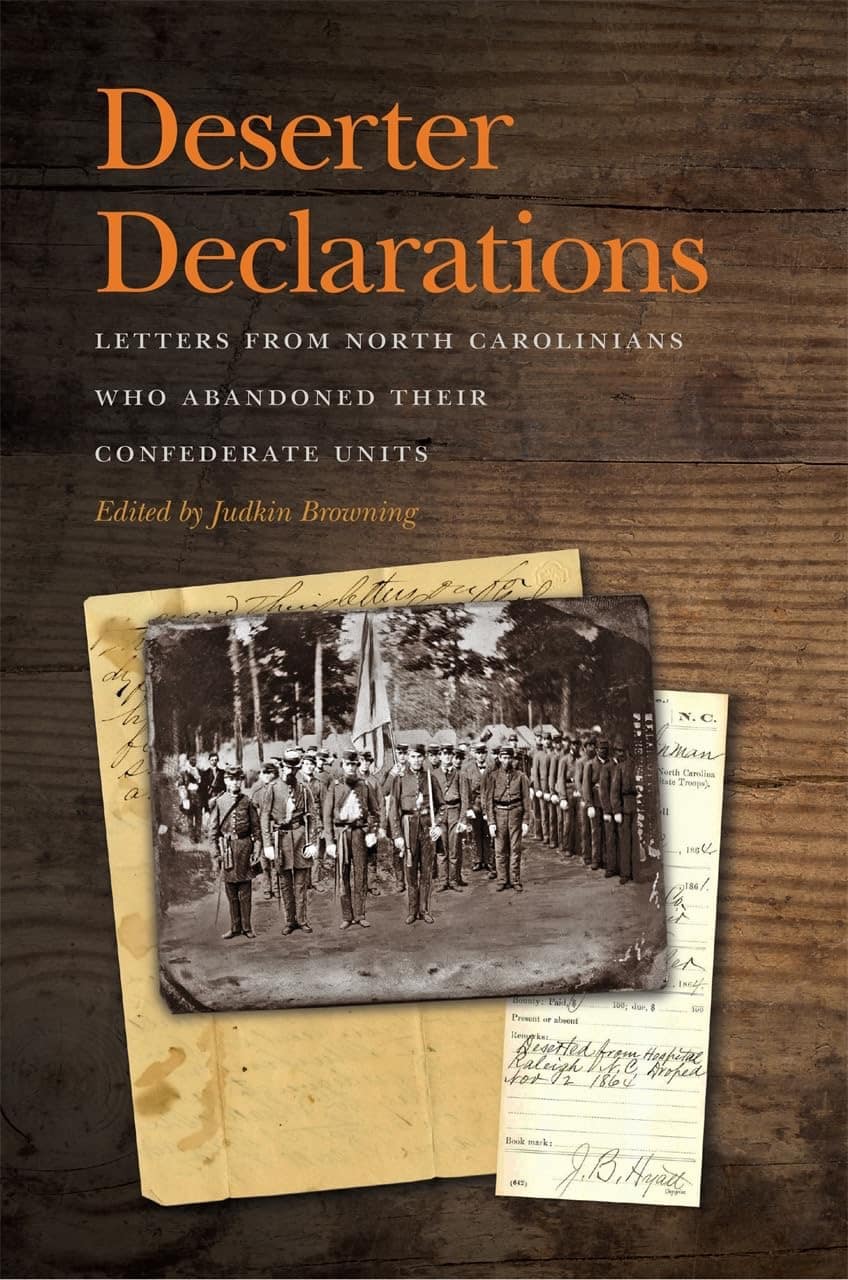
Deserter Declarations: Letters from North Carolinians Who Abandoned Their Confederate Units. Edited by Judkin Browning. Athens: The University Press of Georgia, 2026. Paperback, 273 pp. $29.95.
Reviewed by Michael C. Hardy
Bartlett Nixon was in a fix. A private in the 16th North Carolina, Nixon deserted not long after the battle of Gettysburg, making his way to his home in Lincoln County. He confessed in a letter to Gov. Zebulon B. Vance that he had been “sick for a long time. I was barefoot and almost naked. I was broke down in body & mind.” Nixon was also concerned about his “aged widow mother.” However, Nixon’s health had recovered. He wrote Vance that he had never intended to desert as he was a “true Southener and am willing to spill my blood like water in defense of our rights and liberties.” (128)
In his latest book, Dr. Judkin Browning, professor of military history at Appalachian State University, dives into the subject of letters written by North Carolina Confederate soldiers who had deserted their commands and then wrote to Governor Vance, wanting some type of reprieve so that they could return to their regiments. Deserter Declarations: Letters From North Carolinians Who Abandoned Their Confederate Units presents this largely untold story through the words of the soldiers, their loved ones, or concerned family members.
North Carolina makes an excellent case study. The Tar Heel state sent over 100,000 men to Confederate service. With so many men, both volunteers and conscripts, it seems natural that there were more deserters from North Carolina than from other states. As the soldiers’ letters explain, they left for a variety of reasons: sick family members, starving wives and children, and a disdain for certain commanding officers. Yet instead of remaining in the bushes attempting to evade the home guard or bands of Confederate soldiers sent to root out the outliers, these men sought to return to their regiments. They did so by writing the governor. Vance often could do little. A soldier who was absent without leave or who was declared a deserter was liable for punishment according to Confederate law, specifically the Articles of War. Vance could give a soldier a pass through the lines to return to his regiment, and he could recommend leniency but could not commute harsh punishments or even death sentences.
As noted by Browning, as the war dragged on into 1864 and early 1865, Vance expressed less enthusiasm when the deserters or their family members wrote to him imploring his assistance.
It was not just the deserters who wrote Vance. Wives, fathers, and mothers frequently wrote the governor, seeking his help. Fathers typically expressed shame at their sons for abandoning their companies. Wives usually portrayed themselves as indigent and in dire need of their soldier-husband’s aid around their farmsteads.
Browning presents scores of these letters with footnotes documenting the service of the soldiers and often the men and women writing the letters. The opening essay covers the existing copious amounts of literature on the role of deserters in Confederate service, especially in North Carolina; possible motivations behind North Carolina’s deserters; desertion and Confederate nationalism; and demoralization as the war dragged on. All of these elements are evident in the letters exhibited in the book. Several other themes, like the geographical areas represented by the correspondents, leave room for other scholarship in the future. Overall, Browning’s Deserter Declarations: Letters from North Carolinians Who Abandoned Their Confederate Units is a welcomed edition to the scholarship on both the role of deserters and North Carolina during the Civil War.
What became of Nixon? He returned to the 16th North Carolina on November 14, 1863, was court-martialed for being absent without leave and forfeited two months of pay. Nixon was promoted to sergeant on September 1, 1864, captured near Petersburg on April 2, 1865, and incarcerated at Point Lookout until he took the Oath of Allegiance and was released on June 29, 1865.
Michael C. Hardy is an award-winning and widely published author. A graduate of the University of Alabama, he has written on a large array of subjects — Confederate regimentals, Southern places, and personalities — in thirty books, numerous articles, and over one thousand blog posts. In 2010, Hardy was named North Carolina Historian of the Year by the North Carolina Society of Historians. He was also awarded the James I. Robertson Literary Prize by the Robert E. Lee Civil War Library and Research Center in 2018 for his history of the Branch-Lane Brigade. His latest Civil War book is Feeding Lee’s Army of Northern Virginia (Savas Beatie, 2025). When not researching, writing, and traveling, he volunteers at historic sites, sharing his love for history.


