Book Review: Brigadier General William Haines Lytle: The Union’s Poet-Soldier

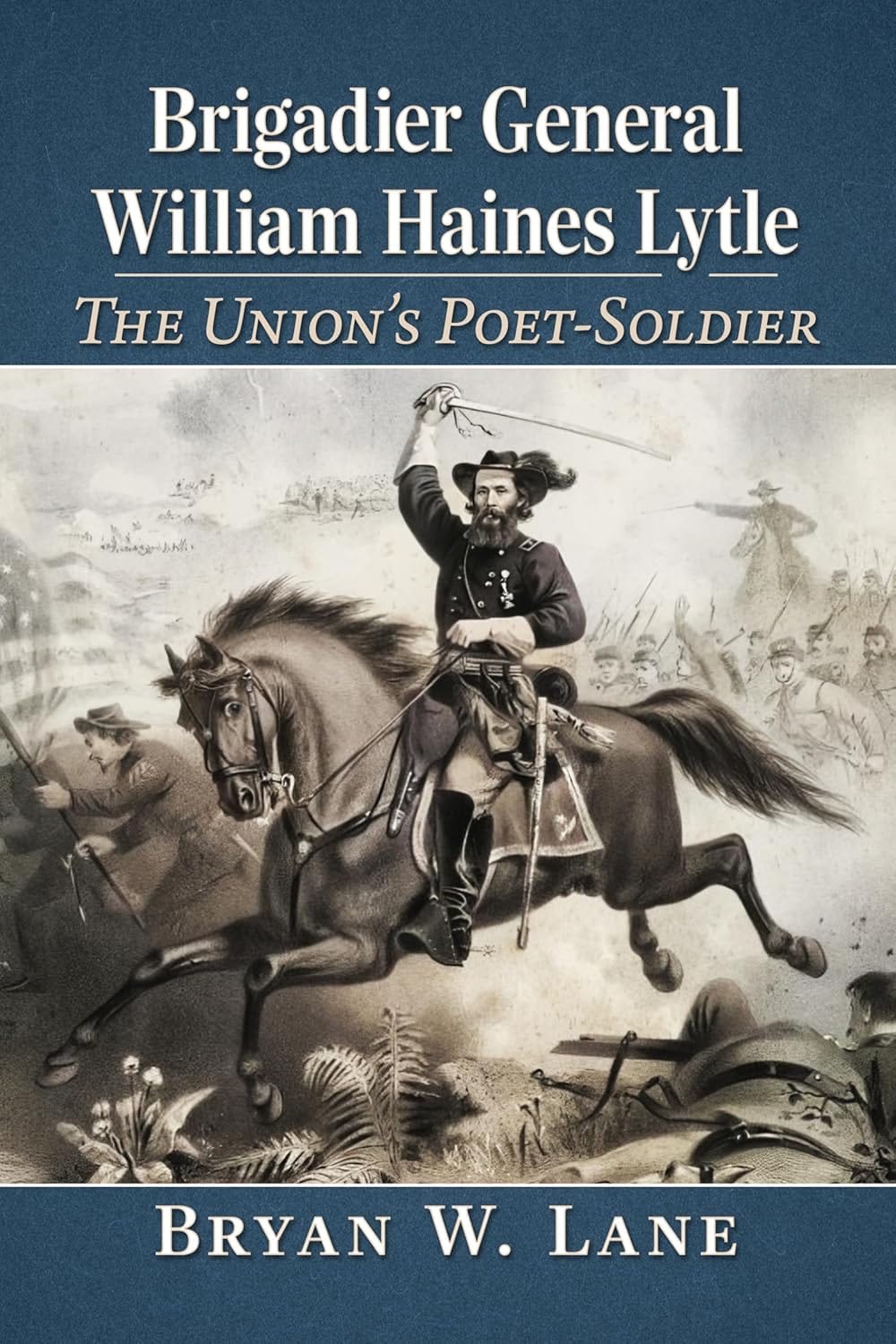
Brigadier General William Haines Lytle: The Union’s Poet-Soldier. By Bryan W. Lane. Jefferson, North Carolina: McFarland & Company, Inc., Publishers, 2025. Softcover, 213 pp. $39.95.
There was much that could have captured the attention of Capt. Douglass West on September 20, 1863. Smoke still lingered over the Chickamauga battlefield, fed by brush fires ignited during the fighting. Bodies lay scattered across the ground, including those of West’s Confederate comrades. Yet his attention was fixed on a fallen officer dressed not in Confederate gray, but Union blue. As West recalled, “My first exclamation on looking down upon his graceful and manly form, so perfectly dressed and accoutered, was ‘I am dying, Egypt, dying.’” (145)
The body belonged to Brig. Gen. William Haines Lytle. Five years earlier, Lytle had published a poem titled “Antony and Cleopatra,” which opened with the same line that sprang to West’s lips. (49) The verse had earned Lytle notable fame in his own time, enough that even a Confederate officer recognized him. Yet, Lytle’s reputation has since faded. Bryan Lane’s recent biography, Brigadier General William Haines Lytle: The Union’s Poet-Soldier, hopes to restore attention to this “extraordinary person.” (2)
Lytle lived an unusually full life in just thirty-six years. Born in Cincinnati on November 2, 1826, he belonged to one of the city’s leading families. After he lost both of his parents as a teenager, he took to disciplined study at Cincinnati College (now University), where he first distinguished himself as a poet and orator. It was on the public stage where he demonstrated a devotion to Jacksonian Democratic ideals inherited from his father, including anti-Black racism and anti-abolitionism. His desire for national expansion inspired him to volunteer for the Mexican War, rising to the rank of captain despite seeing no combat. In the decade that followed, he became a lawyer, was elected to the Ohio House of Representatives, spoke at major Democratic rallies, ran unsuccessfully for lieutenant governor, and published several poems.
When civil war broke out, Lytle desired to serve the Union. He helped establish Camp Dennison near Cincinnati, but soon grew dissatisfied with administrative work and accepted a commission as colonel of the 10th Ohio Infantry. Commanding a regiment largely composed of Catholic Irish and German immigrants might have posed difficulties for a wealthy, native-born Protestant, but Lane emphasizes that Lytle and his men “form[ed] a very strong bond” that endured throughout the war. (57)
Lytle fought in three major engagements, becoming a casualty each time. At Carnifex Ferry in 1861, he was shot in the left calf while leading his regiment. At Perryville in 1862, a shell fragment struck him behind the ear as he attempted to rally his brigade, resulting in his capture after he insisted his men left him behind. His final battle at Chickamauga proved fatal: he was shot in the spine and face. Recognized by Confederate officers, his body was returned to Cincinnati, where he received a hero’s funeral.
Lane frames the book as a candid account, presenting both “the good and the bad details” of Lytle’s life. (1) While he clearly admires his subject, he avoids portraying Lytle as flawless. He addresses Lytle’s struggles with alcoholism and episodes of verbal and physical rage against rivals and, in one case, his own sister. (46) Lane suggests that the responsibilities of wartime command moderated many of these behaviors, though this conclusion rests more on implication than sustained analysis. Nevertheless, Lytle’s steadfast racism was not shaken, meaning that the war witnessed both changes and continuities in the complex figure.
The biography moves between broader historical context and intimate personal detail, a strategy that is generally effective, if occasionally uneven. Lane is particularly strong in depicting the less dramatic aspects of soldiering: long marches, time spent recovering from wounds, parole after capture, and labor repairing infrastructure. These passages serve as a reminder that Civil War service involved endurance as much as combat. The book is further enriched by a substantial set of illustrations, many provided by a descendant of the Lytle family.
Lane draws on a wide range of secondary literature as well as “firsthand contemporaneous accounts,” including Lytle’s poems and the Lytle Papers housed at the Cincinnati Museum. (1) Much of this correspondence appeared earlier in Ruth Carter’s For Honor Glory and Union (1999), and Lane uses it effectively by pairing Lytle’s words with accounts from contemporaries such as aide-de-camp Alfred Pirtle. While he succeeds in incorporating perspectives from fellow officers and family members, the views of enlisted men unfortunately remain largely absent.
Lane succeeds in writing a solid biography of a surprisingly understudied figure. The narrative is concise, yet detailed, allowing readers to visualize Lytle at home and at war. By recovering a life at the intersection of politics, poetry, and war, Lane demonstrates how cultural prominence and military sacrifice could coexist in the nineteenth century, encouraging readers to remember William Haines Lytle for more than the tragic poetry of his death.
Danny Brennan is a PhD Candidate at West Virginia University who works as a seasonal ranger at Gettysburg National Military Park. He is interested in exploring the culture and experience of Union soldiers in war and memory.


