Unconditional: Frank Blair’s Fight for Missouri
Events in St. Louis were approaching a crisis in June 1861. At the Planter’s House Hotel – named for the slaveholding elite of Missouri’s Little Dixie – a clandestine meeting unfolded.
Missouri’s pro-secessionist governor, Claiborne Fox Jackson, accompanied by Sterling Price, the commander of the legally constituted yet questionably loyal Missouri State Guard, met with Unionist leaders. The Federal delegation was led by recently-appointed Brig. Gen. Nathaniel Lyon, a career soldier commanding the Union forces at the St. Louis Arsenal.

Courtesy of Wilson’s Creek National Battlefield.
The meeting aimed to de-escalate the threat of armed conflict in Missouri. After several unproductive hours, Lyon brought the discussion to an abrupt end. Pointing to the secessionist delegates, he forcefully exclaimed that “rather than concede to the State of Missouri for one single instant the right to dictate to my Government in any matter however unimportant, I would see you…and every man, woman and child in the state, dead and buried.”[1]
Lyon’s statement demonstrated his intense commitment to the Union cause. While he was a newcomer to Missouri, another figure at the table was not. Colonel Frank P. Blair was already a fixture in Missouri politics. Blair shared his counterpart’s uncompromising dedication to the Union and Missouri’s place within it. His efforts, with “utter disregard of the mere letter of the law, which was one of his most marked characteristics,” were essential to the political triumph of Missouri’s Unionist forces in 1861.[2] If Lyon was the crusading zealot of unconditional unionism, Blair was its benefactor.
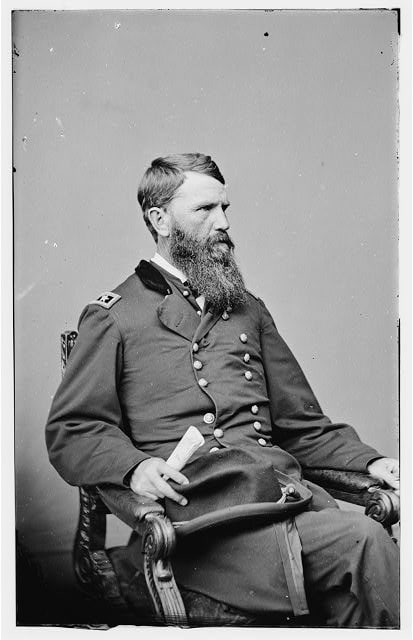
Photographs of Blair present a handsome but hardened man, with close-trimmed hair and an unsentimental gaze. His blunt personality was matched by his talent for fiery oratory, profanity, and “the organization of hatreds.”[3]
Blair was part of a political dynasty. His father, Francis Preston Blair, was a close confidant of President Andrew Jackson and founder of the Republican Party. His elder brother, Montgomery, served as President Abraham Lincoln’s postmaster general.
Raised in Washington, Frank P. Blair’s own path took a western course. Arriving in St. Louis in 1842, he soon threw himself into the family business: politics. He entered the state legislature in 1852 as a disciple of Missouri Senator Thomas Hart Benton, sharing his white supremacy and fierce opposition to slavery’s expansion.[4] By 1861, he was a Republican congressman for his adopted state.
The Blair patriarch and his sons were close. Lincoln described the family as a “close corporation” with a “spirit of clan.”[5] That unity and their deep ties to the Republican leadership were vital to Blair’s forthcoming success.
Contemporary accounts reveal Blair’s role in the secession crisis. James Peckham, a political ally and Union officer, wrote the first lengthy account in 1866. Peckham’s book was followed in 1888 by Thomas L. Snead, who served as aide-de-camp to Price and attended the Planter’s House Hotel meeting.[6] Of Peckham’s work, Snead observed that, “glaring faults are more than compensated by the important facts the remembrance whereof it has preserved.”[7]
Ally and foe alike recognized Blair’s decisiveness. “He knew exactly the work before him,” Peckham noted, “and the depths he would necessarily stir into fermentation.”[8] Snead put it bluntly: “Blair did not hesitate. He never did.”[9]
As other border-state politicians pursued compromise, Blair prepared for war. Before South Carolina’s secession, he wrote to his brother Montgomery: “We must either accept the Southern slaveholders as our masters or dispute the point on the field of battle,” he stated, “and for my part I do not hesitate to embrace the last alternative.”[10]
Blair began by building a military organization outside either state or Federal jurisdiction. Two months before the firing on Fort Sumter, he led the creation of the secretive Union Safety Committee in St. Louis.[11] He also reorganized the St. Louis chapter of the Wide Awakes, the Republican political club he had established in the city, into military companies.[12] These companies, drawing heavily from the city’s large German community, began drilling and arming under Blair’s supervision.[13]
To sustain this force, Blair partnered with like-minded entrepreneurs to coordinate the purchase of weapons, equipment, and horses, smuggling and hiding them throughout the city.[14] Blair also raised over $10,000 – more than any other contributor – through Eastern banks and financiers, and his personal contributions.[15]
These actions were not only controversial; they were illegal. Despite his openly secessionist sympathies, Claiborne Fox Jackson was the elected governor of Missouri. The Missouri Volunteer Militia, soon to be re-organized as the Missouri State Guard, was constituted under state law. Blair’s private army was not.[16] To preserve the Union, Blair operated against the laws of the state and country he sought to save.
Two individuals were instrumental to Blair’s success: Lyon and Lincoln. Nathaniel Lyon’s arrival in St. Louis was in large part due to Blair’s efforts to protect the massive Federal arsenal. Lyon was uncompromising, ill-tempered, insubordinate, and aggressive, with an intense hatred of slavery and secession.[17] The bond between the two men was “an intimacy, which speedily ripened into the warmest friendship and the most profound mutual respect and confidence.”[18] Throughout, recalled Peckham, “Blair was the trusted, confidential adviser, sought for in every instance, and in every instance upholding and sustaining.”[19]
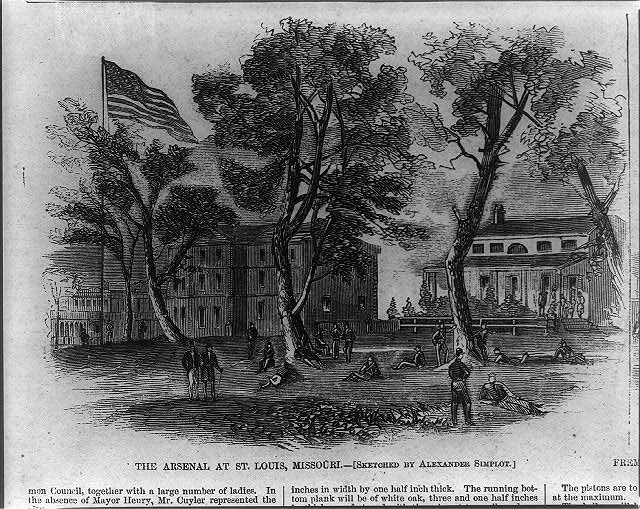
Blair tested the limits of legality in urgent times. When the Lincoln administration called for state volunteers after Fort Sumter, Governor Jackson refused. Blair and Lyon tried to circumvent him by mustering Blair’s volunteers directly from the arsenal. This was blocked by Brig. Gen. William Harney, Lyon’s departmental commander, attempting to maintain the peace by acknowledging the governor’s constitutional authority. Blair responded by contacting his brother in Washington, “urging the removal of General Harney from this post, and giving us someone to command who will not obstruct the orders of the Government.”[20] On April 21, 1861, a day after pro-secessionist militiamen seized a small Federal arsenal in Liberty, Missouri, Blair and Lyon sought to compel Harney to meet their demands. Blair then implored the secretary of war to directly order the mustering and arming of their men and appointment of Lyon as brigadier general.[21] To prevent any knowledge of these communications, they were taken across the Mississippi River to Illinois to be transmitted.[22] The effort succeeded.
Blair and Lyon had the necessary authority, but it was constitutionally questionable. In calling for volunteers, Lincoln avoided Congressional authorization and instead operated within the constraints of an existing law.[23]
Blair’s orders went further. Instead of the untrustworthy state authorities, the Federal government directed a junior regular officer and an improvised civilian committee to oversee assembly of a state military force.
Lincoln would empower Blair further. In early May, he gave discretionary orders for Blair to relieve Harney from departmental command and elevate Nathaniel Lyon in his place. Lincoln was nevertheless uncomfortable with this action. He urged Blair not to exercise it, “unless in your judgment the necessity to the contrary is very urgent.”[24] Unsurprisingly, Blair found sufficient cause; Harney was relieved within weeks.
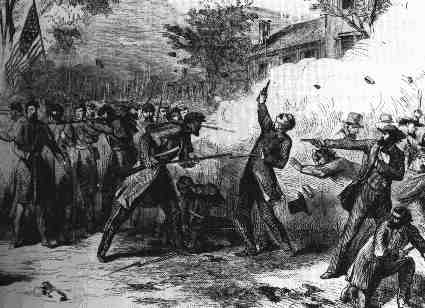
Historical Society.
Events soon accelerated. Blair and Lyon acted quickly to assert their newfound authority. The two men suppressed Camp Jackson, the pro-secessionist militia camp located near the St. Louis Arsenal, on May 10, 1861, provoking a violent riot and the imposition of martial law. The previously described Planter’s House Hotel meeting occurred one month later. In its aftermath, Missourians were forced to choose sides.
Lyon’s star burned brightly, but briefly as a martyr to the Union cause at the battle of Wilson’s Creek on August 10, 1861. Blair’s military prominence rose steadily, reaching the rank of major general and command of the XVII Corps as a trusted member of William T. Sherman’s military circle. Yet in heading off secession in Missouri, Blair demonstrated that for him, there were few limits to unconditional Unionism.
Devan Sommerville is a consultant lobbyist based in his native Canada, living in Toronto, Ontario with his wife and young son. A lifelong student of the American Civil War and American Antebellum History, he holds an Honours Bachelor of Arts in History and a Master’s in Public Policy from the University of Toronto.
Endnotes:
[1] Nathaniel Lyon in Thomas L. Snead. The Fight for Missouri. (New York: Charles Scribner’s Sons, 1988), 200.
[2] Snead, 155.
[3] Jon Grinspan. Wide Awake: The Forgotten Force that Elected Lincoln and Spurred the Civil War (New York: Bloomsbury Publishing, 2024), 75.
[4] Sean Wilentz. The Rise of American Democracy: Jefferson to Lincoln (New York: W.W. Norton & Company, Inc., 2005), 671.
[5] Abraham Lincoln in Michael Burlingame and John R. Turner Ettlinger, ed. Inside Lincoln’s White House: The Complete Civil War Diary of John Hay (Carbondale, IL: Southern Illinois University Press, 1999), 123.
[6] Snead, iii.
[7] Snead, vii.
[8] James Peckham. Nathaniel Lyon and Missouri in 1861. (New York: American News Company, 1866), x.
[9] Snead, 105.
[10] Frank P. Blair to Montgomery Blair. (Blair Family Papers, Princeton University). November 23, 1860.
[11] Peckham, 32.
[12] William Garret Piston and Richard W. Hatcher III. Wilson’s Creek: The Second Battle of the Civil War and the Men Who Fought It. (Chapel Hill: University of North Carolina Press, 2000), 34.
[13] Snead, 66.
[14] Peckham 37-38; 143.
[15] Peckham 40-41.
[16] Piston and Hatcher, 37.
[17] Piston and Hatcher, 28-29.
[18] Peckham, 58.
[19] Peckham, 58.
[20] Frank P. Blair to Montgomery Blair, April 19 1861, in Peckham, 110.
[21] Frank P. Blair to Andrew Curtin. (Blair Family Papers, Princeton University). April 21, 1861.
[22] Peckham, 110.
[23] Michael Burlingame. Abraham Lincoln: A Life, Volume Two. (Baltimore: Johns Hopkins University Press, 2008), 134.
[24] Abraham Lincoln to Frank P. Blair, May 18 1861, in Peckham, 210.


What a curiously compelling article…
It is said that “politics makes strange bedfellows.” And when it comes to strange bedfellows, none were stranger than Missouri politicians.
Politics in Missouri had been more than WHIGs versus Democrats since at least 1846, when the Wilmot Proviso was introduced to the U.S. Congress, and long-time Missouri Senator Benton spoke in favor of that proviso [which attempted to prevent conversion of any territory acquired from Mexico into new slave states.] Thomas Benton’s decision against the spread of slavery split Missouri democrats into Bentonites, and the anti-Benton faction; along with the terminally ill WHIG Party, Missouri politics became a three-horse race… with horse-trading and backroom deals appearing to decide the outcome of elections up until the outbreak of Civil War. Politics in the Show-me State became even more muddled when John Fremont, who had married into the Benton family in 1841, became the first Candidate for President of the WHIG party’s successor Republican Party in 1856. The entire Blair Family – Francis Sr., Montgomery, Francis Jr. – were Jackson Democrats… then Bentonites… then Republican (til the end of the Civil War)… then Democrats again. Old Man Blair was a king-maker: advisor to Andrew Jackson; advisor to Abraham Lincoln; advised his son, Francis Jr. to run for President.
As regards Francis Blair, Jr. “not being strongly committed to The Law,” when your family MAKES the Law, and AMENDS the Law, it probably becomes accepted practice to “Transgress a bad law now… and just rewrite it later.”