A Thousand Words a Battle: Lexington
Lexington, Virginia
1865
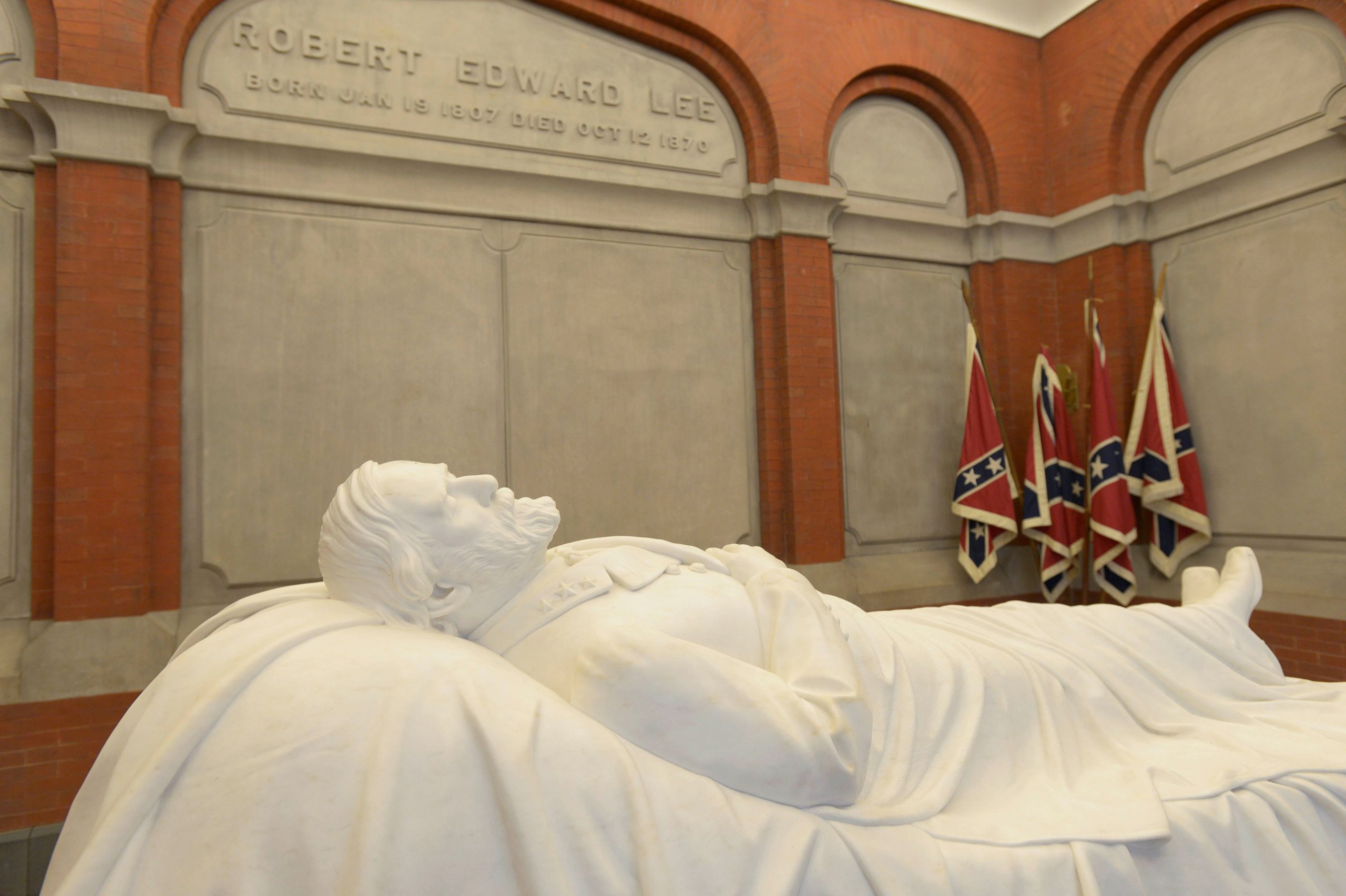
Just four months after Robert E. Lee surrendered the Army of Northern Virginia, he found himself in Powhatan County, Virginia, at a home called Derwent, considering what his future held. As the former leader of a rebel army, he feared he might be prosecuted by the federal government for treason. Other former Confederate leaders were imprisoned, self-exiled, and many were looking to him as to how continue on in life as defeated Confederates in a newly restored Union. His family home at Arlington had been turned into a military cemetery. Mentally and emotionally, he had to contend with the fact that he had led tens of thousands of men to their deaths for a cause that was now lost.
Lee had many options on the table. He could have left the country and sought a new life in a new land. He could have found ways to profit off the fame of his name, such as writing a book. Instead, Lee was interested in finding a way to help rebuild Virginia and heal the wounds in the country. In August of 1865, the dilapidated and struggling Washington College—located in Lexington, Virginia—reached out to Lee to see if he would be interested in serving as the president of the impoverished school. The college, ransacked by Union forces during the war and in deep debt, needed a great deal of help.
Lee, who had served as the superintendent of West Point before the Civil War, accepted the offer. His letter to accept the position encapsulates his humility, submission to the newly restored United States government, and his faithfulness and devotion to peace, reunion, and the betterment of mankind.
Powhatan County, August 24, 1865.
Gentlemen: I have delayed for some days replying to your letter of the 5th instant informing me of my election by the Board of Trustees to the Presidency of Washington College, from a desire to give the subject due consideration. Fully impressed with the responsibilities of the office, I have feared that I should be unable to discharge its duties to the satisfaction of the trustees or to the benefit of the Country. The proper education of youth requires not only great ability, but I fear more strength than I now possess, for I do not feel able to undergo the labor of conducting classes in regular courses of instruction. I could not, therefore, undertake more than the general administration and supervision of the institution. There is another subject which has caused me serious reflection, and is, I think, worthy of the consideration of the Board. Being excluded from the terms of amnesty in the proclamation of the President of the U. S., of the 29th May last, and an object of censure to a portion of the Country, I have thought it probable that my occupation of the position of President might draw upon the College a feeling of hostility; and I should, therefore, cause injury to an Institution which it would be my highest desire to advance. I think it the duty of every citizen, in the present condition of the Country, to do all in his power to aid in the restoration of peace and harmony, and in no way to oppose the policy of the State or General Government directed to that object. It is particularly incumbent on those charged with the instruction of the young to set them an example of submission to authority, and I could not consent to be the cause of animadversion upon the College.
Should you, however, take a different view, and think that my services in the position tendered to me by the Board will be advantageous to the College and Country, I will yield to your judgment and accept it; otherwise, I must most respectfully decline the office.
Begging you to express to the trustees of the College my heartfelt gratitude for the honor conferred upon me, and requesting you to accept my cordial thanks for the kind manner in which you have communicated their decision,
I am, gentlemen, with great respect,
Your most obedient servant,
R.E. Lee[1]
In addition to saving Washington College, Lee insisted the students conduct themselves as gentlemen. His contributions were so great that almost immediately after his death in 1870, the school renamed itself Washington and Lee. Lee is buried in a chapel on the university’s grounds.
— Mark Maloy
[1] Freeman, Douglas Southall. R.E. Lee. Vol. IV, New York: Charles Scribner’s Sons, 1934. 217-218.


George Washington’s will established the college. Early in the document is it’s establishment, in his words:
“…That as it has always been a source of serious regret with me to see the youth of these United States sent to foreign countries for the purpose of Education, often before their minds were formed, or they had imbibed any adequate ideas of the happiness of their own; contracting, too frequently, not only habits and dissipation & extravagence, but principles unfriendly to Republican Governmt and to the true & genuine liberties which, thereafter are rarely overcome…my mind has not been able to contemplate any plan more likely to effect the measure than the establishment of a UNIVERSITY in a central part of the United States, to which the youth of fortune and talents may from all parts thereof might be sent for the completion of their Education …”
By the way, his will begins, “I George Washington of Mount Vernon a citizen of the United States,” (note, not “a citizen of Virginia,”).
Washington rebelled against his government. I wonder where the South got the idea that they could do the same?
Treason doth never prosper: what’s the reason?
Why, if it prosper, none dare call it treason.
– John Harington (the couplet was often invoked during the tumultuous Stuart dynasty when the lines between treason and duty became quite blurred)
Washington’s will did not “establish” the college. He provided funds to an existing institution, which in gratitude, and no doubt a bit of marketing sense, changed its name to reflect the president’s gift.
As far as Washington’s reference to himself as a “citizen” of the United States, given his national role as Commander in chief of the Continental Army, and being twice President, it’s hardly surprising he would so refer to himself as such. Lee had no similar national command, thus his emotional framework was more transcribed and his sense of nationalism narrower, and more tribal.
Lee was superintendent of West Point during which time he was responsible for cadets from all over the United States, and this was only a small part of a 31 year long U.S. Army career which took him all over the country and into Mexico. It seems to me that he very much had the opportunity to form a national vision – far more so than most Americans at the time, anyway.
Great post and one of the best in this series.
Good article. I’m just exploring some further thoughts on this thousand words. If feels like this note from Lee is in keeping with his method of operation. I foresee criticism a’coming but damn the torpedoes. In 1861 when dithering on whether to stay in the US Army or resign, he left the decision in the hands of someone else, namely the people of Virginia. “If Virginia stands by the old Union, so will I,” wrote Lee. We advance to Gettysburg, where Lee orders Ewell to take that hill, “if practicable.” In 1865, when Grant says, “Surrender, dude, further effusion of blood is on you.” Lee writes, I paraphrase, “I don’t think so, but what terms are you thinking about.” So, and I’m not the deepest reader, I read these thousand words above as, paraphrasing, “I’m not your man, but if you think so I’ll try.” By the way, Lee resigned from the army before Virginia voters approved Secession. You think he could have waited? But I digress.
In terms of George Washington stating that he was a citizen of the United States, he actually wrote, “…a Citizen of the United States and lately President of the same.” He could have said only the words “lately President of the United States” to establish the certainty of his identity. It’s clear he went out of his way to emphasize, a citizen of the United States, not of Virginia. He was leading by example for all future generations of United States citizens by these words, and it’s further clear by the 1810’s New England secession discussion, how short a memory his independence minded post revolution generation had. And when you read his words about why he wanted the College to exist, its clear that he wanted the United States to come together and stay together. To say that of course he’s going to refer to himself as a citizen of the United States, being as he was commander and twice president, makes me think, as does his will’s freedom of his slaves (but not Martha’s – they weren’t his,) that he would have come down against a slavery-based secession tearing apart the United States that he had a large role in creating.
I may stand corrected in any college George Washington “established”, his will’s words called for the establishment of a college, but am not surprised by such an error to be used as a diving board to launch an attack on the thought that George Washington was pro-Union, after all he was gone by then and you can’t today say how Lincoln would respond to Artificial Intelligence in schools, although Mark Twain I suspect would have a field day, and I express thanks to those who have studied the subject in depth, for expected correction of my factual inaccuracy on “establishing a college” in my comment resulting from desire for brevity and only having so much time in a day, it’s a blog not a Bible. Both sides, North and South, treated Washington as honored. Mount Vernon was neutral territory run by the Mount Vernon Ladies Association, which soldiers from both sides visited, unarmed inside the home and without uniform; George Washington’s step-great granddaughter, Robert E. Lee’s wife, Mary Anne Randolph Custis Lee, was authorized to travel between lines from Arlington to Fairfax. Their Ravensworth plantation house in Union territory was undisturbed while many nearby homes were no longer standing by war’s end. I did not want to present a thousand word response to a thousand word article, but if solicited so will forego brevity, whereby my cloth of historical knowledge may be shredded by all opposed like a New Orleans regiment’s Shiloh battleflag, which, though tattered and torn will continue to brave future engagements. Those few still reading, please pardon my smile at my previous pompous puffery, been absorbing alot of period reading material of late. Hope all have fun exploring the subject.