In Memory of Don Pfanz: Kris White
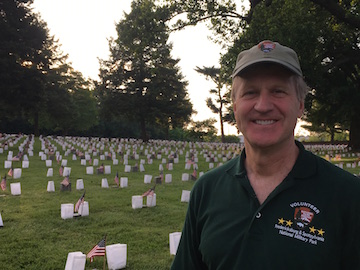
I often refer to myself as “the guy behind the guy,” be it at Emerging Civil War with Chris Mackowski or at the American Battlefield Trust with Garry Adleman. My job is to find sources for articles and books. The right equipment for filming videos. And to make sure that the ship is always moving forward. Perhaps the ultimate person behind all of our endeavors as historians and preservationists was Don Pfanz. I certainly wouldn’t have my job at the American Battlefield Trust without him.
To the avid Civil War buff and Gettysburg aficionados, Don’s father, Harry Pfanz, is a household name. Harry’s masterful works on the first and second day of that battle set the standard for microtactical studies of engagements for years to come. Harry instilled a love for history in Don and, in turn, Don followed in his father’s footsteps by donning the green-and-gray of the National Park Service. The younger Pfanz spent 32 years in the National Park Service at Fort Sumter National Monument, Petersburg National Battlefield, and Fredericksburg and Spotsylvania County National Military Park.
While many folks may not know Don as well as Harry, they are very familiar with his work. Perhaps they aren’t familiar with his biography of Confederate general Richard S. Ewell or his collection of articles about the Battle of Fredericksburg compiled in War So Terrible: A Popular History of the Battle of Fredericksburg. But they certainly are aware of an organization he helped to found, The Association for the Preservation of Civil War Sites (APCWS), known today as the American Battlefield Trust.
On April 22, 1987, Don penned a letter to fellow historian Brian Pohanka, expressing his concerns “over the widespread destruction of Civil War sites in Virginia…” He told Brian, “As I see it, the preservation movement has failed in recent years not for the lack of interest, but for the lack of an organization which might channel the energies of individuals to good purpose.” Don advocated for an “organized campaign to get Congress to pass a bill authorizing the extension of National Park boundaries,” and called for a letter writing campaign, ad campaign in “various publications,” which included Blue & Gray Magazine and Civil War Times Illustrated, while also advocating to engage with Civil War buffs around the country via the then robust network of Civil War roundtables.
Eight days later, Don wrote a passionate letter to historian Robert K. Krick, informing him of this noble project while enclosing a copy of the letter. “What better time to introduce such legislation than during the 125th anniversary celebrations,” opined Pfanz, “[g]oodness knows, it won’t be possible by the 150th. Apathy, of course, is the greatest problem.”
Luckily for the battlefield preservation movement, Don wrote to two of the least apathetic historians. Brian responded positively to Don’s letter, via Bob, on May 5, 1987, stating “In short, I think that most of us would agree that the time has come to organize…before more of that ‘hallowed ground’ is lost forever.”
In the coming weeks, months, and years, preservationists around the country united. Some of them—including Bob Krick, Will Greene, Dennis Frye, Brian Pohanka, Gary Gallagher, and Don Pfanz—met in private homes or at the now-gone Arbuckles Restaurant on Sophia Street in Fredericksburg. They pressed Congress for action, which materialized in the form of the American Battlefield Protection Program. To date, the organization that Don helped to form has saved more than 60,000 acres of “hallowed ground,” in 25 states. Without Don’s passionate letter, those acres may have been lost to the ages.
I had the good fortune of knowing Don for 20 years. We met in 2005 when I was an intern at Fredericksburg. From day one, he treated me not as an intern but as an equal. He was one of those rare people in our field that everyone respected AND loved. He always greeting you warmly with a smile and friendly hello.
We became fast friends. We compared notes about projects, and I kept him informed about what was happening across the river in the Fredericksburg Battlefield Visitor Center. As the staff historian at Fredericksburg, Don was stationed in the old kitchen at park headquarters at Chatham. He was in charge of a vast collection of printed materials, more than 500 volumes in fact. He and a team of volunteers undertook the Herculean task of digitizing the volumes, which they accomplished in about one year.
Before the digitization of the bound volumes, I spent many hours in the park library pulling volumes for research. Don always helped me to locate what I was looking for and would hang out at the copy machine asking me about what I found. He was genuinely curious and interested. Chris Mackowski and I often compared him to the Nutty Professor (in a loving way). He reminded us of that professor crossing the quad with a jumble of papers not quite knowing where he was off to next. I’ve often said that Chris Mackowski taught me how to be a writer. Greg Mertz taught me how to be an interpreter. And Frank O’Reilly and Don Pfanz taught me how to be a researcher.
Two of my favorite personal memories of Don date to 2008-2009. At that time, I was in charge of the park’s website, and our IT manager, Mike, showed up at the visitor center, exasperated. I asked him what was wrong, and Mike told me that when he was working on Don’s computer earlier in the day, he came across all of Don’s various computer passwords written down on a piece of paper and just lying in the open on his desk. Later I asked Don about the incident and, ever the old-school historian, he complained about the number of passwords and told me that he’d keep the paper in his desk from now on. That was totally Don.
My other favorite personal memory of Don is tied to an eBay auction. One of our colleagues collected funny photos and items related to the park staff. He’d proudly post these pieces on a door in his office. We always popped in to see if we made the door of shame and what was new. One day, he came across an eBay auction for a letter from famed historian Don Pfanz. One of Don’s jobs at the NPS was to respond to research requests, and he often responded in the form of a letter. Someone received one of these letters. Posted it on eBay, for an auction price of $2.50. Don later told me he was surprised that it was going “for that much.”
The last time that I saw Don was on a tour I was conducting for the Trust at Mine Run. As we walked back to the cars, I commented that he still wore his National Park Service belt. “Kris, this is the best belt I ever owned,” he declard. He then hiked up his pants to proudly show me the “best socks he ever owned.” They were the first socks he received as a National Park Service ranger. That was Don.
He was passionate about history and battlefield preservation to the very last. Be it his telling of the real story of Clara Barton and her time on the Fredericksburg area battlefields, or his research on the history of Fredericksburg National Cemetery, Don poured his heart and soul into his work, and we are fortunate benefactors of that passion.
Perhaps my fondest memories of Don were our conversations as I researched what became Chancellorsville’s Forgotten Front. When I told him that I was researching a book about the Second Battle of Fredericksburg and Salem Church, he laughed. Many people came to him through the years to write such a book, and none of them ever saw the light of day. He reminded me of this as a friendly challenge every time I went to him for research assistance. In 2013, that book saw the light of day. Other than Ted Savas, nobody spent more time on that project with us than Don Pfanz. He assisted in the research, the editing, and penned the foreword to the book. Because of friendship and enthusiasm for the project, we dedicated our book to “our friend Don Pfanz.”
In his foreword for our book Don wrote, “Thanks to their efforts, Chancellorsville’s forgotten front is forgotten no longer.” Because of Don’s work, the dead who lay in Fredericksburg National Cemetery are no longer forgotten. Richard Ewell has a fitting biography. More than 500 volumes of letters, diaries, newspapers, and scores of other miscellaneous sources are now digitized and accessible to the next generation of historians. And, of course, because of Don’s passion, the modern battlefield preservation movement was born. His is a legacy that many of us strive to achieve, but few of us will ever obtain.


What a wonderful memorial to Don Pfanz! I never met him, but now I feel like he’s an old friend.
A very moving tribute, Kris. Well done.
Some great Don stories there!
Wow!
Superb job, Kris! Mentors play key roles in our lives!
Great tributes from my friends Kris and Chris! We will surely miss Don! He was great at helping us with our research and he was a great friend! I often teased him that he should come out of retirement and come back to the park. Instead he came back as a battlefield guide for Battlefield Tours of Virginia! The people who were the recioients of his tours must of realized they were given tours from one of the best battlefield guides and also one of the nicest people on God’s earth! Rest in Peace Don, you deserve it!
Kris, I am glad that Don encouraged you to write Chancellorsville’s Forgoten Front! I remember Chris and I telling you that you had to write that book because it was your passion! It was a great book and I reccomend it always! I also tell people about going on a Second Fredericksburg tour with you and Chris! It was one of the most enjoyable Civil War tours that I have been on! You two make a great partnership and I am glad that I can call you both my friends!
I recommend your book your book always (correction of sentence)