Aftermath of Battle: Returning to Normalcy at Gettysburg’s Lutheran Seminary
On September 16, 1863, the last patient was transferred out of the Lutheran Seminary in Gettysburg. As Lt. Col. George McFarland of the 151st Pennsylvania lingered in these academic halls for over two months, hospital staff prepared to return to Seminary back to its students. Classes began eight days after McFarland departed, but the battle was far from over at the “Ridge.” A new fight for compensation and the push for commemoration would save this building from the ravages time, preserving it as the Seminary Ridge Museum and Education Center.
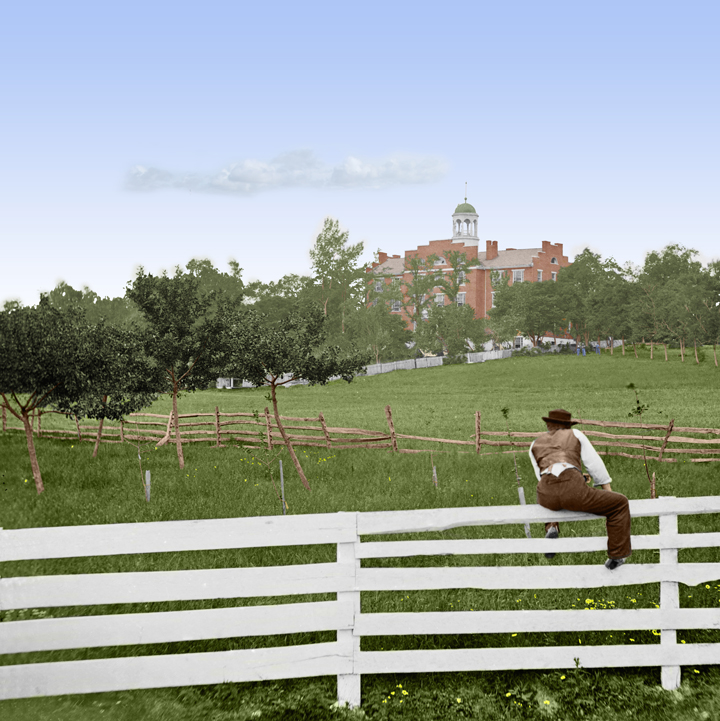
Of the 700 reported patients who occupied the Seminary during the battle of Gettysburg, 493 have been identified. This site, which prepared young men for a life in the ministry, was nothing short of a medical miracle. 90% of admissions walked out alive – albeit many with devasting injuries. 78 documented deaths may not seem like the kind of number to wreak havoc on a large schoolhouse, but 500 injured and diseased men descended on the building in a short period of time. That also does not factor in the damage wrought by Union artillery on the east side of the complex!
The Seminary had the distinct privilege of being the only facility in Gettysburg to serve as a field hospital, aid station, lookout post, general hospital, and prison. Federal troops barricaded within the building soon became prisoners when Confederates camped outside on its lawn. Once the rebels retreated, the Union retook the college and transformed it into a massive hospital complex. Surgeons and nurses hurried around this massive structure while Union command occupied its precious and valuable Cupola. At the outset, it seemed like a decent and humanitarian deed to repurpose the Seminary in the middle of the summer semester. Its founder Samuel Schmucker and the Board of Directors – despite being cordial and open to the hurt soldiers – petitioned the War Department in Washington for redress.
Many soldiers were transferred to Fort McHenry in Baltimore when the dust settled. McFarland and his preferential treatment, however, may have overstayed his welcome. While McFarland’s wife and children moved into the hospital to care for him, Schmucker and his Board filed damage claims to the government of Pennsylvania and the War Department itself. Three versions of the damage claim were produced in collaboration with Gettysburg College (then called Pennsylvania College) to forward an appeal for relief and funding.
The appeal had a direct and specific purpose: to reverse the damage wrought by the battle. The State of Pennsylvania provided a lump sum for both institutions, which was split between the two. Washington did not provide adequate support for the Seminary. Since the damage was not caused by Confederate hands, the Seminary could not receive federal support. In the South, residents and businesses filed with the Southern Claims Commission for property damage done by the Union Army. In the North, there was no such equivalent organization for injuries caused by one’s own side.
On September 24, a mere eight days after McFarland left for home with his family, students returned to their freshly-scrubbed dorm rooms and settled into their fall schedules. By the end of Summer 1864, all exterior damage was repaired as if the bloodiest battle of the Civil War did not occur at their doorstep. The Seminary hosted attempts at reunion beginning in 1866 and played a key role in more notable commemorations. It was an important stop to many who paid homage to its part in the events of early July 1863. Veterans stayed in dorms once used to care for their comrades, reminiscing about lives saved and lost on those fateful days.
This turnaround for the Lutheran Seminary was remarkable. Compared to private homes, storefronts, and crop fields caught in similar crossfires during this war, the Seminary had luck on its side to resume business as usual just a few months after a heinous ordeal. The frequent reunions helped preserve the building and kept it tied to the battle for decades to come, even if Schmucker disdained its confiscation. Over 500 soldiers, 78 deaths, and 36 surgeons later, it is a testament to wartime carnage, humanitarianism, and a group of executives focused on restoring their building back to proper use.
Madeline Feierstein is an Alexandria, VA historian specializing in psychiatric institutions, hospitals, and prisons. A native of Washington, D.C., her work has been showcased across the Capital Region. Madeline leads efforts to document the sick, injured, and imprisoned soldiers that passed through Civil War Alexandria. Additionally, she supports the National Museum of Civil War Medicine. Madeline holds a Bachelor of Science in Criminology from George Mason University and a Master’s in American History from Southern New Hampshire University. Explore her research at www.madelinefeierstein.com.


It is perhaps fitting that eight days prior to classes resuming at the Lutheran Theological Seminary, the last patient to leave was Lt. Col. McFarland, an educator himself and the commander of the “Schoolteacher’s Regiment.”
That’s an amazing coincidence!