“You Are True Louisianians, and Therefore, True Americans”: Civil War Memory and the Washington Artillery During the First World War
ECW welcomes guest author Alex Kleinman.
On May 28, 1918, a crowd gathered in New Orleans to rally in support of America’s new war. Three and a half years of attrition had already melted away since the First World War erupted in Europe. The public was only too familiar with news of the distant carnage.
But this rally was unique. Rather than rail against violations of neutrality, there was no mention of the familiar outrages: Lusitania’s sinking, unrestricted submarine warfare, or the Zimmerman Telegram. On this day, the centennial of Confederate General P.G.T. Beauregard’s birth, an observer could be excused for confusing just what cause the speeches glorified.
New Orleans attorney Milo B. Williams spoke.[1] He began by framing a challenge: “Hades is paved with good intentions. That, distinguished speakers, ladies and gentlemen, is the taunt hurled at us, at our President, at our country by the Germans.”[2] To meet it, Williams urged inspiration from “the noble deeds of some of our brave Louisianians.”[3] He spoke of Louisiana’s “sons” who “backed up [their] intentions by noble deeds.”[4] First, Confederate Gen. Albert G. Blanchard (technically born in Massachusetts) who, during the Mexican War, had been “the first to rush into the fortress” at Veracruz.[5] Next, Beauregard, whose “life history is well known to every Louisianian” and whose “natal day” was the subject of the gathering.[6] He exuded confidence his countrymen would meet the challenge, for “you are Louisianians, and therefore, true Americans.”[7]
Of the historical soldiery named in Williams’s speech, only one unit was preparing to deploy to French trenches: the 141st Field Artillery Regiment, the federal redesignation of the historic Washington Artillery Battalion of New Orleans.[8] Formed in 1838, it fought for the Confederacy from First Manassas to Appomattox (and in the west from Shiloh to Spanish Fort), then reformed as a militia unit. Now a U.S. National Guard regiment, it was about to embark on a chapter that its commander, Col. Allison Owen, had been preparing his whole life.
“A long and interesting period of service . . .” (1861-1918)
Colonel Owen combined rare roles. His father, William Miller Owen, served as adjutant of the Washington Artillery during the Civil War, then was its post-war commander in the late 1870s.[9] In 1885, the elder Owen published a memoir of his wartime service, In Camp and Battle with the Washington Artillery of New Orleans, a valuable primary source.[10] In 1914, the younger Owen published his own history, “Record of an Old Artillery Organization” in the U.S. Army’s Field Artillery Journal, tracing the battalion’s “long and interesting period of service.”[11]
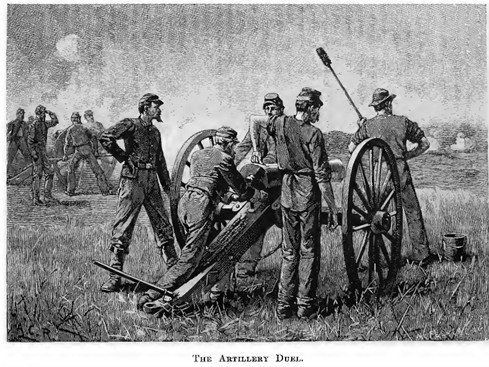
It is difficult to find any comparable parallels in American military history of a father and son both commanding the exact same unit of lineage, let alone both writing its history. But, by war’s outbreak, the younger Owen had stepped into the same role as his father as chronicler of memory.
Reading “Record of an Old Artillery Organization” makes clear that the younger Owen regarded his regiment’s Confederate service as both continuous with the broad tradition of American artillery, and the heir to a distinct Louisiana legacy. He observed twists of history. For example, one federal battery that had stood opposite the Washington Artillery at First Manassas (Battery E, Third U.S. Field Artillery) was, by the early 20th century, commanded by Capt. Fred T. Austin; Owen noted that this was the officer who later formally inspected and mustered his battalion into federal service under the Militia Act of 1903.[12]
As the regiment prepared to embark, the press also noted these dual traditions. On March 28, 1918, the Daily States predicted that some “day perhaps not so very far off there is going to be a rumble and thunder of heavy wheels as the caissons and gun carriages of what was once the Washington Artillery swing over the cobblestones of a ruined French village, for the line from which they will hurl their shells in the direction of Berlin and points east.”[13] Later, the New Orleans Item quoted Col. Owen as explaining that a regimental fundraiser’s purpose was to ensure that, “the name of the command will live forever.”[14]
“[W]hen a man is once a member of the Washington Artillery, he is always a member” (1919)
The 1918 Armistice came too soon for the 141st to fully deploy to the Western Front. Nonetheless, it returned to exuberance in April 1919. Excitement arose when New Orleans Mayor Martin Behrman received a War Department telegram that the 141st was “now homeward bound.”[15] The States predicted of the planned festivities that, as “the solemn observance of the victory of Jackson at Chalmette more than 100 years ago still is read by the eager school boy and girl, so will the boys of the next century read of the homage paid Louisiana heroes Monday.”[16] A full day’s schedule of celebrations included Col. Owen leading a grand parade up Canal Street.[17
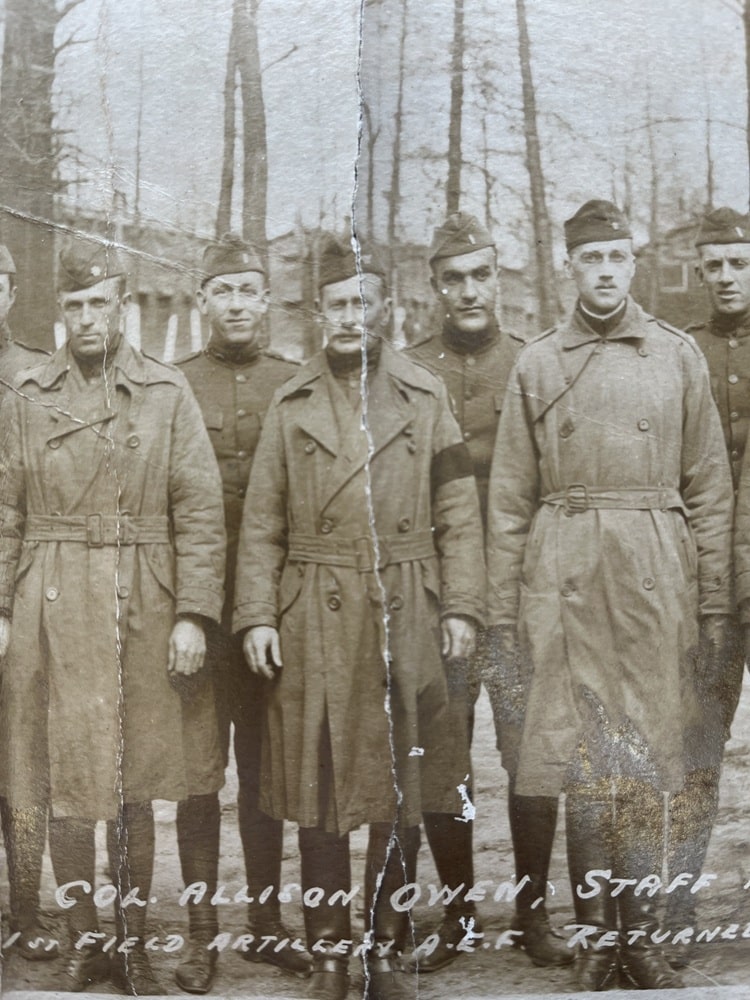
The States captured Owen’s remarks to the press. He noted that the full regiment had not yet returned; French speakers and a trench mortar company remained abroad.[18] He emphasized this did not matter, for “I hold the view that when a man is once a member of the Washington Artillery he is always a member, no matter what unit he fought with.”[19] Freshly returned from France, he now personally embodied his opening sentence to “Record of an Old Artillery Organization”: “[f]or some reason Louisiana has always been singularly rich in artillery.”[20]
Alex Kleinman is a New Orleans native and attorney practicing in Washington, D.C.
Endnotes:
[1] Williams, Milo B. “General Beauregard and General Blanchard in the Mexican War: Address at the Beauregard Centennial, New Orleans, La., May 28, 1918.” Louisiana Historical Quarterly 1, no. 4 (April 1918). Louisiana Historical Society, Cabildo. Copy held at Jackson Barracks Military Museum, New Orleans.
[2] Ibid, 1.
[3] Ibid.
[4] Ibid, 2.
[5] Ibid.
[6] Ibid.
[7] Ibid, 1.
[8] “Washington Planning to Send 39th by Way of the Crescent City.” Undated newspaper clipping, likely New Orleans States or New Orleans Item, ca. 1919. Copy held at Jackson Barracks Military Museum. See also “A Lineage of Honor.” Washington Artillery of New Orleans. Accessed October 28, 2025. https://www.washingtonartillery.com/america.htm.
[9] Owen, Allison. “Record of an Old Artillery Organization.” The Field Artillery Journal 4, no. 1 (January-March 1914) at 16; “Commanders of the Washington Artillery.” Washington Artillery of New Orleans. Accessed October 28, 2025. https://www.washingtonartillery.com/Commanders%20of%20the%20WA.htm.
[10] Owen, “Record of an Old Artillery Organization,” 18.
[11] Ibid, 6.
[12] Ibid.
[13] Ibid.
[14] “Tiger Day’ Aid Day to Washington Artillery.” The New Orleans Item, July 25, 1918. Howard Library. Copy held at Jackson Barracks Military Museum, New Orleans.
[15] “Washington Artillery Is Speeding to Orleans.” New Orleans States, April 25, 1919. Louisiana State Museum Library at the Cabildo. Copy held at the Jackson Barracks Military Museum, New Orleans.
[16] “New Orleans to Welcome Returning War Heroes.” New Orleans States, April 27, 1919. Louisiana State Museum Library at the Cabildo. Copy held at Jackson Barracks Military Museum, New Orleans.
[17] “Smiles, Tears Greet Heroes: New Orleans Gives Returning Heroes Flaming Welcome.” New Orleans States, April 28, 1919. Louisiana State Museum Library at the Cabildo. Copy held at Jackson Barracks Military Museum, New Orleans.
[18] “Colonel Owen Talks of His Gallant Boys: Many Still in France; Some Made Supreme Sacrifice for the Nation.” New Orleans States, April 24, 1919. Louisiana State Museum Library at the Cabildo. Copy held at Jackson Barracks Military Museum, New Orleans.
[19] Ibid.
[20] Owen, “Record of an Old Artillery Organization,” 1.


Thanks for sharing your research. You captured my attention from the start with the topic. Always love hearing about the Washington Artillery and its modern organization.
Thank you very much, Neil!
My grandfather, 1st Lt William M. Rosson, served as the commanding commander, Co. A, 305th Infantry Regiment, 77th Division, in the Meuse-Argonne Offensive in Sept-Nov 1918. From Mobile, AL, his grandfather, Cpl. Middleton D. Rosson, died of wounds after the Battle of Gaines Mill in June 1862 while serving with the 8th Alabama Regiment. The irony was not lost on my grandfather who joked years later to me that he took some ribbing when first attached to the regiment in September 1918 due to his southern accent. When the fighting started, that was all forgotten. After the war, the veterans called him affectionately “Alabama Bill.” There was never any ill-will between the New Yorkers in the regiment and my grandfather, the grandson of a Johnny Reb.
Thank you for sharing this remarkable family story! It beautifully illustrates my post’s point about how World War I brought Americans from very different regional and Civil War-era backgrounds together in common purpose
Neat memory study!
Thank you, Chris!