Book Review: Measuring the Man: The Writings of Frederick Douglass on Abraham Lincoln

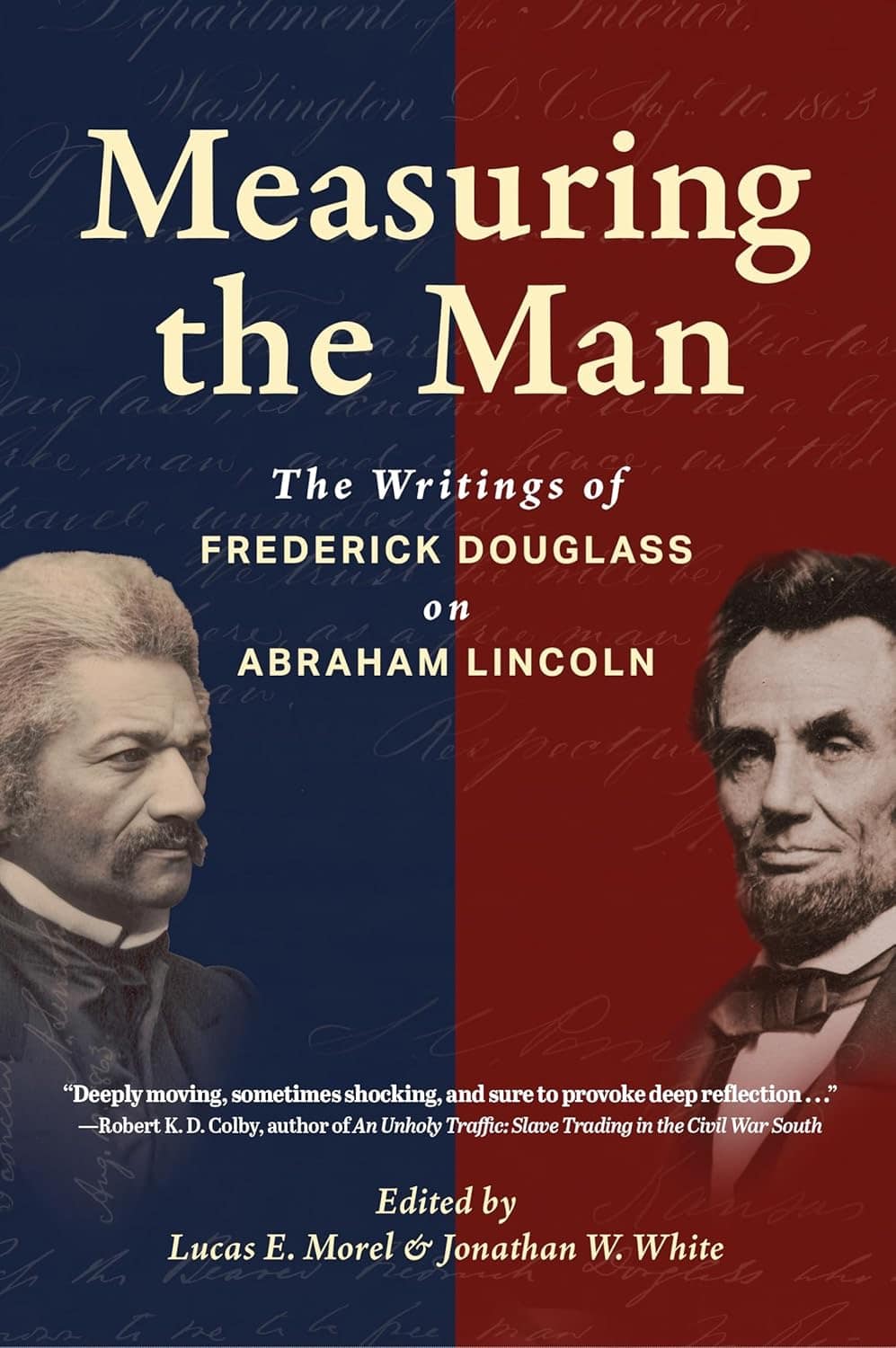
Measuring the Man: The Writings of Frederick Douglass on Abraham Lincoln. By Lucas E. Morel and Jonathan W. White. Saint Louis: Reedy Press, 2025. Softcover, 312 pages. $24.00.
Reviewed by Peter Vermilyea
In Measuring the Man: The Writings of Frederick Douglass on Abraham Lincoln, editors Lucas E. Morel and Jonathan W. White have produced an illuminating and definitive volume that offers readers an intimate view of one of the most important relationships in American history. By gathering Frederick Douglass’s speeches, editorials, letters, and reflections on Abraham Lincoln in one place, the editors provide a portrait not only of Lincoln as perceived by the nation’s most prominent Black abolitionist, but also of Douglass himself as a political thinker whose thinking shifted as events unfolded.
One of the book’s greatest contributions is its highlighting of the Douglass’ Monthly, the abolitionist newspaper through which Douglass analyzed the Civil War in real time. For readers accustomed to Douglass’s retrospective speeches – particularly his famous 1876 oration at the Freedmen’s Monument – encountering his earlier wartime journalism feels revelatory. In these writings, the reader sits beside Douglass at the editorial desk, witnessing his hopes and frustrations as the war progressed and as Lincoln’s policies evolved. The immediacy of these pieces captures a Douglass far more dynamic than the iconic elder statesman remembered today.
Through these contemporaneous writings, the volume traces Douglass’s oscillation between sharp criticism and reluctant admiration of Lincoln. At the war’s outset, Douglass’s tone is blistering: he castigates Lincoln for prioritizing Union over emancipation and for what Douglass viewed as excessive caution toward slaveholding interests. However, as Lincoln’s actions became more radical – the Emancipation Proclamation, the enlistment of Black soldiers, and even discussion of Black suffrage – Douglass’s assessments shifted. This was not a simple nor full conversion on Douglass’s part; it was, rather, a complex, contested, and continuous process. Douglass remained an unceasing advocate for abolition and civil rights even as he came to recognize the burdens and constraints of Lincoln’s wartime leadership.
In presenting these documents chronologically and with insightful but concise annotation, Measuring the Man allows readers to experience Douglass’s changing perspective as he experienced it. Certainly, much has been made of the Lincoln-Douglass relationship, with interpretations running the gamut from a friendly partnership to a contentious one in which Douglass is never satisfied with Lincoln’s achievements. The great value of this book is in providing its readers with the opportunity to read how Douglass measured Lincoln, in his own words, and in the very moment history was being made.
Peter Vermilyea teaches history in Falls Village, Connecticut, and for the University of Connecticut. The co-director of the Gettysburg College Civil War Institute teacher program, his most recent book is Litchfield County and the Civil War (2024).


